Showing posts with label anime review. Show all posts

Wednesday, 7 January 2015

Mobile Suit Zeta Gundam (1985-1986) review

Last year I made the decision to watch Mobile Suit Gundam, the granddaddy of all Gundam series. After finishing the series I wrote at length about it and I had plenty of good and a few bad things to say about the show. As you can surely tell from the title of this post I’ve watched the sequel series titled Mobile Suit Zeta Gundam which was originally broadcast in fifty episodes from 1985 to 1986. Mobile Suit Zeta Gundam was a direct sequel to MSG. That’s actually pretty surprising in itself since MSG was cancelled before it could complete its intended run. In the intervening years between the end of MSG and the beginning of ZG the original series gained quite a bit of popularity. Having recently finished ZG I’m pleased to say that I’m glad a sequel was made since it turned out to be a very good show, equally good to the original series but with much better animation.

Yoshiyuki Tomino, the man responsible for directing MSG, also directed ZG. He wasn’t the only crew member to return as Yoshikazu Yasuhiko once again did character designs and Kunio Okawara returned as mechanical designer, this time aided by Kazumi Fujita. Two notable mechanical designs by Okawara include the RX-178 Gundam Mk-II and the RMS-106 Hizack while Fujita is credited with the design of the titular MSZ-006 Zeta Gundam. The influences of these crew members is clearly felt and seen in ZG as the series feels like a natural progression from MSG for better and for worse. Before getting into more details of the good and the bad let’s recap the basic story of the series.

Saturday, 18 October 2014

Dragon Ball Z: Battle of Gods review


Like most other Canadian or American fans my introduction to Japanese anime and manga was through the Dragon Ball Z TV series. I remember being mesmerized every time the show was on. I didn’t have cable as a child and the only time I could watch it was when we visited my grandma. Lucky for me we visited often. Still, I only caught episodes sporadically here and there and my friends at school would fill me in on the episodes I missed. A few years later I got to watch both Dragon Ball and Dragon Ball Z from start to finish. I loved it. Not just because of the crazy action and the innumerable types of power-ups. That was all good but what differentiated Dragon Ball Z from the rest of the action and brawling anime then and since was the characters and their zany humour. They’re well designed but they’re also individualized more than you were used to seeing in anime of that time period. Looking at a group picture of the main Dragon Ball Z characters you can easily spot your favourite characters because they personalities shine through in the way they’re illustrated. It was the beginning not only of my interest in Akira Toriyama and his body of work but also of manga and anime. Something that I continue to enjoy to this day though with a bit less excitement than I had when I initially started to explore manga.

The story of Battle of Gods takes place near the very end of the series, somewhere around the middle of the ten year jump before the final two chapters of the manga. Buu has been defeated and the Z-Fighters are enjoying their peaceful lives. Many galaxies away Beerus, the God of Destruction, wakes up after 39 years of sleep. He set himself an alarm to wake up because of a prophecy he heard that announced the arrival of a legendary Saiyan warrior. He’s interested in finding the Super Saiyan God and challenging him to a fight. Accompanied by his aid Whis, he makes his way to Earth where he thinks he’ll have his best chance of finding the Super Saiyan God because of the relatively high presence of Saiyans and half-Saiyans. On Earth both new arrivals crash Bulma’s birthday party. Eventually Beerus’s temper gets the better of him and the Z-Fighters are once again Earth’s final line of defence.

I quite liked Battle of Gods. My summary makes it sound like the plot resembles the plot of many other Dragon Ball Z stories. It’s true the series because pretty formulaic. The feel and tone of the movie fits quite nicely with the tone of the series. The focus isn’t on the action, it’s on the character interaction. There is an equal amount of time spent showing the events of the birthday party than there is devoted to the God of Destruction and his search for the Super Saiyan God. Nearly all the heroes of Dragon Ball and Dragon Ball Z show up and it’s delightful to see them spending time together. Emperor Pilaf from Dragon Ball also makes an appearance. With the aid of Mai and Shou he attempts to steal the Dragon Balls to become rich. The goofing around that takes place in the story makes it pretty evident that Akira Toriyama played an active role in the development of the movie.


Unlike most of the previous 17 Dragon Ball and Dragon Ball Z movies, this one fits nicely in the timeline of the show. It’s not an alternate universe version of characters and stories. It’s set in the same timeline as the series and deals with the same incarnations of the characters we’ve come to know and love. To make things better a lot of the voice actors from the show returned for Battle of Gods. I would have been happy with another movie that didn’t fit with the show, another movie that didn’t “matter” but the fact this this one does fit in and feels like it matters makes it that much more enjoyable to watch. Granted, making a new movie in this franchise is definitively nostalgic but I don’t mind because it does something that the last few movies didn’t focus on. It’s refreshing and it makes it easier to forget the impulse to make yet another movie in this series.

That being said, this isn’t a perfect movie. There are a number of things I didn’t like and would like to see improved in the 19th Dragon Ball Z movie that is already rumoured to be in production. The first thing that comes to mind is that the movie introduces yet another Saiyan transformation form. It’s simply unnecessary at this point. It’s not nearly as exciting or meaningful as it’s intended to be. It also seems an odd choice of fighting technique to hinge a movie on considering how long it’s been since the last movie. I would have been just as happy to see character perform some of their classic techniques instead of being ridiculously outclassed and easily defeated.

I also wasn’t a fan of the animation. It was inconsistent and it didn’t transition well from the more traditional animation to the computer animation. I like how crisp the animation looks but the computer generated stuff just sticks out like a sore thumb. It doesn’t belong. Likewise, the camera angles used in the final battle is a nice touch but it’s too much. In the movie, characters that have spent years watching high speed battles admit to not being able to follow the fight between Beerus and Goku, that’s a problem. If the characters can’t follow the fight how are we, the viewer, supposed to be able to follow along? The animators’ intentions are obviously to provide fans with a fantastic battle scene and I appreciate the effort to show us something we haven’t already seen in the hundreds of Dragon Ball and Dragon Ball Z episodes and previous movies but it fails. It’s flashy, unnecessary and ineffective. I would have preferred a movie made with only a single style of animation. I’m in support of a sleeker looking Dragon Ball Z but preferably something that also keeps the classic feel and look of the series.


Even the villain introduced in the films harkens back to some of Goku’s first adventures. Compared to many of the series’ villains were actually quite evil while others were simply goofy, yet powerful. Beerus falls into the latter category. He’s an antagonist, clearly, but I wouldn’t consider him evil. He’s too much of a buffoon for that and his main interest in the movie is similar to one of Goku’s own personal interest: he just wants to match his fighting strength to another extremely powerful being. For someone called the God of Destruction, destruction doesn’t appear to be on his mind as more than just an afterthought. He’s still threatening and works well as a villain because the movie does take the time to establish him as a threat but Beerus goes around seemingly in an attempt to undo the scriptwriters work and find an opponent to fight.

The movie is quite enjoyable. Most characters have their moments to shine. Oddly enough, my disappointment with this movie lies with the animation and the final battle scenes. You would think that having a new Dragon Ball Z movie would mean a movie with better animation. That’s only partially true as half the movie is very good and the other half is terrible. One of the staples of Dragon Ball Z is the battles and the ones in this movie are good but they’re not nearly as good as I was expecting nor are they as good as what we’ve seen in the series. The new Super Saiyan form is also unnecessary. Those problems aren’t enough to make this a bad movie though because the characters’ interactions, including new characters such as Whis and Beerus. It’s goofy fun and it works because it’s consistent with how we’ve seen the characters before. More importantly, the fighting and action in the series has plateaued, perhaps even on more than one occasion. The story formula of the series has been used to death and it’s nice to see Battle of Gods play around with that, albeit only a little bit. Dragon Ball Z is a classic and loved anime series not only because of the action but because of the characters and their odd-ball personalities. It’s refreshing to see a movie that focuses so much on heroes and villains goofing off. In many ways it feels like a throwback to Dragon Ball where humour was as much a part as the show as epic battles in which the universe hangs in the balance. 

Wednesday, 10 September 2014

Mobile Suit Gundam (1979) review

Every once in a while I think about the kind of reviews I write for Shared Universe Reviews. One thing always sticks out to me and is that most of my reviews are of older works. Not all of them, but a significantly large enough amount of it that it sticks out. I’m thinking about that once again because I’m about to write a review for an anime series that is roughly 35 years old. To many anime fans that seems kind of outrageous because such an old show much be damn near unwatchable for a modern audience. It’s nothing new for me though as I regularly sample entertainment from previous decades and a lot of that ties into my philosophy on how I experience my entertainment. Reading old books in a genre I love, something I’ve been doing with my The Blog Fantastic project, allows me to get a greater sense of the history and evolution of the genre. It also allows me to contextualize works in a loose historical chronology. Most important of all, it creates a dialogue between the more recent works I’ve read and the older ones that preceded it. It’s one thing for a reader of George R. R. Martin’s A Song of Ice and Fire to read about Martin’s influence in an interview or an article but it learning of his influences is has very different meaning to readers who have also read the works Martin cites as influential to him and his series.

What does any of this have to do with Gundam? Well, several weeks ago I thought I knew what Gundam was all about but there was a voice in the back of my head (you already knew I was crazy, right?) which said “How can you think you know about Gundam when you’ve never watched the original series?”. Good point. So I watched Mobile Suit Gundam (1979) and I have to say that little voice in my head was right. I’m glad I watched this because as old as it is, it’s an impressive series and it’s changed the way I think about Gundam and anime in general. In other words, Mobile Suit Gundam (from this point on abbreviated to MSG) is old, certainly, but it’s worth your time for being incredibly influential and for spawning an immense anime, manga and plastic model franchise.

Enemy soldiers are people too? Stop making sense!

I don’t want to spend too much time summarizing the events of the series. I want to focus on specific elements and write about what I enjoyed, what worked, what didn’t work so well, and reasons why MSG is an important anime series, let alone important to the Gundam metaseries. For anyone who wants a broad introduction to the setting of the events of MSG, you can check out the introduction post to my Mobile Suit Gundam: The 08th MS Team. There I wrote a piece that works well as an introduction for the Universal Century timeline and for MSG.

As for the series proper, the first dozen or so episodes of MSG are nothing short of stellar. The first episode begins with a bang. The Earth Federation’s new Gundam carrier ship, the White Base, has recently landed on colony Side 7 (also known as Noa) near Lagrangian Point 3. The colony is in the middle of evacuating civilians since the presence of the White Base and the experimental RX-78-2 Gundam is believed to be attracting the attention of Zeon forces. Naturally, three Zeon Zakus enter the colony to spy on the Federation’s activities and everything quickly escalates to a full blown attack on the colony. A young man, Amuro Ray, son of the engineer who built the RX-78 Gundam pilots the mobile suit for the first time in an effort to protect his friends. By the end of the first episode Amuro has already shown an affinity to piloting the Gundam and he, along with some of his friends, are being asked to serve aboard the White Base which is severely undermanned, having lost soldiers in the attack. For the first third of the series the story focuses on the trials the White Base and its crew face as they try to escape the Zeon forces and eventually get officially enlisted in the war effort. 


Those episodes make for a stunning introduction to the series. Not only are they good stories but they set the foundational elements for the rest of the series. Nearly all of the main characters are introduced, some in more detail than others, but they will all get fleshed out as the series progressed. Some of the key villains are also introduced, specifically Char Aznable also known as the Red Comet. In many ways, this exemplary beginning plays the same role for the rest of MSG as the series did for the rest of the Gundam metaseries. But before I get to that I want to talk about the elephant in the room: 35 year old animation.

I can say without a doubt that some people will not like the animation of MSG, begrudging it for being old, unpolished and difficult to watch. Personally, I learned to like it. If you’ve watched anime before, it’s unavoidable that there will be a jarring effect when you start watching MSG. Once I had watched three or so episodes I started to settle in and get used to it. After a while I didn’t mind the older animation and I only noticed just how old it was when I consciously focused on it. If you’re open minded and, like me, can accept that it’s mostly old animation and not specifically bad animation, you’ll be able to focus on the story and the characters as opposed to the fact that most of the explosions are pink and that the mobile suits regularly move as if they’re either made in one solid piece or made of rubber and bend in was they simply shouldn't be able to bend. I think it also helped that I didn’t watch any other animated movies or series during the time I was watching MSG. I imagine if you’re bouncing back between old and new series, this gem from 1979 will always be irritating to watch.

Char "Red Comet" Aznable is one of the best Gundam characters ever. 

It was interesting to watch such and old series though because I realized that there are things about new animation that I like and things that I don’t. Things I like about new animation that I missed while watching MSG was the consistency in the animation. The RX-78 Gundam doesn’t look 100% the same from episode to episode. It also isn’t consistent in the way that it moves. One of the things I dislike about modern animation is the lighting and use of shadows. It’s done well as often as it’s done badly but some series are either over lit or far too dark and shadowing which makes it difficult to determine what’s going on. In contrast, MSG is lit almost objectively. Everything is lit in the same way and you lose that sense of depth and weight that good lighting can provide. There are many other comparisons that could be made between the animation used in MSG and more recent anime series but the point I’m trying to make is that MSG’s animation is not all bad. I’m not suggesting it’s better than today’s animation but it certainly has its charm. Another example is that this old animation has a certain kind of warmth to it, specifically in the motion of characters and the colouring. It has the fluidity of hand-drawn animation that really suits certain kinds of storytelling while computer generation or computer assisted animation fares better with the mechanical designs.

What helps with the (now) sub-par animation is that the mechas, the ships and the characters are really well designed. Many of the iconic visuals of the franchise are lifted straight from MSG or are updated versions of what we first see in this series. It’s from the obvious things like the RX-78 Gundam, the Zakus and the White Base to smaller things like the cockpit of the Gundam, particularly the lever that slides forward and backwards. Even the way that device is used in the cockpit has become a staple of Gundam shows to follow. When a character slams it forward it’s because he is launching into the air or it means that a battle has gotten serious and the character isn’t going to leave any other mobile suits standing.
 
All the girls have to wear pink, OK? Boys in blue, please. Good soldiers.

As teased above, MSG is a microcosm of the entire Gundam franchise. It’s not just responsible for introducing the iconic design of the RX-78 but of many other things that make up the bread and butter of the metaseries. Let’s make a list of recurring elements that were introduced in MSG, just for fun:

·         Political and philosophical debates about war,
·         The visual designs of the series including mecha designs and the sleek (though blocky) design of the White Base which Gundam SEED shamelessly revamped in their even sleeker design of the Archangel,
·         The way battles are setup and choreographed,
·         The conflict between Earth and the space colonies. Sure this changes from series to series based on the specific factions and political or military organizations, but the main element remains the same,
·         Villains that are later portrayed as heroes or at least more heroic than they were at an earlier point in the series,
·         Characters who wear masks,
·         New mobile suits for important characters or upgrades to current mobile suits (side note: just how many mobile suits and mobile armors does Char pilot in this series?),
·         Newtypes or a more physically and mentally advanced population of humanity,
·         Characters dying and staying dead, and
·         The main character always starts of as whiny, brattish and thinks the entire weight of the world (plus the space colonies) rest solely on their should. In the good series the character grows out of it and becomes an interesting character. In the bad series and Gundam SEED, the main character just gets more insufferable and the series goes on. 

I’m sure there are plenty of other things I’ve missed but I’m also sure there are tropes specific to Gundam series that I’m not even familiar with since I haven’t watched all of the series. I think the above list is enough to support my claim that almost everything Gundam related can trace its source back to this series. That might seem like a dumb statement but it’s important to point out because none of these elements would have endured in multiple variations had the origin versions not been good. Some later series improved on some of the elements found in MSG but chances are they wouldn’t have tried it if it wasn’t for MSG’s initial success with it. Above all else, it’s the characters, complex and properly examined during the show’s run, that tie everything else together into a satisfying series.

Ramba Ral. One of the best Zeon officers. You were too awesome for us.

I have to clarify that MSG is by no means a perfect show. Even when you don’t factor in the quality of the animation, this is a very flawed series. While shorter than your average number of episode for a Gundam series (50 or so) I think MSG would have benefit from even less. The series explodes out of the gate and sustains this wild and manic energy for several episodes before slowing down considerably before the middle of the series. It’s here that things seem to meander around for a while and I admit to taking a break from watching it because I got a little bored. It’s crazy to think that I binge watched the first half of the series only to leave it for a few weeks before returning to it. I’m glad I did because the last third of the series picks up considerably and while it doesn’t quite match the impact of the first third of the show it still ended in a satisfying way, though abrupt, way.

Other criticisms would include the female uniforms. Why are they pink? Why can’t everybody be in Federation blue or command grey? Don’t even get me started about the terrible idea of Gundam transformation. Unfortunately, around episode 10, this idea was introduced and it’s just awful. The Gundam’s cockpit is actually a core fighter (think space jet, and you'll get the idea) which can be used as the cockpit for the Guntank, the Guncannon and the Gundam. It’s the most ridiculous and hokey idea of the entire show but I really started to hate it when I realized the recurring use of the transformation sequence in the show. Aside from seeing the segment repeated over and over (occasionally multiple times in a single episode) I completely disagreed with the idiotic strategy to send out Amuro, the only person abord the White Base who can pilot the gundam, in a ship other than the Gundam because it almost always resulted in the decision to have him transform or transfer into the Gundam mid-battle. Things get even worse later on as more parts are given to the crew of the White Base. The Gundam can now be combined with the G-Fighter to produce the G-Armor, they can detach in mid-air! Wow! Who fucking cares? Not me. It’s lame. I admit I’m a bit consoled by the fact that the gunplay model kits outsold any other kind of merchandise that was produced based on this transformation idea.

Sleggar being fly. Don't get too attached, Mirai.

At the end of the day though, this series isn’t fondly remembered for its animation or use of transforming Gundam sequences. People remember MSG because of the story and how the characters are handled. They remember the series because of how realism was incorporated into the series. Being a long series there are several episodic stories here and there, some of which don’t matter at all to the larger story, but some of those episodes contribute to character development. It’s also pretty sophisticated for an anime series about big robots, mostly because it’s not just an anime about big robots. It’s about characters and how the war influence and impact the characters. Amuro’s development throughout the series is fascinating to watch. The changes he faced during the series affected me also. I’ve cared for him, hated him and pitied him in turn. Complex characters make for complex reactions from viewers and this series is an example of that.

"What do you mean we're getting cancelled? Bummer."

It’s easy to forgive a lot of the show’s flaws as with many trailblazing works of fiction, there is a great deal of experimentation, happenstance, studio/publisher/editor interference, luck and marketing that can have a large impact on the work’s legacy. While animes that focused on giant robots was nothing new, MSG heralded the sub-genre of Real Robot. Prior to Gundam, series that focused on giant robot characters were of the Super Robot sub-genre. Mazinger Z is a classic of that genre. The added realism in which MSG dealt with their robots heralded a new form of story. I’m not an anime expert and I’m certain many other people would be better qualified to place MSG in a historical context, but it doesn’t change the fact that MSG was very different from other shows on at the time. However, it wasn’t popular during its initial run. In fact, it was threatened with cancellation and the studio eventually agreed to end the show on a shorter run (hence only 43 episodes). It took a few years for it to be recognized as an important and entertaining series and its continued legacy as one of the pillars of anime is proof of its status as a classic. Some series in the franchise have gone on to improve this one (something I’m a little familiar with but I’ll get a better idea once I’ve watched more series) while others have made a mess of things and can only be remembered for their action sequences and Gundam designs. The fact remains that for die-hard fans of newcomers alike, MSG stands tall as an inspiring series . . . as long as you can accept its animation style.

Wednesday, 30 July 2014

Mobile Suit Gundam: The 08th MS Team rewatch – “Battle in Three Dimensions”

Welcome to The 08th MS Team rewatch! I’ve never watched “Miller’s Report” chances are I’ve never seen “Battle in Three Dimensions” either. In case you haven’t realized it, this rewatch is over. This is the last post.


Summary: “Battle in Three Dimensions”:
Original Release: February 22, 2013

This special short is set during the middle of the series. Eledore is away being treated for his injuries and Michel is stuck co-piloting the hover truck with Sanders. Michel is writing a letter to B. B. and we learn that he feels Sanders is a difficult person to talk to and it makes for awkward situations when he has to spend time with him.

The 08th team is out on a mission. They reach a large bridge and begin to cross. Karen’s Gundam gets hit by a Zaku sniper and she is knocked out by the blast. A Gouf Flight Type jumps over the bridge and shoots at Shiro. The Gouf’s pilot remarks how tough the Gundams are, obviously expecting that his surprise attack would have been more successful against Shiro’s Gundam. Shiro manages to use the sniper rifle from Karen’s mobile suit to destroy the Zaku sniper. That evens out the battle and makes it a one-on-one fight. The Gouf’s superior manoeuvrability gives it the advantage and Shiro isn’t able to make a successful hit. The battle isn’t really one-on-one though since Shiro has Michel and Sanders providing him support. They use a cable to send Michel over the bridge to communicate the Gouf’s movements to Shiro who uses it to shoot the Zeek pilot’s mobile suit. Shiro manages to destroy the Gouf with the use of his beam saber.


Michel and Sanders become chummy as soon as the fight ended but things return to the familiar awkwardness in the evening. Sanders seems to realize how uncomfortable things are so he offers Michel a cigarette and he refuses since he’s underage. Embarrassed for asking, Sanders walks out of the hover truck. Michel runs after him and says that he’s sorry for turning him down but, if he offered coffee, he’d have a drink with him. He hands Sanders his cup. The episode ends, suggesting that they bond over coffee.


Commentary:
The title refers to the fighting style of the Gouf pilot. Gundam wikia has this to say about the experimental mobile suit:
Developed as a refined version of the MS-07 Gouf Fligh t Type, the MS-07H-8 was a prototype unit designed to test the concept of an atmospheric flight-capable mobile suit, However, the Zeon military halted this unit's development to focus on the creation of a flying mobile suit. Despite the cancellation of the program, several experimental units still occasionally found their way into the field for testing. The MS-07H-8 featured an improved backpack fitted with more powerful thrusters and thermonuclear jet engines. Aerodynamic control surface wings were added to the backpack and waist armor, giving the MS-07H-8 more stability in flight. Although the unit was a vast improvement over its predecessors, tests revealed that the H8 still suffered the same problems encountered by previous versions: the engines were prone to overheating and consumed a lot of fuel at high altitudes and high speeds, limiting its range and flight time. 
So battle in three dimensions because the Gouf is effectively flying above and around Shiro’s RX-79(G) Ez-e Gundam, which is a ground type mobile suit. The title of the episode does not refer to 3D animation as I previously thought.


The episode is short. It’s about 9 minutes long including the credits. Because of the short length we do not get anything spectacular as far as character development goes but the inclusion of Michel and Sanders budding friendship does add a bit more depth (even if only a tiny bit) to what could otherwise have been a shot length action video of a Gundam battle.

The animation during this short is much better than anything previously seen in The 08th MS Team. It’s a joy to watch. I think it was a smart decision to focus on a mobile suit battle as opposed to characters because it’s easier to appreciate the level of animation when there is a lot of movement on screen. There is use a computer generated graphics but it’s mostly used for background like clouds and jungle vegetation. All in all, it’s a smoother integration with the more two dimensional characters and mobile suits compared to how CG and digital animation have been integrated in the past, particularly in the early 2000s.

It’s kind of shitty that Karen gets taken out so early in the episode. I think it would have been nice to see her participate in the battle. Mostly though, the show exists to give Shiro yet another good mobile suit battle. On a final note, I love seeing the Gundams with their backpacks on. They’re just so big and blocky. What do they have in there?


Last Stop:
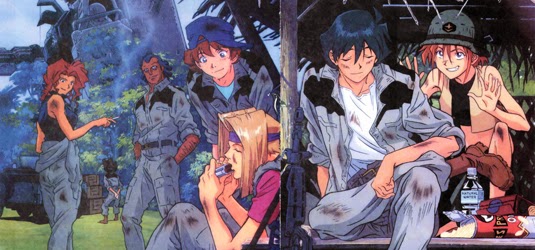
Here ends my rewatch (and part . . . first watch) of the entire Mobile Suit Gundam: The 08th MS Team. I have to admit that going into the rewatch I was equal parts excited and worried. Excited because this, as far as I could remember, is my favourite Gundam series but I was worried that it wouldn’t hold up well under additional scrutiny. I was also worried that the less than stellar episodes (and the one really terrible episode) would only be worse than what I remember. I realize now that I shouldn’t have worried because The 08th MS Team holds up pretty well.

The themes developed in the show are rather typical for a Gundam series as well as for military fiction. Several characters are defined by the way they view and interpret the acts of war or peace and two characters in particular (Shiro and Aina) are complicated by their opposing ideals of peace and their roles in the war. While nothing is really done with these themes to make the show more memorable than another, they’re handled well for the most part. The consistency in Shiro’s behaviour during the revelation and development of his character arc is well done. What makes the show really stand out is its attention to realism in the context of the larger Gundam metaseries.


In one episode they call for a lunch break in the middle of a mission. There is as much interesting conflict outside of the mobile suits than there is in them, not everything is about the mobile suits (but they still play the primary role in the series). The inclusion of a support team piloting the hover truck is a nice way to ground the action but the best of all is that these Gundams sustain battle damaged and it doesn’t magically disappear once the credits role. Not only that but the Gundams break down and sometimes it’s for a simple a reason as a filter clogged with sand. It’s also refreshing and interesting to see battles fought on the ground as opposed to the free for all, no rules combat in space. The added realism to this series also increases the viewer’s concern for the characters’ well-being since we’re shown multiple times that these Gundams are not infallible. Both those elements combined with good character development (some of these characters are more developed than the main characters of Gundam Wing and Gundam SEED) make for a slightly more serious Gundam show that isn’t without humour or impressive action sequences. Not only would I recommend this show to fans of all things Gundam but I would also try to introduce someone to the metaseries with the help of this show.   

Tuesday, 29 July 2014

Mobile Suit Gundam: The 08th MS Team rewatch – “Miller’s Report”


Welcome to The 08th MS Team rewatch! I’m such a fraud. I’ve never seen this before so I can’t truthfully call it a rewatch, can it? Well yes, I can. As long as I use a disclaimer! Caution: not actual rewatch ahead. Commentary might be poor due to the lack of familiarity with “Miller’s Report”.


Summary: “Miller’s Report”:
Original Release: August 1, 1998

The episode begins with a recap of the desert episode where the 08th team set up an ambush for the Apsalus. It shows the beginning of the ambush up to the point where the Apsalus flies away with Shiro in tow. The title card appears and a voiceover by Alice Miller describes the setting of the story. She’s been sent to the Kojima base to investigate the development of a new Zeon mobile armour (the Apsalus). We’re introduced to Miller properly when Shiro is brought to her by other soldiers. She’s in a hangar and she’s studying the wreckage of the Apsalus. This takes place ten days after Shiro’s return to base, presumably after his inquiry. Miller is familiar with the details of the events of Shiro’s time in the mountains with Aina. She informs him that he’s being investigated for espionage. Shiro dismisses the accusations as ridiculous and Miller agrees with him but she tells him that it’s very difficult to convince the higher-ups to change their minds. She tells him that the only way to prove his innocence is to tell the truth about what happened in the mountains.


Miller knows about Aina and when she tells Shiro, he thinks back to the events of the first episode and parts of it are replayed. While he appears to be remembering these events, he’s actually recounting them to Miller. He also tells her about the events of the inquiry.

The viewer is also privy to more information as we get a scene that takes place at the base’s bar while Shiro is in the inquiry. The other members of the 08th team are talking about Shiro. Sanders is very vocal in how much he likes the captain. Karen isn’t as nice. She thinks Shiro is too simple minded and it’s that personality trait that makes her think he’d make a poor spy. These events are expanded upon from those we see in “Duty and Ideals”. It’s a very good episode and it’s nice that we get to see the consequences of that battle. Kojima decides to trust Shiro a little because he defeated the enemy but the mission he assigns him to is an extremely dangerous one with a low probability of survival. That mission is the one where they get air dropped: “Front Line”.

After he’s done telling the truth about the events that happened while he was with Aina, Miller confronts Shiro about the contradictory nature of his belief in peace and his actions against the Zakus. She fails to convince him to forget about his non-lethal strategy towards warfare and, with the support of his team, Shiro heads out on his new mission.


Commentary:
This movie is essentially a clip show which uses a combination of clips from episode of the OVA series and new clips which expand on them. After having just watched all 12 episodes, it’s kind of a bore to rewatch bits and pieces of it intercut with Miller’s interrogation of Shiro. It’s so uninteresting in fact that I can’t help but wonder why it was ever made.

I admit I wasn’t paying all that much attention to the short movie, my mind just started to wander, but I’m pretty sure that Miller doesn’t find out new information that viewers and fans of the OVA don’t already know. It makes me wonder who the intended audience for this short movie is. Surely the point can’t be for to show viewers that Miller attempted and failed to reform Shiro as a mindless soldier of the Earth Federation Forces. What this movie does it take some the good episodes (desert ambush, inquiry episode/Zaku attack on the guerrilla village) and cuts it up with new footage of Miller’s investigation and the result is a re-edit of those episodes that lessens their impact. I get a feeling it was meant to do the opposite and make it more interesting but it fails to do that.

The focus of the story is Shiro’s relationship to Aina because that, Miller believes, is the key to understanding Shiro. By getting a good understanding of Shiro she will be able to determine whether or not he is a spy and poses a risk to the Federation. The problem is that concentrating on Shiro and Aina is to focus the short movie (well, more of a long episode) on one of the most uninteresting and poorly development storylines of the series.


The conversation between the members of the 08th Team is the most enjoyable scene in the movie. It’s nice to see their personality being expressed for an entire scene. Most of the series gives us snippets of each individual while keeping the center of attention on Shiro. Such a small scene doesn’t make up for the otherwise uninteresting movie, though.

The best part of the episode is just the 08th team talking about their situation. I like this bunch and just having them talk to each other is more interesting than the clichéd diatribe Miller spouts throughout the movie.

The only thing this movie is successful at is tarnishing the superior OVA episodes that precede it. Yes, even the first episode and the one with Shiro and Aina in the mountains are better than this movie. Two decent episodes and two very good ones are used in what amounts to an extended and poorly re-edited montage of good and bad scenes from the series.

At least the next mini-episode, the subject of my final post in this rewatch, was made up of entirely new footage. It’s also pretty great. See you tomorrow.  

Monday, 28 July 2014

Mobile Suit Gundam: The 08th MS Team rewatch – Ep. 12 Last Resort


Welcome to The 08th MS Team rewatch! The rewatch has successfully confirmed that this is a good Gundam show but this episode might ruin everything. I remember it being bad. Really bad. Will it redeem itself after years of being aired? Probably not.


Summary: Episode 12 “Last Resort”:
Original Airdate: July 25, 1999
English Airdate: Never aired

December 24, UC 0079. The One Year War has ended. On Earth, Michel is on a board and he’s thinking about the end of the war and the giant machines left behind on old battlefields. We learn that the members leftover from the 08th MS Team where shipped around the globe as part of the post-war reorganization. Michel received a discharge and he now spends his time looking for Shiro who he believes is still alive. He does this with the help of Kiki. They find a Zeon spaceship that crashed into the jungle. They investigate and find out that someone is living in the jungle. They spend the night in the ship.

When they wake up the next day, Kiki and Michel find themselves tied up on a raft piloted by the children from the Zeon ship. They float through a village that has been flooded during the war. The children are taking them to their leader and on the way there, they pass a few graves in a field. Upon arrival they are ask to provide their names and rank. They’re very hostile towards them. The kids were drafted during the war and now that it’s over, they’re just trying to lead a peaceful existence in an abandoned village in the jungle.

Michel is speculating as to why they don’t come out of hiding and surrender themselves to the Earth Federation. He thinks they crash landed their ship on purpose to escape from the war. Thanks to Kiki’s quick thinking, they escape. The find the kids digging yet another grave in the field. They bury a girl with blue hair. She’s bandaged and we can’t see her face. Kiki interrupts them, taken aback by their lack of respect for their dead friend. Kiki puts numerous flowers into the grave and conducts a makeshift funeral. Kiki doesn’t understand how strangely the kids are behaving and she gets them to talk about the woman and how they knew her. One of the kids says her name was Aina. Kiki and Michel are surprised. She shows them a picture of Shiro asking them if they recognize him. The oldest of the children tells them Shiro is dead.


Later, Kiki confronts the leader and asks him who that girl really was. She says Aina wasn’t that young. She thinks the children are hiding things and she wants to know what it is. The next night Kiki and Michel go grave digging. They feel bad about it but finding out the truth is that important for them. The kids, without the leader, arrives and tells them the graves they’re digging up are empty. The children share their story. A man named Dr. Flanagan was conducting tests on them. After their ship crashed the man died and the children were eventually found by Shiro and who taught them how to survive. They gave all the kids some names (the names of the members of the 08th team and their friends). That’s what the leader of the group is scared of losing. He worries that Kiki and Michel will take away his name and his identity. Kiki calms him down by telling him that she, no anyone else, can ever take away his name.

Later, it begins to snow. They use the wreck of a Zeon mobile suit and they use it to warm up the water in the river and they swim around. It’s a trick Shiro showed them. The leader tells them where Shiro and Aina went. They’ve travelled North in the hopes of finding a new world to live in. When Kiki wakes up the next morning, she finds that the kids have disappeared and they haven’t even left a single footprint in the snow. She and Michel start to think maybe they never met them. Michel is thinking either an illusion or ghosts but Kiki just thinks they left in search of a new world, like Shiro and Aina.

That’s basically what Kiki and Michel have been looking for. A new life. That’s why they’re searching for Shiro and Aina. The episode ends with them finding the pair. Aina is pregnant. D’aaawwww.


Commentary:
While “The Shuddering Mountain, part 2” was a bland ending for a series, in part because of its lack of denouement following the show’s climax, “Last Resort” is no better. Actually, it’s worse. It doesn’t give us much of anything to enjoy. The story with the kids is forced and filled with clichés. More importantly, they don’t matter at all. They’re just an aside to the main story of Kiki and Michel’s search for Aina and Shiro. With such vague directions as simply travelling North, it’s difficult to believe that they even find them in the end. Why Michel and Kiki? They’ve both lost someone important to them and I guess Shiro is now the most important person in their lives which isn’t all that hard to believe because he has that endearing naiveté and strong personality which makes for a memorable friend.

Attempts at character development are made. Michel carries around a picture of B. B., the woman he wrote to during the entire length of the series. In the picture she is seen wearing a wedding dress and accompanied by a man (who’s face has been scribbled over) and holding a baby. That’s kind of rough for Michel, especially when you consider that her letter earlier in the series in which she said she can’t deal with the uncertainty of whether or not Michel will survive the war was probably bullshit. She just found another guy.  


The sad thing about this episode is that it doesn’t offer the viewer anything interesting. It doesn’t even work wells as a story about what soldiers (enlisted and guerrillas) do after a war is ended. Again, it’s all clichés. Michel becomes a lazy drunk with no ambition and Kiki becomes obsessed with finding a man who once rejected her love for him. What is she going to do when she meets Shiro? Does she plan on living with him and Aina and butting in our the life they’re making together? It just seems odd as I would have picture her living the rest of her life in her village, surrounded by friends. I also don’t know why Michel stayed on Earth. I guess he’s still heartbroken by B. B.’s decision to marry another man and start a family of her own? Since I’m asking questions, can anyone tell me why is the episode called “Last Resort”?

This episode is the fucking worst. I’m done rewatching Gundam: The 08th MS Team OVA but there are still two posts left. Next up is “Miller’s Report”.

Sunday, 27 July 2014

Mobile Suit Gundam: The 08th MS Team rewatch – Ep. 11 The Shuddering Mountain, Part 2


Welcome to The 08th MS Team rewatch! There is still one episode to go after this one but really, this is the big finale. The final showdown against the Apsalus. Will the 08th Team survive? Probably, they’re the stars of the show!


Summary: Episode 11 “The Shuddering Mountain, Part 2”:
Original Airdate: April 15, 1999
English Airdate: August 6, 2001

Ginias is celebrating the completion of Apsalus and calling it his son. Blood drops out of his mouth as he stands victorious in front of his completed machine. Aina asks him where his research staff is (he murdered them in the first part of this episode) and, when he doesn’t respond, tells him to put on flight suit. The episode recaps what happened during the first part including the launch of Apsalus III and Shiro’s decision to resign from the service.

We learn through the use of a flashback that Karen was ordered by Ryer to kill Shiro if he deserted. When Sanders see that there is a mobile suit weapon locked on Shiro’s Gundam, he realizes that the higher-ups got to her too. She doesn’t kill him but she yells at him and Shiro’s Gundam walks away.


Aina, quite aware of her superior firepower, burns a perimeter at the bottom of the mountain. She gives the Federation commanders an ultimatum: if they do not cross that line she will not attack them. She hasn’t entirely given up her ideals of peace. She wants to evacuate the sick and injured from the mountain base. Karen comments that she understands why Shiro loves her, she’s as naïve in her way of thinking about war and peace than Shiro. War isn’t that simple, Karen thinks.

The Federation says they will not be intimidated but they agree to a ceasefire. Captain Ryer lied though and orders snipers to take out Aina who’s excited her cockpit. While outside watching the Kergeulen take off, Ginias steps into the pilot’s chair and starts attacking the Federation’s mobile suits. Captain Ryer orders that his forces shoot the Kergeulen. They do and it is destroyed. Kojima says to himself that the Federation is no better than the Zeeks, something that Shiro has been saying for a while. Infuriated by the Federation, Aina strikes out in angers and fires a beam shot right about the Federation’s command center and destroys a huge part of a nearby mountain.

Aina and Ginias argue over their conflicting philosophies. She pities him for attributing so much value to war and his Apsalus Project. He shoots her and she falls off the Apsalus but Shiro manages to catch her with his Gundam. Ginias blames Shiro for influencing Aina and making her disagree with her brother. He accuses Shiro of being the reason she died. A mobile suit shoots one of the legs of the Apsalus and it crashes to the ground. Ryer tells Karen to capture the enemy pilot, Aina, and execute Shiro since he deserted in the face of the enemy. Kojima disagrees with Ryer. He orders Karen to assemble the troops; they’re running a different mission now. Kojima goes against his superior’s order stating that even though they’re waging war, there are certain lines that cannot be crossed and Ryer crossed it when he ordered the Kergeulen, carrying sick and wounded passengers, destroyed.


Kojima’s orders are to destroy the Apsalus and take Shiro into custody. Reunited once again, Shiro and Aina are happy. The rest of the 08th Team, accompanied by Kojima, are racing to the Apsalus. They want to get there before the sniper does so that they can capture Shiro and prevent the Sniper from killing him. Aina and Shiro are piloting the Gundam (damaged while battling the Gouf in part 1) together and are trying to destroy the Apsalus. The Sniper destroys the Gundam’s entire right arm but Shiro and Aina are still alive. Ginias turns his attention to them. He’s preparing a full power blast to destroy the remaining Federation troops. Shiro apologizes to Aina letting her know that he plans on killing Ginias. Ginias fires at the command centre, killing captain Ryer and many others but most of the troops survive because Shiro pushed the Apsalus out of the way.

After firing the Apsalus, Shiro’s Gundam and the Apsalus fall into the heart of the mountain. Shiro’s voiceover says that not long after that day, the war ended. They never find Shiro or Aina but Michel writes to B. B. that he believes that Shiro is still alive.

The last shot is of Aina helping Shiro walk out of the mountain base.


Commentary:
I like the progression of the 08th Team throughout the series. In the beginning they’re very much a rag-tag team. Through hard work and having shared the hardships of several missions, they’ve become a tight group of respected colleagues, if not outright friends. Still, superior officers of the Federation military have contacted Sanders and Karen in an attempt to have greater control on what the team does. Orders from superior officers are threatening to pull the team apart. Sanders struggled with his conscience during the first part of “The Shuddering Mountain” but he overcame this when he confided in Shiro. He likely sided with Shiro and his team because this is the first time that Sanders is in an MS team that hasn’t be destroyed during their third mission. He’s never really had enough time to build camaraderie with his fellow soldiers and he can’t let that go, even if ordered to do so by Captain Ryer.

In this episode, we learn that Karen was ordered to execute Shiro if he deserted. Ever since the events of Episode 8 “Duty and Ideals” it’s been clear that Shiro’s commanding officer, Kojima, no longer believes in Shiro’s ability to wage war with the enemy. He is of the opinion that Shiro is blinded by unrealistic ideals of peace. Karen’s a different kind of person than Sanders. She’s by the books. She takes insubordination seriously and has even been known to point it out to her commander when her own team members acted against orders (such as in episode “The Broken Order to Standby”). She can’t follow through on the orders to kill Shiro but she does call him out for his decision to abandon his team. She doesn’t deal well with abandonment, likely because her husband died doing a heroic (read: foolish) gesture. Something she’s had difficulty forgiving him for.


Shiro’s decision to kill Ginias is compatible with his behaviour throughout the series. At first he was trying to damage the Apsalus and make it unfit for battle but after Aina told him that Ginias is preparing for a blast at full power, he changes his tactics. The full power blast would destroy the entire area. He wants to protect his friends and the only way to do that is to destroy the Apsalus which will also kill Ginias.

The most disappointing this about this episode is the ending. It’s a bit of a letdown after the stellar action from the first half of the episode. It also doesn’t successfully deal with the implications of Shiro’s decision to leave the Federation forces, Aina’s decision to aid Shiro in putting an end to her brother’s plans or the consequences of Karen and Sanders breaking a direct order from a superior. It’s likely that Kojima let the Karen and Sanders off the hook because the orders came from Captain Ryer who proved to have no respect in how war is waged. In short, my main problem with the ending is that it feels like the two-part episode wasn’t really building towards anything other than the destruction of the Apsalus and when that happens, the episode just stops. There isn’t a denouement and that’s affecting the overall quality, not only of this episode but of the series as a whole. I guess that’s why they made another episode which serves as an epilogue. If memory serves me right, the episode marks a further decline in quality that this episode.

Saturday, 26 July 2014

Mobile Suit Gundam: The 08th MS Team rewatch – Ep. 10 The Shuddering Mountain, Part 1


Welcome to The 08th MS Team rewatch! The little OVA that could continues to impress. This episode marks the first half of the climactic finale of the show and we’re treated with a great mobile suit battle. It’s one of my favourites.


Summary: Episode 10 “The Shuddering Mountain, Part 1”:
Original Airdate: July 25, 1998
English Airdate: August 3, 2001

Federation Jet Core Boosters attack the Zeon mountain base where Ginias is finalizing his Apsalus project. It’s a bombing run. Captain Norris Packard, who we’ve seen in several episodes before, counterattacks the Jet Core Boosters with a Gouf mobile suit. The Federation also brought MS teams and Guntanks as reinforcements. The 08th Team is part of those reinforcement forces.

Zeon’s plan is to evacuate the mountain base and escape in the Kergeulen. The 07th Team heads into the tunnels which lead to the centre of the base. It’s the Federation’s fourth attempt to infiltrate the base and, so far, 9 teams have been put out of commission. Captain Ryer suggests trying to destroy the entire mountain and not just the base within. Base commander Kojima is reluctant to do so since it would likely require the use of nuclear armaments which are forbidden by the Antarctic Treaty (confirm treaty name). Since mobile suits are powered by a nuclear reactor, Ryer suggests that they intentionally cause a mobile suit meltdown. A suggestion that Kojima is shocked to hear.


Aina is coordinating the evacuation and giving careful attention to the injured. After having a heart to heart with Norris, her friend sets out in his Gouf to clear a path for the escaping Kergeulen. Unheard to Norris, Aina vows that if anybody harms Shiro it will be her and she’ll be going into the afterlife along with him.

Back in the ruined city, Eledore hears a sound he’s familiar with. It’s a Gouf, piloted by Norris. He engages with the 08th Team. Norris proves to be an excellent pilot. The 08th Team feels as though they’re being played with. Because the Gouf is so fast and the Gundams’ vision is obstructed by all the buildings, command is given to Eledore. Using his ground sonar and the rest of the equipment in the hover truck, he will guide the MS pilots during the fight.

While Karen and Sanders fight very well, the real standout is Shiro. He’s not an enhanced or super pilot like some of the main characters from other Gundam series, but he’s very capable. He goes head to head with a pilot he admitted is better than any of the pilots in the 08th Team. He’s scared but he still does it. Norris defeats Shiro but doesn’t destroy his mobile suit entirely nor does he kill him. But he does use Shiro and his Gundam as a shield. Freaking out in a mobile suit which has had its fuses blown, Shiro starts screaming that he wants to lives. He reboots his Gundam, rips off his broken arm and starts attacking the Gouf again. He screams that he wants to marry Aina and grown old. Norris realizes that he’s been fighting the man Aina loves.


Shiro kills Norris by cutting his mobile suit in half but not before Norris can destroy another Guntank. Shiro failed to protect his comrades in the Guntank division. Disappoint by his performing and the senseless killing, Shiro announces to his team that he’s leaving the Federation’s military service.

Back in the mountain base, the Apsalus is completed and while toasting to victory with his top advisors, Ginias watches as the poisoned wine takes effect. He can now claim all of the glory and recognition for the completion of the Apsalus. Again, Eledore hears a sound he recognizes and he warms the team that Aina is about to pay them a visit. The completed Apsalus III, a larger model than what we’ve seen before, shoots out of the mountain. Its beam weapon destroys the mountainside.


Commentary:
There isn’t much character development in the series anymore and that’s ok because there isn’t really a need for it. Since enough episodes have been used to develop the characters, all we need now are small moments, such as what the characters say during a battle, to sustain their individual characteristics for the viewer. Since this is the beginning of the show’s climax, it’s fitting that the focus shifts to the action. The tension and excitement of watching the mobile suit battles is intensified by the viewer’s emotional attachment to the members of the 08th Team which we’ve come to know and like since they were first introduced. The battles are even more exciting because The 08th MS Team’s careful attention to detail and added realism helps to heighten the sense of danger for the characters. We know their Gundams aren’t invincible and we know that the enemy has better technology and weaponry but what the 08th Team has is great camaraderie and a willingness to do what is required of them to end conflict quickly. They’re also pretty fucking badass.


The highlight of this episode is without a bout the battle in the abandoned city. It’s great stuff. Battles in Gundam series have often been reduced to two mobile suits meet up, fire at each other head on, and the good guy defeats the bad guy. That there is a battle with a terrain worth mentioning (the abandoned city) is refreshing. That they also employ a strategy specific to that terrain and the technological capabilities of the enemy’s Gouf (using the hover truck’s ground sonar to direct the MS pilots) is also refreshing. It’s also nice to know that the enemy has very capable pilots that aren’t superhuman or anything like that. Norris has a custom Gouf which he’s clearly piloted numerous times in the past and he’s using his mobile suit to great effect. I also like that Shiro is presented with a challenge. At three against one, Norris holds his own and it makes for a great action sequence.

The show isn’t entirely focused on the action though. Parts of this episode are setup for the second half of “The Shuddering Mountain”. There is also additional character development between Aina and Norris. We learn that Aina considers Norris to be a father figure for her and she’s greatly inspired (or intrigue) by a man who can be so compassionate and self-sacrificing towards his troops and Zeon civilians yet also be a considerable threat to the enemy’s forces.


There is one thing that confuses me and it’s how Ginias convinced Aina to pilot the Apsalus III. Shiro, despite his peaceful ideals, continues to battle with the 08th team because that’s his job. He’s a soldier. Refusing to do his duty can, and already has, resulted in disciplinary actions. Aina, as far as I can tell, isn’t part of Zeon’s military. She’s a civilian. She doesn’t have to do shit yet she continues to support Ginias’s Apsalus Project by being his pilot even though she disagrees with the project.