Showing posts with label The Blog Fantastic. Show all posts

Wednesday, 23 December 2015

The Blog Fantastic 045: Wyrd Sisters by Terry Pratchett Review

Terry Pratchett passed away earlier this year and like many of his fans, it hit me pretty hard. I’ve only read a small fraction of his Discworld series and none of his other work, but even with so few books under my belt, his mastery of a particular kind of novel is simply unbelievable. I’m regularly amazed that more people don’t talk about him and how simply excellent his writing is. He continuously does things in his books that should be impossible. There’s no way these things should work. Of course we had plenty of excellent articles written about him last spring after his passing, but I find Pratchett simply isn’t part of the regular conversation as some of his peers sitting next to him on the fantasy shelves. Actually, that’ll never happen because Pratchett’s written so many books he easily takes up a shelf or two on his own. My point is that he’s not talked about enough, at least as much as I think he should be talked about.

I’ve tried to rectify that by writing reviews of his Discworld novels as I read them. I read about two per year and they’re always a treat. I usually go to them looking for something lighthearted. They always succeed at making me laugh but Pratchett always delivers a lot of substance to his books. I’m still surprised by this every time it happens. I prepare for it, yet it still hits me when things get really philosophical. Pratchett has the ability to make you laugh and think really, really hard.  

Wednesday, 11 November 2015

The Blog Fantastic 044: Storm Front by Jim Butcher Review (Unread 030)

When I prepared my introduction to The Blog Fantastic, I had some authors and series in mind. Books that I knew I wanted to check out or revisit. Some of those have been a pleasure to discover or reread. A few of the books I revisited or tried out where disappointments. One of them I didn’t even finish (consequently I didn’t review it either). The flip side of these disappointing books is that there are others books that pop up on my radar and inexplicably jump to the top of my reading pile. Even better, some of those books I enjoy. Jim Butcher Storm Front, the first in his Dresden Files series, is such a book. I’m not sure where my interest in this book came from, but it’s a good fit. There was a distinct lack of urban fantasy in The Blog Fantastic archives.

For those who aren’t all caught up in the Dresden Files craze, they’re a pretty clever combination of private detective fiction and urban fantasy (or paranormal fantasy). It’s a good mix, but something has made this particular series very popular even in comparison to other similar series. I don’t know why just yet, but I’m sure I’ll find out if I keep reading past the first book. Let’s start with the setting, Chicago, the windy city. This is the home of Harry Dresden, a wizard for hire which means he’s essentially a private detective for hire and he specializes in cases that deal with magic. One of his regular clients is the Chicago Police Department, most often the Special Investigations Unit.

Wednesday, 4 November 2015

The Blog Fantastic 043: Moreta: Dragonlady of Pern Review (Unread 029)

Every once in a while I like to look at the Blog Fantastic page and assess the reviews I’ve done so far. Most of the time when I do this it’s to help me decide which book I should read next. As regular readers know, I’m reading several series at the same time rather than read a single series from start to finish before moving on. I do this because I like variety in my reading pile. That’s how I roll.

This time, what stood out to me, is how many reviews I’ve written of books in Anne McCaffrey’s Dragonriders of Pern series. This is my seventh review in that series, more than any other series I’ve read so far and I think I know why. This series has been one of the most enjoyable to read since I’ve started the project. Not only do I enjoy reading the books, I find the reviews are relatively easy to write. I don’t have to think too much about what the content of the review will be, it sort of comes out naturally once I’ve finished reading. This differs from some of the other series I’ve reviewed.

Robert Jordan’s The Wheel of Time is kind of a pain because the books take so long to read. They literally take me weeks and sometimes it’s discouraging because those books regularly have entire chapters of 20+ pages where next to nothing happens. Other times, I’m devouring roughly 200 pages during a weekend because out of the blue, the plot kicks in and there is action galore. The books also give me conflicting feelings as I fluctuate from love to hate, sometime within a single chapter. They’re so sprawling in content and length that I find them a little exhausting. Other series that I absolutely love, like Ursula K. LeGuin’s Earthsea, are also hard to review. The difficulty is caused by different reasons though. LeGuin’s books are just excellent, masterpieces of the genre. When I review them I can’t help but feel inadequate, as if my commentary doesn’t begin to describe the excellence of her writing and the stories contained in her books.

Wednesday, 16 September 2015

The Blog Fantastic 042: Yendi Review (Unread 024)

The main reason I started The Blog Fantastic project was to integrate my desire to read more fantasy books with my (then) new habit of blogging. Ever since reading Dragonlance by Margaret Weis and Tracy Hickman I’ve been a fan of the genre. As it happens, I’m also a very distracted reader, with bookshelves filled with various works, in many genres, and penned by many different authors. Some are familiar, often revisited, and some are still new to me. Because of this I tend to jump around, rather randomly, from series to series and from one genre to the other. I have no clear pattern. The Blog Fantastic was a way to give me a reason to focus my attention on fantasy titles, at least more than I had since my university days. As a whole, the project has been a success. Still, I’ve had a few disappointments, such as discovering the Redwall series by Brian Jacques no longer has any appeal to me and that while I can understand the appeal of other series, such as the successful Forgotten Realms novels of R. A. Salvatore, they just don’t impress me or entertain as well as I want them to (or as well as they used to).

It’s sometimes a bit of a bummer to realize you don’t like something anymore, but they’re good realization to make. Why continue reading a series of books you know you probably won’t enjoy?  Both of the above examples are series I first tried out a decade or more ago and knowing that they’re not my kind of thing anymore is helpful when I’m searching for other series and writers to discover. Besides, I like variety enough that I’m in no danger of reading through my entire pile of unread books.

Wednesday, 9 September 2015

The Blog Fantastic 041: Tehanu Review (Unread 023)

When I look at my bookshelves, certain books stand out. Some of them do so simply because their covers or spines are visually alluring. They catch the eye without much effort and they immediately distance themselves from other books next to them. Some books practically leap off the shelf because the sight of them causes a flow of memories to rush into my mind. Feelings, passages of the book, memories of my time reading them, all appear in my head. Other books with a strong presence, perhaps the strongest, are the works I consider to be classic. The books I consider to be masterpieces and written by some of my favourite authors. I’ve reread them before and I’ll read them again because they’ve stirred something up inside of me.

Not all book lovers make lists about the best books they’ve ever read or who their favourite authors are, but I do. I’m one of those people. While I’ve admired Ursula K. LeGuin’s writing since I’ve read The Wind’s Twelve Quarters, Volume 1. While slowly reading my way through her Earthsea series she steadily made a place for herself amongst favourite authors. Reading her online blog made me like her as a person (and I’ve come to learn quite a bit about her cat in the process). After reading Tehanu, the fourth book in the series, I’ve had to shuffle around some of my best of lists. Earthsea is an unconventional, sometimes emotionally devastating, and always masterfully written fantasy series. Tehanu is one of the best fantasy book I’ve read in my life. I was so thoroughly impressed by LeGuin and this novel that I’ve been living in a state of deep thought ever since. Why don’t more people talk about LeGuin? Why doesn’t anybody mention Tehanu as one of her great works?

Wednesday, 29 July 2015

The Blog Fantastic 040: The Sword of Shannara Review (Unread 017)

Reading a book like The Sword of Shannara, which comes with a lot of baggage, is the kind of thing I have to mull over before I actually open the cover. This is the kind of book where people tend to be more familiar with the criticism and commentary surrounding the book than have actually read the book themselves. In the Information Age, many potential readers probably discover that the book can best be summarized as a Lord of the Rings rip-off or Lord of the Rings-lite and decide to simply skip it over. For readers like me who decide to give it an honest try, it’s more or less impossible to read it with an open mind. It makes it difficult for you to enjoy the book on its own merits because you constantly have to juggle your reaction of the story against the criticism already attached to the book. This is certainly true of all books but there are notable novels, such as this one, that have received an overwhelming negative response that overshadows the positive response, often resulting in it being dismissed far too quickly and unfairly.

Here’s the biggest problem with The Sword of Shannara, the most popular criticisms thrown at it are usually 1) it’s a near identical copy of The Lord of the Rings both in terms of plot and characters, and 2) it’s a really shitty version of that great epic.  These comments can be found far and wide, both in and outside the confines of the Internet. Those criticisms are true but they also offer an incomplete assessment of what The Sword of Shannara has to offer.

Tuesday, 14 July 2015

The Blog Fantastic 039: Prince Caspian Review (Unread 015)

When I read the first book of C. S. Lewis’s The Chronicles of Narnia, I had a lot of problems with it. I enjoyed myself while reading, but once the book was done and I thought about it a little bit, it felt slight and weightless. There wasn’t much substance for me to hang on to and the experience I had with The Lion, the Witch and the Wardrobe soon drifted away. Just like the Pevensie children, I knew I would one day return to Narnia, mostly because I had already bought all seven volumes from Bay Used Books – a matching set, no less. I’ve decided to read the series in publication order so the second book I picked off the shelf was Prince Caspian.

I mentioned in my review of the first book that I enjoyed the writing style and that the plot had little tension or thrills to offer, my reaction to Prince Caspian is eerily similar. The plot isn’t thrilling, not much happens and what does happen is accomplished with far too much ease. Worst of all, I had a more difficult time reading the second volume because the writing style annoyed me for most of the book. I found it to be pandering and patronizing. Why I enjoyed it with The Lion, The Witch and the Wardrobe and not with Prince Caspian I can only blame on my mood while reading this book. This time around, I found that the writing style pulled me out of the story, provided too many interrupting commentary, and not enough plot momentum. If anything, it slowed down the story. It also surprised me just how little dialogue this book has. It’s a clear example of how breaking the storytelling rule of “show, don’t tell” will make for a shitty reading experience.

Wednesday, 8 July 2015

The Blog Fantastic 038: Dragondrums Review (Unread 014)

Dragondrums is the third volume of the Harper Hall trilogy. It’s noticeably different than the first two volumes because this volume focuses on Piemur, rather than Menolly. I read some reviews and comments online about how some people really didn’t like that change. It was said that it undermined Menolly’s character and that Piemur isn’t worthy enough to lead his own book. I personally like the change. Menolly rubbed me the wrong way because she was infallible and could do no wrong. She reeks of Mary Sue’ness and that got tiresome pretty quickly. She’s still a part of Dragondrums but it’s less focused that in the previous volumes. I did have my moments where I really liked her but overall, I liked her better in this book. She works better for me when she’s not in the spotlight. For me, she’s a character that works best when I’m not spending all my time inside her head. I can appreciate her talents and personality much more this way. I also happen to like Piemur, so having more of him in Dragondrums was a positive change, in my opinion. However, like Menolly, he did have his moments where he annoyed me.

This book is about growing up and dealing with changes that our out of control (kind of funny then that readers were upset about the change in main character – you can’t do anything about it so settle in and enjoy the story). Piemur, at the age of 14, loses his soprano voice leaving him unable to sing until his voice settles down and he finds his new vocal range. He’s at a loss as to what his future hold. He doesn’t know what to do. He’s never excelled at anything else at Harper Hall besides singing. He’d even become Master Shonagar’s favourite student because of his voice. Aside from that, he’s not really any good in other fields of music. He sucks at making instruments, his gitar playing is no more than average, he isn’t good at composition, or at copying sheet music. Crushed by the thoughts that he would have to return to his childhood Hold, he is given incredible news.

Wednesday, 24 June 2015

The Blog Fantastic 037: Last Sword of Power Review (Unread 012)

Have you ever built up an author (or director, musician, etc.) in your head as being one of the greats? Maybe even a genius in their respective field? Now I don’t think David Gemmell is a genius, but I’ve always considered him a skilled writer who excels at certain types of stories. Those stories often focus on tough men put in situations where their survival is in question but the situation often leads to their redemption as heroes for having done the honourable thing in said difficult situation. I’ve pointed out his weaknesses as a writer before (female characters!) and his stories can be similar when looking at them side by side (yet they’re usually varied enough in the details to remain separate individual works). Sometimes he plays with big ideas and when he does, he rivals many of the other great fantasy authors. To be clear, I think David Gemmell is pretty great and up until a few weeks ago, at least, he was one of my favourite fantasy authors, comfortably sitting amongst the other greats in the literary pantheon of my mind.

Oh, how the mighty have fallen.

Wednesday, 17 June 2015

The Blog Fantastic 036: Elantris Review (Unread 011)

I don’t read as many books as I would like to, especially in certain genres. There’s too little time to get around to everything that interests me. Because of that, sometimes I try a book by an author who has caught my attention only to be disappointed by the sample of their work. It sucks when that happens, and it happens regularly. That’s why I’m thrilled when I discover a writer whose work I really enjoy, especially when that other has plenty more books to offer and all of their books are readily available. For me, Brandon Sanderson has become one of those writers in the last two years or so. I’ve known of him since he was handpicked to finish writing Robert Jordan’s The Wheel of Time, but I only got around to giving one of his books a try until a couple years ago. Since then, I’ve been enjoying him work. I still have plenty of his books to read (he writes at superhuman speeds) which means I’ll have several more Sanderson reviews to write in the future.

Elantris is the most recent book by Sanderson that I’ve read. I enjoyed it, but not as much as I enjoyed Warbreaker and The Emperor’s Soul. The novel is Sanderson’s first published work, though not the first book he’s written. As his first published book it’s certainly something to be proud of because there are loads of really good things about it. One of those things is the prologue which instantly grabs the reader and sucks them into the world of Elantris. The setup is pretty simple. There once was a city of gods. It was a city filled with magic and limitless possibilities. A few decades ago that city died and all its gods became decrepit wretches, now living a cursed life. This event was called the Reod, the fall of the gods. Still, the city lives on in a way because the magic that chose people among the populace of the surrounding cities to become gods in the famed city of Elantris continues to work. Though now, the Shaod (the Transformation) is no longer a blessing, it’s a sentence to a miserable new life. 

Wednesday, 13 May 2015

The Blog Fantastic 035: Ghost King Review (Unread 008)

One of the best things about this
book is the cover.
David Gemmell is one of my favourite fantasy authors. I first discovered his writing when my brother lent me his copy of Lord of the Silver Bow, the first volume in Gemmell’s Troy trilogy which he was nearing completion before he passed away. His wife, Stella Gemmell, finished the trilogy and has since published a novel of her own titled The City. Since I’m a fan of Greek mythology and The Iliad I was excited to read it and Gemmell really impressed me. He mostly ignored a lot of the specifics of classical writing on the subject. It’s difficult to believe but Homer and Virgil didn’t have as much of an influence on Gemmell’s story as you would have expected. He definitively walked down his own path but that’s alright with me. At that point in his career he knew his strengths and by focusing on soldiers and other characters with strong personalities and by severely limiting the use of magic along with the presence and influence of the gods, he managed to write a trilling and action packed historical fantasy trilogy. This led me to reading several of his books and I’ve enjoyed every one.

After finding copies of most of the Stones of Power series at my local used book store (Bay Used Books) I read up a bit on the series before reading it. The cover of the first two books looked radically different than the other three. As it turns out, they’re two separate series that are tied together by the titular Stones of Power. From what I can tell there aren’t that many more connections between both stories. Sadly, I do not own a copy of the final book in the Jon Shannow trilogy which also happens to be the concluding volume of The Stones of Power. Hopefully I can find a copy by the time I get to that point in the series. I decided to start with Ghost King and its sequel Last Sword of Power because they were published first and they’re also first in chronological order. It’s always fun when that happens. I was really looking forward to Ghost King because it’s yet another book where Gemmell retells a well-known fantasy story. This time it’s the legend of King Arthur. Unfortunately, it’s kind of crap.

Saturday, 17 January 2015

The Blog Fantastic 034: The White Dragon review (Unread 003)

The Dragonriders of Pern is one of the series I’ve written the most about as part of my Blog Fantastic project. It’s a cheat since it’s pretty clearly a science fiction series but my blog, my rules. The series has a shit ton of dragons in it and that’s enough to quality it as fantasy for me. The White Dragon is the third and final volume in the Dragonriders of Pern trilogy but it’s the fifth Pern novel to have been published. I’ve been reading them in publication order so I broke up the original trilogy with the first two volumes of the second (or concurrent?) trilogy focusing on the Harper Hall. As such, the main plot of The Dragonriders of Pern continues with this volume but it doesn’t bring a satisfying conclusion to the trilogy. Certainly it wraps up several elements of the story so far but it also poses many new questions.

The trouble with the Pern series is that it’s not something you can easily adapt into a trilogy of books. The problem is that Anne McCaffrey’s stories are essentially slice of life. There are no villains, instead the books has a few antagonists. With Pern she’s developed a colonized planet and the Dragonriders of Pern trilogy focuses on the rediscovery of dragonriders’ role in Pernese society. The first and second books are mostly about discovering the fictional world and it works well because the reader learns along with the characters. It makes for a very interesting read because the world McCaffrey created is rather fascinating. The White Dragon has plenty of moments of discovery and innovation as well but it brings a more balanced approach to it because we also get several chapters’ worth of everyday life on Pern from the point of view of several different characters.

Monday, 12 January 2015

The Blog Fantastic 033: The Silmarillion review (Unread 001)


Like many other fan of J.R.R. Tolkien’s work, whether you discovered it before watching The Lord of the Rings films or not, you eventually find out about The Silmarillion. There are varying opinions about this work but one of the prevailing comments made about it is that The Silmarillion is a difficult book to read. Having been forewarn of the challenges I put off reading it for years even though I really wanted to know more about the history of Middle-earth. For now, I’ll simply say that it was unfortunate to not have read it earlier. I wilfully deprived myself of a wonderful and satisfyingly challenging reading experience.

As most fans of Tolkien’s body of work will know, The Silmarillion was published posthumously. Tolkien’s son, Christopher Tolkien, assembled the book from multiple manuscripts into a cohesive narrative. In doing so he had a lot of difficulty as many of the stories told in the book existed in multiple versions while other texts were incomplete or only fragments remained in the possession of the Tolkien Estate. In order to reconstruct certain texts as well as create original material to bridge certain passages together, the young Tolkien enlisted the help of Guy Gavriel Kay, a Canadian who became a renowned fantasy novelist in his own right a few years after the publication of the text. Much can and has been said about Christopher Tolkien’s efforts but I will not be discussing them here as I would like to focus on the published work, not on the editing of the book nor its merits as something wholly or only partially attributed to J.R.R. Tolkien. I must admit that I personally find that sort of discussion interesting though I don’t think it’s entirely consequential. One thing is clear, I’m very grateful that he and Kay took on the challenge. 

Sunday, 21 December 2014

The Blog Fantastic 032: Hogfather review


I’ve been reading the Discworld novels one at a time by publication order. I was going to read the sixth books, Wyrd Sisters but I thought it’d be fun to skip ahead to book twenty, Hogfather because it’s a Christmas book. There were a few problems with doing this because skipping over a dozen books meant that I missed out on books two and three of the Death series (Reaper Man and Soul Music). The biggest problem with that was not knowing who Susan Sto Helit is but you eventually find out while reading this book. She’s Death’s granddaughter. In the grand scheme of things that’s pretty minor and so I’m pleased with my decision to squeeze in a festive book in my reading list for the month.

I said this is a Christmas book and it is but the holiday isn’t quite the same in Discworld. There, they call it Hogswatch and it is celebrated on the last day of the year, December 32nd. They have a Santa Clause like fellow who go around in his sleigh pull by four boars (Gouger, Rooter, Tusker, and Snouter). He also goes down chimney ands to give gifts to the good girls and boys. Instead of leaving our milk and cookies he’s expected to find sherry and a meat pie. For the most part, he’s rather similar but Santa Clause and Hogfather’s origins could are quite different but I won’t say how because that would spoilt a big part of the book.

In many was Hogfather delivered what I’ve come to expect from Terry Pratchett’s Discworld novels. There was humour abound, much philosophizing and satirizing as well. The structure of the story was different though. The book is made up of four storylines that are all, at best, loosely connected at first. Those storyline are:

1-The Guild of Assassins is hired to murder Hogfather. In turn they hire the services of Mr. Teatime (pronounced the-ah-tim-eh) to do the deed. He accomplishes it successfully in the very beginning of the book but how he did it isn’t revealed until the end of the book. It’s the mystery that ties the other storylines together. 
2-Susan Sto Helit , granddaughter of Death and governess to two children (in a very Merry Poppins way but funnier), is trying to find out what happened to Hogfather. Along the way she is aided by the Death of Rats, a rude raven, and the “Oh God” of Hangovers.
3-In Unseen University, the school of wizards, Archchancellor Ridcully is trying to find out why so many new gods (or anthropomorphic personifications), such as the Verruca Gnome, the Hair Loss Fairy and others,  are sprouting up all over.
4-Since the Hogfather is dead, Death has taken his place in order to fill the void. His main goal is to restore believe in Hogfather in order to bring him back.

As the story progresses some of the storylines cross path and they eventually all crash together for a big finish. It’s probably one of the most satisfying conclusions for a Discworld novel that I’ve read so far. The entire book might be the best so far, actually. While we know who hired the Guild of Assassins we do not know why until the very end. When we do learn why it’s a thematic punch to the face as Pratchett delivers and incredible amount of big ideas that are tied to humanity’s very existence and thriving nature on Discworld which echoes are own existence in the real world in a rather stirring way. 


I won’t spoil it here but Pratchett deals with the notion of why believing in fantasies such as Hogfather or the Tooth Fairy prepares us for believing some of the larger ideas of the universe. It’s form of mental exercise, basically. Stories and fantasies also act as a way for us to explain the world around us when we’re unable to explain it any other way. Learning and understanding how the stories and fantasies evolve throughout the ages also helps to better understand ourselves.

Hogfather delivers on some of the great elements of all Discworld novels. Pratchett has populated his world with dozens of interesting characters. Best of all he knows how to make them interact in ways that feel real but are also zany, completely unusual, and delightfully entertaining. That’s not to mention how witty he is with his narration. Hogfather provides additional proof (as if any was needed) that Pratchett is the king of satire. His observations are accurate and they betray his wise and uncompromising understanding of people and the world we live in. They’re also hilarious as anything you’re likely to come by. The best of all, his humour isn’t one-note. His mastery of all things gut-busting can be found on every single page and it appears in the form that is best suited to the particular scene being told. It includes situational comedy, wordplay, witticism, clever dialogue, comedy of manners, gallows humour, philosophical jokes, etc. You name it and he’s done it. Even multiple times and millions of fans around the world have enjoyed it. You’d be hard pressed to find a better book to give to a book loving friend in order to pass along some holiday cheer. Happy Hogswatch!

Wednesday, 29 October 2014

The Blog Fantastic 031: The Forest of Doom review

Sometimes the internet amazes me with its accidental usefulness. A short while ago I was searching for an action packed fantasy novel and so I searched for “best fighting fantasy novel” and an image for The Forest of Doom popped up. Immediately I recognized the cover. This is the book I borrowed from my elementary school library. Except for the words, it was in French book, this was the exact cover of a book that has been in my mind for years. I may even have mentioned it on the blog one or twice. I remember this book because of its striking cover, it’s simply gorgeous, but also because it’s the only choose-you-own-adventure fantasy novel I’ve ever encountered. More than that, I remember there was a character sheet and dice rolling involved. At the time, I didn’t use the adventure sheet, didn’t keep score when I fought monsters, and I didn’t roll any dice. I didn’t want to write in the book because I’ve always taken good care of books. Worse, I didn’t have a way of scanning the pages and making copies so I read without playing but it amazed me nonetheless. Simply put, it was a wonderful reading experience. I never remembered what the title was so I haven’t been able to search for it with any success. Thus it stayed lost to me until a couple weeks ago. Thanks, Internet.

Any fan of fantasy that grew up during the 80s or early 90s is probably familiar with this type of book, if not with this book specifically. Fighting Fantasy books were a huge hit at the time and they’ve had a resurgence of sort in the last decade. Recently they’ve been taking on the form of mobile and table apps with apparent success. For those who aren’t familiar with Fighting Fantasy, it’s a series of novels that combined choose-your-own-adventure books and table top role playing games in the vein of Dungeons & Dragons. The result is a role playing adventure you can play on your own and essentially anywhere. To be clear, the kind of enjoyment you get out of book like The Forest of Doom is more akin to playing a game of adventuring and monster slaying that the kind of entertainment you would get out of a straight-up novel. If you need more information about these books or if you’re simply interested in the origin of Fighting Fantasy, I urge you to read Damien McFerran’s comprehensive history of the series at Euro Gamer. It’s the best article I’ve found on the subject.

The Forest of Doom is the third book in the Fighting Fantasy series. It is written by Ian Linginstone with interior illustrations by Malcolm Barter and a cover y Iain McCaig. The story is quite simple, you are on the edges of a forest when a dying dwarf stumbles onto your campsite. Before dying he entrusts you with a mission to find the legendary Hammer of Stonebridge and he pays you 30 gold pieces for it. You must journey into Darkwood Forest and find both pieces of the hammer as the head and the handle are separated. In the forest you must face all manner of foul beasts and evil creatures. It’s a simple but effective setup for the adventure. “Two dice, a pencil and an eraser are all you need to make your journey. YOU decide which parths to take, which dangers to risk and which monster to fight.” Game on!

I had three adventures with The Forest of Doom. My first one was a blast but ultimately a pretty spectacular failure as far as completing my mission. I made it through the forest but I almost died several times and the monsters I managed to kill almost had the best of me. I didn’t find any of the hammer pieces and when I arrived at Stonebridge I met a disappointed dwarf who gave me the option of walking around the forest to start my adventure anew. While do just that I was attacked and killed by Wild Hill Men. I didn’t do anything that I had set out to do. My game was essentially an exercise in putting off the inevitable death that awaited me in the eponymous Forest of Doom.

My second adventure actually went better. I was a little more informed as to what to expect in the forest and so I was able to prepare for it. I went in a completely different direction than my first trip partly because I wanted to explore the rest of the forest and also because I didn’t find anything of value in my first trip. Shortly after I stared the second adventure I found my first piece of the Legendary Hammer. It took a long time and a lot of exploring to find the second piece but I had some good enough stats that I was able to make it through the forest without too much trouble. I had to use my provisions to heal regularly but avoiding death is basically all you need to do to keep going. After finding the second piece of the hammer I fought the Wyvern a second time, it was easier because I had a flute, and walked triumphantly into Stonebridge where the dwarves rewarded me with riches. I’m actually a little disappointing the second go around was more or less easy. It could also be that my first trip into Darkwood was pitiful and my second trip only looks good in comparison.

The third round was actually played by Lisa, my young sister-in-law. She’s twelve and I thought she might be the right age group to really appreciate this kind of book. She also happens to be a fan of fantasy and science fiction movies, many of which we watched together. She was incredibly lucky with her dice roles before the start of the game so two of her three stats were maxed out and the third one was only missing one point to be at its maximum. Naturally, it was advantageous to her during gameplay. She started out being very careful and pretty skittish. She ran away from potentially dangerous sounds or dark tunnels in the ground. After I commented on this she started to be a little more daring. After about two fights with monsters her confidence shot through the roof. She became arrogant and overly confident in her skills as a fighter. At that point she started to actively seek out opponents and she more or less forgot about her mission. In one memorable series of battles, she went down a well and crawled through three separate tunnels not, you must understand, in search of the Hammer of Stonebridge, but in order to slay all of the Gremlins she could find. She found five and none of them could even remotely stand up to her since her Skill and Stamina were so high (she kept her Stamina high by using her meal provisions and regaining her Stamina points when it got too low, which wasn’t often). The game lasted for nearly three hours and she only lost after being killed after restarting from the beginning when she arrived at Stonebridge empty handed. Her stats were helpful through the entire game but in the end, her complete disregard for her safety resulting from the confidence she placed in her Skill and Stamina resulted in her downfall.

It was a joy to play with her. I read the passages in the book, putting emphasis here and there (“The forest of dooooom”, “Out from the shadows emerged . . . a werewolf!”). I also rolled the dice for the various monsters. It certainly made it more entertaining for her because she didn’t need to worry about the rules but they’re simple enough that she picked up very quickly and I didn’t even need to say anything to her. She knew what to do and when and understood why. I also let her do most of the math in her head which is a good exercise for since we often defer to calculators when they’re not really needed. I’m pleased to say she even wrote out additions and subtractions on her adventure sheet when she wanted to make sure she was calculating correctly. Another reason I liked to read for her was that it prevented her from cheating! It’s far too easy to cheat while playing a Fighting Fantasy gamebook but by relinquishing that control to me she was unable to try cheating though she jokingly asked if she could back track a few time knowing that I wouldn’t let her.

I’ll have to bring another Fighting Fantasy book the next I visit because she had so much fun. Even her dad who was watching TV shouted a few suggestions from the other room. It’s so easy to get wrapped up in the story’s events that you can barely resist jumping in, even if it’s only temporary. I didn’t have as much fun reading The Forest of Doom alone but that’s ok because I’ve found a partner who’s willing to play along with me. It’s not exactly a two-player game but we made it work and we both had fun. That’s really what these books are about and it’s surprising how invested you get when you’re at the heart of the story and are given control to do as you please. After playing my first Fighting Fantasy book, as opposed to simply reading it like I did when I was young, it’s clear to me why they were so popular before and continue to endure today.


Consider it Covered:
The cover of The Forest of Doom by Iain McCaig is pretty spectacular. Even though I haven’t seen it in several years, I still recognized it immediately for what it was. It imprinted itself into my brain. The forest he draws looks pretty dense and everything looks a little bit sickly. It gives off the impression of danger. The monster is superb. It’s original yet a little familiar; probably do to its reptilian features and humanoid shape. The face has all the elements of a human face (eyes, nose and mouth) but the proportions and shape of those features have little bearing on anything human. Likewise the hands are one finger short and too long to look too human. It’s clearly a monster but it also looks as though it’s a creature that thinks. It looks deadly not only because of its claws, spikes and sharp teeth but because it looks intelligent enough to know how to use them in the most effective ways. What makes this cover so effective is that you feel the danger and the creature’s hand is curled in such a ways as to taunt you to enter at your own peril. Come into Darkwood Forest and see what else you’ll find there. It’s great stuff.


Wednesday, 22 October 2014

The Blog Fantastic 030: Dragonsinger review


Dragonsinger is the second part of the second trilogy of the Dragonriders of Pern series. When I wrote about the first part of the trilogy, Dragonsong, I provided some context as to its publication. The same applies to Dragonsinger. Actually, in many ways both books resemble each other. When I started to read the book it quickly became apparent that it’s more of a continuation of Dragonsong than an actual sequel. However I do agree with splitting up the book in two as the first book focuses on Menolly’s life at Half-Circle Sea Hold and her eventual escape while the second book focuses on her arrival at the Harper Hall where she will be receiving her training in harper craft.

I enjoyed my stay at the Harper Hall but I admit that I’m a little bummed out I was accompanied by Menolly the whole time. I like Pern, I really like Robinton and, more importantly, the storytelling in this book is enjoyable. It’s surprising that McCaffrey can write what more or less amounts to slice of life storytelling in an engaging way. There isn’t a villain, there isn’t a fantasy quest or many other science fiction and fantasy tropes. Instead, the book focuses on one of McCaffrey’s main themes: mankind’s ability to learn and improve. This theme is explored on a few levels. One the macro level, the series’ story, there are many elements in Dragonsinger that deal with the development of the Harper Hall with the inclusion of fire lizards and one of the most promising female apprentices. This also ties into the overarching plot of Pern’s reorganization after the return of threadfall in the Ninth Pass. On the micro level, the book’s story, Menolly actually faces a few challenges. Her reputation as a musical prodigy still holds up but she does face a few new challenges. She learns that she has limitations. She’s not particularly good at singing and one of her most valuable classes is singing lessons with Shonagar, the Voice Master.

Another thing that McCaffrey did well was introducing and developing the Harper Hall. Again, this was important not only for Menolly’s story but also the ongoing narrative of the Dragonriders of Pern up to this point in the series chronology. In Dragonflight and Dragonquest the main focus of the story is on Benden Weyr and the Dragonriders. We’re aware of the existence and some of the roles that the craft halls have but this is the first time that a main story takes place within of the halls. It was interesting to see how the storytelling and the organization of the individuals who work and live at the hall resembled the depiction of schools for magic in works of fantasy. I’m not sure if it’s just me or if there really is a comparison that come be made with places such as Hogwarts from Harry Potter and the School for Wizards on Roke Island in the Earthsea series. It must be tricky to write about something not everybody is familiar with. Magic is one thing but music, even though not everybody understands and not in the same way, especially not classical music, must also be difficult to explain to someone who doesn’t have that training. McCaffrey is pretty adept at writing about music in a way that provides detail without overwhelming readers with it. Even though I didn’t fully understand all the musical details, it was enough to allow me to stay engaged in the story and even flesh out additional conflict between characters.

That brings us to my main critique of this book. It has the same problem that Dragonsong had: Menolly is too good at everything she does. Menolly can’t fail and even worse than that she doesn’t even have to try hard. McCaffrey attempted to give her a handicap by giving Menolly an injury in the first book. She sliced her hand open while gutting a fish and she was poorly healed and her hand has scarred over, severely restricting the movement of her hand. Luckily, she’s so still that she can easily come up with variations that will accommodate her wounded hand while playing music on her gitar. Similarly, we learn in Dragonsinger that Menolly’s voice skills aren’t on the same level as her other musical skills. She’s given special one-on-one instruction by the Voice Master and in less than a week she appears to have mastered the art of singing. Menolly is so much better than everybody else that training to develop her weaknesses is easy for her. This kind of behaviour makes for very little conflict and personal growth. Instead of acknowledging her talents and using them in interesting or beneficial ways she’s glib about it. She acts as though she doesn’t realize just how good she is and it makes her unlikeable. What could easily have been an empowering story for young female readers turns into an exercise in arrogance and petty junior-high level drama. When Menolly dislikes a character it’s obviously because that other person is bad and deserves to be disliked. She’s never in the wrong and when others try to point out Menolly’s flaws many other characters come to her defence. The most frustrating quality that McCaffrey gives Menolly is her inability to understand her abilities in comparison to that of others. I think it’s supposed to make Menolly look like a nice person but it just backfires.

Since I’m (re)reading the series in publication order, I’ll be reading The White Dragon next and taking a break from Menolly. I’m glad I read the first two books of the Harper Hall Trilogy as they’ve provided me with a different point of view on the Dragonriders of Pern series but they were also frustrating, albeit in different ways as the principal trilogy. To be clear, I like Menolly in small doses and I would love for her to be given a challenge worthy of her skills as she is quite capable but so far she’s just coasting and it’s boring and frustrating to read about. I’ll be glad to return to the rest of Pern as I’m anxious to read about Jaxom and his white dragon. I’m also looking forward to seeing how the story of Dragonquest continues to develop. I’ll be returning to the Harper Hall Trilogy with the final book, Dragondrums which thankfully deals with another character other than Menolly, Piemur a character introduced in Dragonsinger that I happen to like quite a bit.


Consider it covered:
Here are some quick thoughts on the cover to my edition of Dragonsinger (pictured above). While I really like the Michael Whelan covers for The Dragonriders of Pern series it’s nice to have a cover by a different artist. In this case, Elizabeth Malczynski, who also did the cover of my edition of Dragonsong. Appropriately the focus is on Menolly and her fire lizards. They’re depicted in a stylized way, with very lean and accented features, particularly the wings and the claws. The result is nice but otherwise unbelievable. Like many artists who draw dragons, regardless of their size, I find that the wings are unrealistically small. I find it hard to believe that they could actually take flight. I’m a bit conflicted with this cover because while it’s a rather nice image with interesting details in the windows’ arches and the characters clothing and the scaly little dragons, it doesn’t do justice to the source material. I find it difficult to believe that there is such detailed architecture on Pern. Most Forts and Holds are carved out of mountainsides and it’s very hard to believe that such detail heavy sculptures were carved out of rocks which are likely sedimentary stone. Same goes for the clothing. Pern is a place where animal hide is a staple of everybody’s wardrobe. Fine dresses like the ones on this cover are likely somewhat rare to see. All of this nit picking doesn’t really matter because the artist gets the tone more or less spot-on. Menolly is pleased to be in a place where she feels accepted and many people at the Harper Hall are happy to have her. However, like the back cover shows, some people are less than pleased at Menolly’s arrival and serve as main antagonists to the story. The details might not be exact but the overall image works. My complaints are minor because I think I prefer a cover like this one knowing I have many other covers that portray the world of Pern a bit more accurately. 

Wednesday, 15 October 2014

The Blog Fantastic 029: The Complete Elmore review


Before I was a fan of Larry Elmore and his artwork, I was a fan of Dragonlance. I’m sure that series was the gateway drug to Elmore for many other fans. For several years I would regularly think of his artwork for the series and look for some of it online. Some of his paintings simply amazed me. I remember having the urge to see more and I got my chance once I found out online that he had run a very successful Kickstarter campaign for an art book, entitled The Complete Elmore. This is the review of that book.

The Complete Elmore is more than an art book. It is part biography, part career retrospective, and, of course, part art book. Elmore also finds the time to share some of his thoughts on his philosophy of art, creativity, and personal perseverance in life. When I sat down with my copy of the book I was expecting to discover many paintings I had never seen before in addition to reading some behind-the-scenes information on the creation of some of the paintings. In other words, I was expecting an art book with a short introduction by a colleague or friend of Elmore and pages of pages of art with little or no text. In other words, I was expecting a quick yet satisfying read. Elmore delivered on all those points but he did one better by adding pages and pages of information detailing his life, career and personal aspirations. I was expecting to discover the art of Elmore, famed fantasy and science fiction painter but I also met Larry Elmore the man. I’ve always thought that Elmore’s paintings lack a bit of emotion or gravitas. But it’s not true of all his work, some of his best paintings completely embody the emotion of his characters or the landscapes being depicted. One particularly good example is “Death of Sturm” which is an emotionally charged painting. It’s hauntingly beautiful. After reading The Complete Elmore I discovered that my thoughts on the lack of emotion in his paintings are partially true. Working over 40 years as a professional illustrator Elmore’s had to work under strict deadlines and countless time he’s had to do rush jobs. Few of his paintings show a distinctively rushed quality to them but his working conditions explain the occasional lack of emotion in his work. Some of his more personal works or those which you can clearly tell he enjoyed working on have that extra something that elevates them beyond the rest.

Whatever real or perceived shortcomings Elmore’s work has, his writing in this book completely made up for it. It’s in a conversational style and it works well for this kind of project. Elmore really seems like the kind of guy you could talk to for hours on end and never get bored or run out of things to talk about. The book begins more like an autobiography than a book about art. Elmore writes about his parents, his early life, his love of drawing and his formative years. He goes on to talk about his growing interest in making a career in art and his first foray into fame while working at TSR, Inc in the 80s working on table top gaming modules, the Dragonlance series, calendars, and paperback novel covers. Near the end of the decade he left TSR and started to work as a freelance illustrator which he continues to do today. He ends the book by writing about his personal works and his philosophy of art. This is but a tiny snapshot of what Elmore writes about. Truly, there are pages full of text and while the art remains the focus of the book the additional commentary is what makes this book so special. I knew next to nothing about Elmore before I started to read The Complete Elmore but now I feel as though I really know the guy, almost as if we’ve been friends for years. I used to really like his art and respect the artist, now I love his art and respect the man who for so many years was and continues to be one of the most distinctive and skilled fantasy artists.

I’d like to keep going on about why I enjoyed this book so much but I think it’s time to let Elmore’s art speak for itself. All of the images below were taken from his website which you can visit here (http://larryelmore.com/). I’ve added some commentary of my own but if anything in this post has picked your curiosity in Elmore’s work or reintroduced you to it, I urge you to purchase a copy of this book. They’re limited in number and although they’re pricy, it’s an expense I didn’t mind saving up for especially since the book is so enjoyable and informative. Don’t be fooled by the fact that this is an art book; there is plenty of substance within this oversized hardcover.


01-Circle of Death
This painting was done specifically for the cover of The Complete Elmore. Elmore wanted to take one of his most well-known paintings and draw something that is more akin to the way he feels about his art today. The other painting is the one below which he did for the cover of Basic Dungeons & Dragons. It’s a young man attacking a dragon head on, fighting for glory and riches. The painting above is about that same man but he’s much older now. He’s been through rough battles during his life and this latest battle isn’t one for glory, it’s strictly for survival. He’s not as brash as he used to be but he’s doing his best to survive. It has become one of my favourites.


02-Basic Dungeons & Dragons


03-The Arena
There is a lot going on in this painting and I quite like it. It depicts Caramon Majere from Dragonlance during his time as a gladiator during the Legends trilogy. I mostly put it here for comparison with the painting below.


04-Island of Minotaurs
This is one of my favourite Elmore covers. It is the cover for Land of the Minotaurs written by Richard A. Knaak. Just look at that beautiful scenery. It looks and feels like a real place. It also looks rather tranquil except for the two minotaurs who are about to clash blades. When I think of minotaurs this is the image I think of. Simply put, they’re superbly drawn. With this painting Elmore put his above painting of a minotaur to shame. It’s also notable for being one of the relative few paintings he’s done that has characters in action. One of them is even leaping into action! He truly did an excellent job with this one.


05-Next Generation
This is yet another Dragonlance painting. I just don’t tire of these. If I’m not mistaken it was used for the cover of The Second Generation. I like how the image has room to breathe. It really does look like scenery you would see in a fantasy world.


06-The Last Ingredient
Dragonlance once more. I wanted to show this painting for a couple reasons. The most obvious being that Elmore did another bang-on job with it. I particularly like the clutter and the character’s body language. The other reason I put this painting here is that in his book Elmore shows the step by step creative process for this painting, from photographing models (his son and a friend of his son), working out the angles and placing the furniture inside the room, to illustration and finally to painting. That’s one thing I would have like to see more of in the book but it’s difficult to show your work when dealing with original hand-painted illustrations and the level of technology Elmore used throughout his career.


07-Dragons of Mystery
This is a painting of characters and a scene that were supposed to be part of the early Dragonlance novels. While the scene never made it into the final novels, the image was used, I believe, for a Dragonlance calendar. I quite like the elf maiden’s mace.


08-Floating City
A great looking floating city with its lower edges touching lightning filled clouds. What more would you want? A dragon? Sure thing, Elmore put on in there just for you.


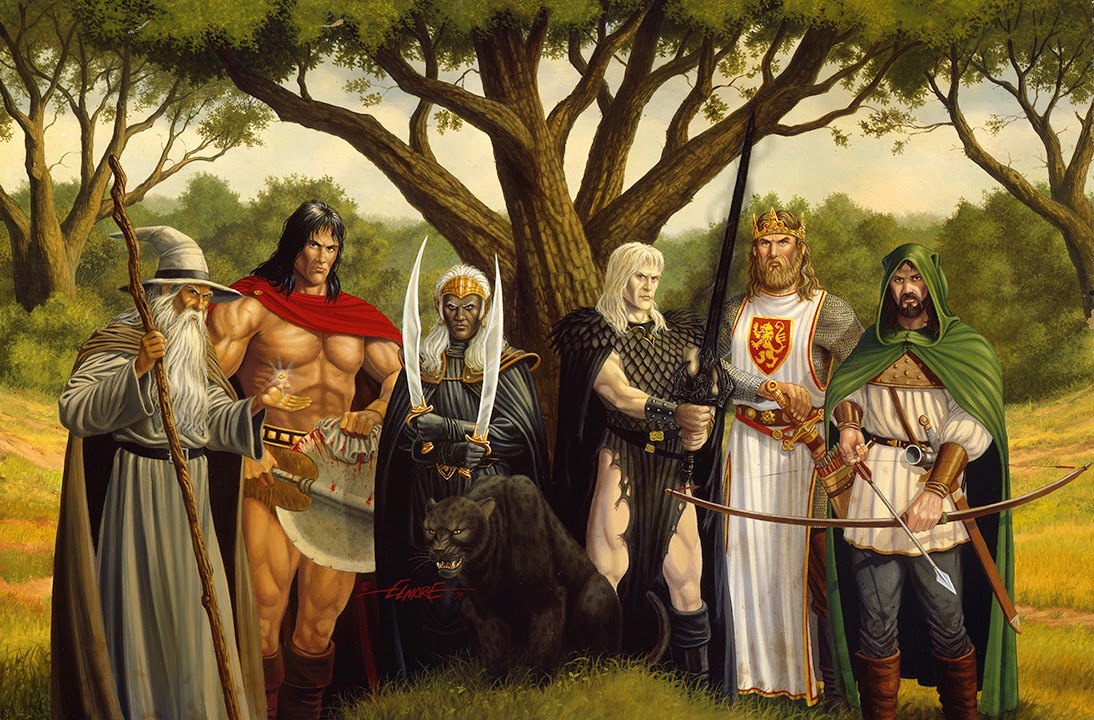
09-Heroes of Fantasy
Heroes of fantasy! Can you name them all? From left to right, Gandalf, Conan the Barbarian, Drizzt Do’Urden, Elric of Melniboné, King Arthur and (I think) Robin Hood.


10-Death of Sturm
As I mentioned above, this is another one of my favourites. Not just favourites of Dragonlance but favourites overall. From Sturm’s superbly detailed armour, the cold and indifferent battle field, Laurana’s quiet moment of suffering and her banged-up armour and clothes. I can’t find anything to criticize. I really wish Elmore would have drawn more scenes from the series but if we’re only to have a few of them, I’m extremely pleased that this is one of them.


11-Larry Elmore on his Harley
This obviously isn’t a painting. It’s a photograph of Larry Elmore on one of his Harley Davidson motorcycles. A lifelong fanatic of old cars and motorcycles, Elmore continues to ride to this day (despite his wife’s dislike of his hobby). Just look at him all rebellious and full of attitude.

On that note, I’m ending this review. I could go on and on about Elmore and his art but now that we have The Complete Elmore there really isn’t a need for me to do so. I’ll finish by offering my thanks to Larry for hundreds of illustrations that have fired up my imagination and helped to further immerse myself in my favourite genre. It’s been fantastic.

Saturday, 4 October 2014

The Blog Fantastic 028: Dragonwriter: A Tribute to Anne McCaffrey and Pern review


I’ve been a fan of Anne McCaffrey since my early teens. For a few years after high school I fell out of touch with her and her writing because I discovered comics full force and that consumed my free time for a while. I’ve actually had the pleasure of rediscovering her Dragonriders of Pern series when I started writing The Blog Fantastic project here on the blog. Even though I’d discovered things about her writing that I don’t like, I’ve really enjoyed immersing myself in the world of Pern all over again. It’s been one of my favourite science fiction and fantasy settings since I read Dragonsdawn. It’s not just the setting or dragons or other interesting science ideas that make her writing interesting to me and hundreds of thousands of other readers. McCaffrey has a knack for weaving interesting and meaningful themes in her work and populating her stories with engaging characters. There are characters in Dragonriders of Pern that I like as characters but dislike as people because she writes them so well.

Anne McCaffrey passed away on November 21, 2011 at the age of 85. That was during the time when I had read one of her novels in at least three years but I was saddened by the loss of one of my youth’s favourite writers. I’m usually not one to feel overly saddened when a celebrity (author, actor, director, etc.) dies. I usually feel sad and sorry for their family but this one, like few have before, hit me where it hurt. That’s one of the reasons I picked up Dragonwriter. I wanted to read something that wasn’t by McCaffrey but about her. I know there are at least two biographies out there but something strictly biographical wasn’t exactly what I had in mind. I wanted something that would discuss her as much as it would also deal with the importance of her writing. I didn’t know that’s what I wanted at the time but after reading Dragonwriter, I realise that I had an itch for that exact book but I doubt I would ever have been able to say so in so many words or in any great detail.

My feelings and my reaction to this book are all over the place. There is a lot of good stuff and a bit of bad but mostly it feels very genuine as the people who contributed clearly cared a great deal about McCaffrey and her work. Instead of blabbering on for pages, I’ll try and keep this short but I need to impose some obvious structure to this review. Below are quick summaries of the articles and tributes collected in Dragonwriter and some of my thoughts on the ones I enjoyed the most.

Anne McCaffrey, Believer in Us by David Brin
McCaffrey was a science fiction writer, no a fantasy writer (more on this later). One of her great themes found in the Dragonriders of Pern series is humanity's conscious effort to better itself. By always looking toward the future, we progress and that's what fuels most of the characters in Pern

Why Are You Reading This Stupid Shirt? By Share Lee and Steve Miller
This article is anecdotal in nature (the first of many). Lee and Miller tell the story of their friendship with Anne which revolves around convention visits and correspondence. We get to see McCaffrey as a fan and as a supporter of other science fiction authors. Lee and Miller aren't specifically celebrating McCaffrey's professional achievements, though there is certainly some elements of that, they focus on the personally and professionally results of their friendship with McCaffrey. 

Star Power by John Goodwin
A short article about McCaffrey's continued involvement in supporting budding science fiction authors, specifically with the L. Ron Hubbard the Writers of the Future program. This is the second article where mention is made of McCaffrey's crazy scooter driving skills in her later years. It's a hilarious mental image.

How the Dragonlady Saved My Life by David Gerrold
A long-time friend of the family, David Gerrold tells the story of how McCaffrey provided him with emotional sanctuary in a time where he needed it most. The experience taught him how to roll win the punches and keep moving forward.

Bookends by Robert Neilson
Neilson recounts moments in his life when he got to see firsthand just how professional, fun and, more importantly, generous McCaffrey could be. Family and friends meant a great deal to her and she always made the effort to help other when they needed it.

Lessons from Lessa by Elizabeth Moon
Moon is the second contributor to argue that Pern is science fiction. One of her arguments is Lessa. She was a unique female character archetype that, at the time of Pern’s first story didn’t exist and is still an interesting character today. Interesting, fully fleshed out female characters didn’t exist in other genres. Especially not in fantasy where they were often sideline characters or objects of desire. I enjoyed the snippets where she mentions the ways in which McCaffrey resembled some of her characters.

Flying in New Directions by Robin Roberts
This is a very interesting essay on McCaffrey's literary impact on the field of science fiction. Unsurprisingly, a lot of this is rooted in her being a female novelist and dealing with many feminist themes. That's not all though, in addition to using these themes in her work, McCaffrey's books were popular and sold very well. That invariably contributed to the influence of her writing on generations of writers. I particularly enjoyed how Roberts made the association between traditionally female arts, poetry, song and weaving them in her stories in ways that made them important to the books in questions. Pern’s survival depended on the use of traditionally female arts.  

That’s not all, by writing about women and their bonds with dragons, McCaffrey was able to address a wide range of women's issues: relationship, sexuality, social influence and power, etc.

Roberts, like many articles so far, also mentions McCaffrey's generosity but in a different context. McCaffrey co-authored several books with up-and-coming female novelists who often later developed into critically acclaimed authors. Some of those authors who've benefitted from McCaffrey's generosity, friendship and guidance have contributed to this book: Sharon Lee and Steve Miller, Elizabeth Moon, Lois McMaster Bujold, Mercedes Lackey, and Elizabeth Ann Scarborough. 

Modeling the Writer’s Life by Lois McMaster Bujold
Bujold writes about her career and how it was modelled, subconsciously or not, after McCaffrey's. It might seem obvious for an aspiring writer to have done so considering she grew up reading McCaffrey's body of work but it's an engaging insight into writers and their literary influences. McCaffrey also influenced some of Bujold's life decisions. In short, this essay is about the effects of modelling yourself after another person and to make sure you model yourself after the best kind people there are: like McCaffrey who was a worthy example to follow both as a professional writer and matriarch of a loving and supporting family. 

All the Weyrs of Pern by Wen Spencer
Fan fiction (or fan fiction) can be a hot topic for some people. Some professional writers have stated their disapproval of fanfic, arguing that it's bad practice for budding writers and it's also a breach of copyright. I'm of the opinion that it can be a great teaching tool for aspiring writers, especially genre writers because it allows you to focus on the structure of a story without having to worry about world building. Like anything else, relying solely on that kind of writing can likely also stilt a writer’s growth. Spencer deals with this idea in her essay. It's interesting to learn about her development as a writer, guided by her understanding of McCaffrey's Pern novels and the opinion and support of friends. For all of the criticisms you can make of fanfic, it's clear that it can have a beneficial impact on genre writers. Spender exemplifies that and her story is interesting on more than one level. 

The McCaffrey Effect by Jody Lynn Nye and Bill Fawcett
A retrospective of organized Pern fandom. The writers of the article make the link between Pern and McCaffrey's fans and what exactly it was about her work that inspired people to reach out with similarly minded people and create a space (real and, later on, vitural) for themselves to share in their common interests. 

The Ships that Were by Mercedes Lackey
Yet another article of a writer who has collaborated with McCaffrey and learned a valuable lesson (or several) in the process. Lackey presents an interpretation of McCaffrey's worldview and how she used that to good effect in her The Ship Who Sang stories. I’ve never any of them but it’s described as a dystopian setting that was different due to McCaffrey's approach to intentionally avoid wallowing in the self-pitying stories of dystopian fiction. In other words, dystopia with a positive twist. Lackey also integrates the real-world origins of this dystopian future in the social realities of the daily lives of disabled individual as it was during the 60s and 90s (the time the stories were written).  Unlike many science fiction writers who focused on the technological, McCaffrey focused on the social and projected that to the future to form a dystopian setting for her stories.

The Dragonlady’s Songs by Elizabeth Ann Scarborough
It was just a matter of time until I reached an article that would focus on music and its importance to both McCaffrey and her work. Scarborough discussed at length on the meaning of music for McCaffrey's novels and she also compares the sources of inspiration for the author. There are also some insightful comparisons between the real world teaching ballads and those found in the Dragonriders of Pern.

Religion on Pern? By Richard J. Woods
Writes about McCaffrey's connection to religion and the role it played in her fiction and her personal life. Honestly, it’s not something I’ve ever associated with Pern but after reading this thoughtful tribute, it’s going to be impossible to disassociate the two. I wouldn’t describe McCaffrey as a particularly subtle or nuanced writer but Woods has convinced me that she can be very nuanced when dealing with certain subjects. I’ll be paying attention to this the next time I read one of her novels.

Annie and Horses by Chelsea Quinn Yarbro
A brief tribute to McCaffrey and her love of horses, a love which Yarbro shared. There isn't much more to it but it's nice to have that facet of McCaffrey non-writing related life mentioned in this collection.

Picturing Pern by Michael Whelan
Whelan shares some comps, detailed sketches of cover ideas, for some of his Pern paintings. He also provides some insight as to the mutual beneficial impact he and McCaffrey had on each other early in their respective careers. Dragonwriter gave Whelan the opportunity to illustrate yet another cover related to McCaffrey’s work.

Red Star Rising by Alec Johnson
Johnson, McCaffrey's eldest son, recounts how his mother's support and encouragement has shaped his life. He also shares how her most famous work, the Pern series acted as an introduction to social and environmental activism, something in which is still a big part of his life today.

Changes Without Notice by Angelina Adams
This is an emotionally devastating essay. It brought me near to tears while also putting me in awe at the power of the written word. Adams also writes about the strength she gained from continued friendship with other fans of McCaffrey’s body of work. To say anymore would take away from Adam’s heartfelt and sincere tribute to McCaffrey’s and Pern’s positive and reinvigorating impact on her life.

The Twithead with the Dragon Tattoo by Charlotte Moore
I believe Moore is the youngest contributor to this collection and I think it's great that she was included. For a moment I thought there wasn't going to be a point-of-view from some of McCaffrey's younger fans but there is and I'm thankful for that. Like most other writers who preceded her in this book (that is, if you reading then in order - I haven't quite done that) her life has partially been a result of McCaffrey's influence, through her writing and during chance encounters (virtual and in the physical world). It's also a funny companion piece (in more than one way) to Adams's essay which precedes it. Moore’s tribute also stands out from the rest for being rather hilarious.

The Masterharper Is Gone by Janis Ian
This tribute is reminding me just how many facets people have in their life. They are multiple different people to other people. To Ian, McCaffrey was an older friend and a fellow artist. Their particular bond meant that their friendship was different than the others described in this book. Likewise McCaffrey impact on Ian is also different as it the impact of her death on Ian. What surprised me most about this essay is that it clearly states that the strong, positive, encouraging, kind and downright wonderful woman described in this book also had darker times in her past years. Nothing out of the ordinary mind you (at least not that I could tell from Ian's writing) but self-doubt can be a difficult thing to live with and it helps to have a friend who understands that and offers genuine and honest advice.

Universal Mum by Georgeanne Kennedy
This story ties all of the other ones together. McCaffrey as the Universal Mum. Yup, that works. McCaffrey was many things to many people but those two words someone encompass all of it. 

Todd McCaffrey, Anne McCaffrey’s son and collaborator on several Pern novels contributed the Introduction and the Afterword of Dragonwriter. He also introduced all of the other articles and tributes. Like any anthology or work that has multiple contributors, Dragonwriter has its peaks and valleys. That’s ok though because it’s a very positive book and the contributions that I didn’t enjoy as much were still interesting to read. It’s rather breathtaking to realize just how much McCaffrey has an impact on people around as a person, not just as a writer. I chuckled a bit at all of the mentions in this book that Pern is science fiction, not fantasy. It seems that McCaffrey had an aversion to having her most famous series mislabelled. I’m culpable of that myself as I’ve reviewed a few Pern novels under the banner of my Blog Fantastic project. To me, they're a combination of both genres but if I really had to choose I would invariably say they're science fiction. It’s just convenient for me to list them as fantasy as it gives me an excuse (and some additional incentive) to write about her novels at Shared Universe Reviews. A similar thing can be said of Dragonwriter and McCaffrey’s novels. It doesn’t matter why you read them or what you label them. It’s clear that McCaffrey was and is still an important writer of science fiction and any excuse to take the time to acknowledge that and discuss the impact and influence of her work on several generations of writers and fans is a good excuse. If you’ve ever been interested in McCaffrey of The Dragonriders of Pern, I encourage you to pick up a copy of this book as you’re sure to enjoy this wonderful tribute.