Showing posts with label Drawn and Quarterly. Show all posts

Wednesday, 3 December 2014

Bumperhead by Gilbert Hernandez review


Bumperhead is the second original graphic novel that creator Gilbert “Beto” Hernandez has done for Drawn and Quaterly, following last year’s Marble Season. Marble Season was a semi-autobiographical story that dealt with the joys of childhood. In my review I described it as “love letter to the magical delights and misfortunes of childhood”. Beto used his own experiences as a framework for the story and with Bumperhead he set out to do the same thing with his experiences as an adolescent. The result is a fascinating story about a young man who was forever shaped by his adolescent years and the life lessons that can be taken from his past experiences.

The book feels similar to a few recent works by Hernandez. Marble Season, of course, because it focuses on a period in a person’s life and develops that into a larger narrative. The other comic is the recent collection of Julio’s Day which tells of Julio’s entire life, from birth to death. Bumperhead combines these two narrative formats into a familiar yet different story of its own. The book starts with Bobby, a young man who is teased for having a big forehead, continues to spend a large portion of the book on his teenage and young adult years to finally wrap it up with a few pages of Bobby in his golden years to end with a strange and unconvincing declaration that he’s had a good life.

Along the way, Hernandez deals with several issues. The first is the passivity of youth and how that can shape a sad, isolated and depressing adulthood. Bobby doesn’t seem interesting in committing to anything one thing in particular. He loves music, he loves girls, he likes hanging out with his friend and taking part in recreational drinking and drug use but he doesn’t have any ambition. He does all of these things but a particularly attractive girl or an excellent record are enough to make him change interests. When discussing his future with a girlfriend, Bobby mentions he doesn’t have any interests in going to college. He’s simply happy to be done with high school and he’s ready for whatever will happen next. What he doesn’t understand is that by choosing not to pursue any in particular nothing worthwhile will ever cross his path.  
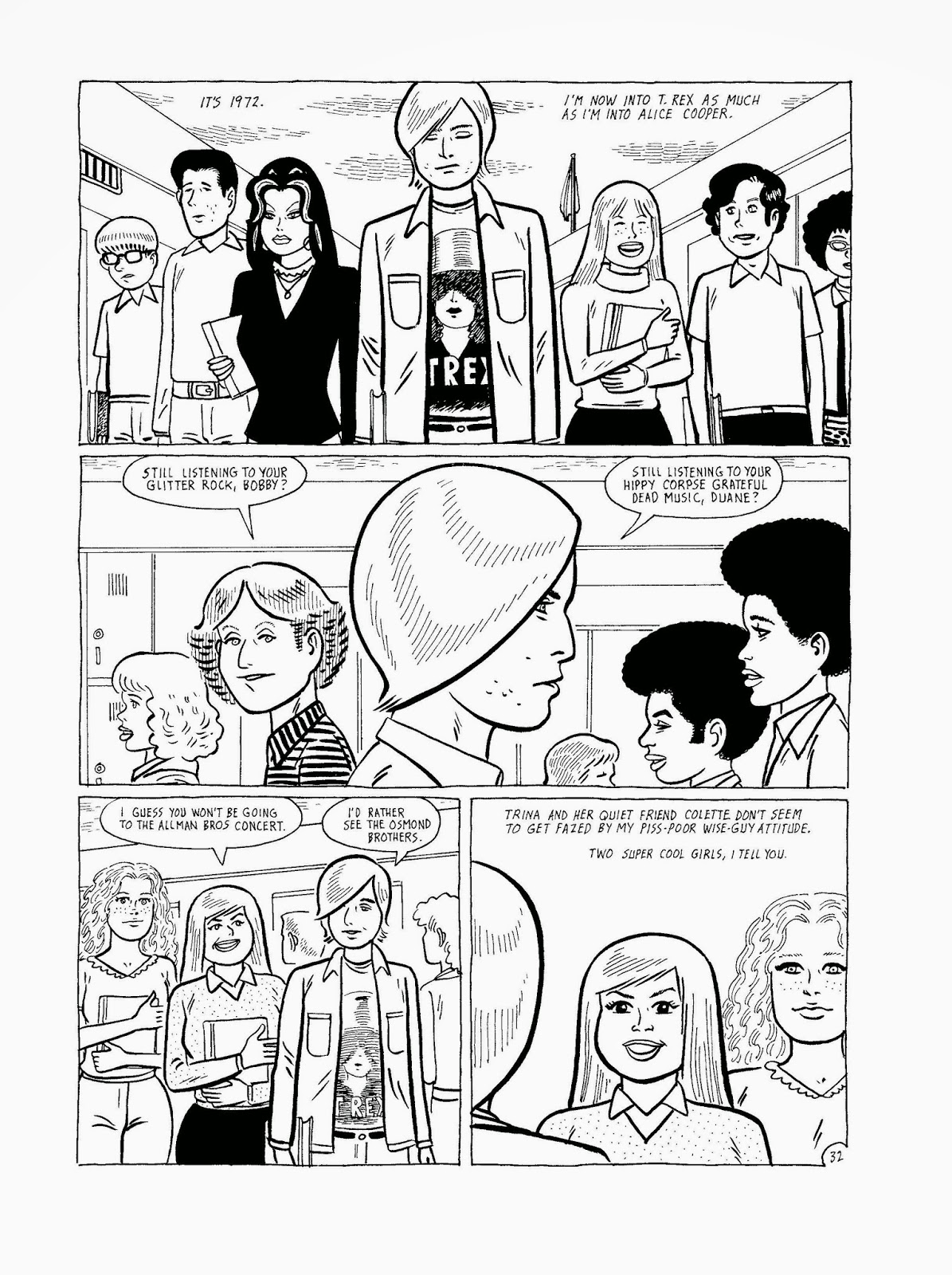

It’s not surprise that he ends up working a job he hates and living alone. That is, until he discovers the punk movement and decides to get angry. He uses this anger to create a new lifestyle for himself but it’s hollow. It has no meaning for him. People get angry for all sorts of reasons and we often try to maintain the anger for extended periods of time. So long that we often forget what initially caused us to be angry.  Bumperhead deals with this theme and we see Bobby deal with his anger in different ways throughout his life only to have it end with the recognition that it’s often not worth holding on to our anger as it’s a self-destructive emotion.

Bumperhead also proves to be an interesting remuneration as to how the smallest things from our past (regrets, thoughts, actions, feelings) can and often do haunt us for the rest of our lives. It’s a neat look at the idea that high school never ends. No matter what we do to change ourselves, we remain the same. We struggle with our identity and the identity of others to the point of stressing ourselves out. The consequences are that it begins to affect our health. We care so much about what other people think of us that we change and continue trying to change to no avail.


Bobby makes his way into the punk scene of the 1970s only to slowly move away from it all. He returns to the scene a few years later but he doesn’t recognize the movement anymore. He sees other punks, shirtless with shaven heads and piercings. He admits to himself that he doesn’t belong anymore. Did he ever truly belong within the punk scene or was it just a way for him to run away from his past experiences? Just like he moved from one girlfriend to the next during his high school days, in adult life he moves from one scene to the other. At one time he’s a lazy, booze sloshing couch potato, then he becomes a heavy drugs user only to move in and out of the punk scene for a few years. Along the way he breaks old friendships, makes new ones as he meets new people only to sever ties with them, makeup with old friends, and start all over.

At times Bumperhead feels like an anthology story. Beto uses the same characters is somewhat different roles in order to present the reader with alternatives to the lives of Bobby and the supporting cast. In each iteration the characters seem unhappy and it takes them their entire lives to recognize that they should stop pretending to be something they don’t truly want to be and simply be themselves with all their likes and dislikes. Even the characters who were consistent throughout the entire comic (and their life), such as Colette a born-again Christian who becomes a nun, doesn’t seem particularly happy with her life choices.

It’s quite nice that Beto doesn’t appear to be judging any of his characters. Instead, he presents their lives with such ferocious veracity as to make his themes that much more effective. Similarly to his black and white illustrations his storytelling presents a stark dichotomy, heartfelt portrayals of humanity contrasting with some of the worst decisions individuals can make in a lifetime.


This year Gilbert Hernandez won his very first Eisner Award for an untitled short story released in Love and Rockets: New Stories #6. He’s been nominated before but it’s shameful that the Eisner Award has failed to recognize such an important creator in comics. Gilbert Hernandez has worked with his brothers Jaime (and sometimes Mario) Hernandez on their ground-breaking and consistently spectacular comic Love and Rockets for more than thirty years. As if that accomplishment wasn’t enough, they’ve used Love and Rockets as well as their side projects to tell some of the most harrowing and heartfelt set of stories in any medium since the 1980s. They’re master storyteller, both of them, and it’s about damn time that Beto gets his Eisner. I wouldn’t consider New Stories #6  his best work but the man definitively needs to be recognized as being one of the great storytellers of our time. He’s worthy of your attention and readership and he’s got dozens of books in print, just waiting for you to dive in and shake you up a little. When people argue against comics being a trashy medium or being nothing but superhero stories, I suggest they read something by Los Bros Hernandez. The works of Gilbert Hernandez act as definitive proof that comics can tell some of the most powerful stories in print.

Wednesday, 3 July 2013

Louis Riel review


As Seth T. Hahne points out in his review of Louis Riel on Good Ok Bad, biography, and history as a whole, is difficult to write. It’s impossible to write it objectively and it can be very difficult to even try to do so. Seth outlines the difficulties a bit more in his review but I’m not going to bother repeating him here. You should be reading Good Ok Bad anyway. Seth is top notch when it comes to comic reviews. What I’d rather focus on is the difficulties inherent in taking biography and attempt to present it in narrative form. Both history and narrative have their own difficulties but I have to say I believe their multiplied when trying to do both at the same time. If nothing else, Chester Brown’s Louis Riel deserves to be respected and studied for its level of ambition.

Louis Riel, as the title suggests, is the biographical story of the titular Canadian hero told as a comic strip. That’s one of the reasons I decided to read the book (I borrowed it from a friend, thanks!). The other reason is that I have an interest in reading more comics by Canadian creators. It’s not something I always follow through with and sometimes when I do, I’m disappointed with the comic or the book in question. If that wasn’t enough, I’m easily distracted when buying books and I don’t always make it home with what I initially intended to buy. Other times, it’s just not in my budget to buy all the books I would want (I borrowed this comic from a friend, thanks!). All of those reasons explain why I’m only reading Louis Riel now when it’s something that’s been on my radar since I first started to read comics.

Despite being such an ambitious project, Brown met his ambition head on and completed a book that can be confidently classified both as a comic book (or comic strip as Brown seems to prefer calling it) and history book. Furthermore, the finished product is good as a comic and good as a history book. When considering both aspects together, Louis Riel is rather fantastic. It is a bit unfortunate that the combination of comic and history is also the book’s primary weakness. I think part of this is that some of the history doesn’t suit itself well to narrative interpretation. I’m thinking primarily of the fourth part which is essentially a simplified transcript of the court proceedings after Riel turned himself in to the Canadian government. It could also be that because this is a biography, Brown tells the story to the end, by which I mean the end of Riel’s life. The structure of Riel’s life, or any other famous historical figure’s life, doesn’t necessarily present itself to a solid narrative structure. Again, I’m thinking of the fourth part which takes up a considerable amount of pages, and it is essentially an epilogue. The thrill, the political intrigue, the rebellion, the action, the multitude of interesting characters, most of those elements no longer play a part by the beginning of the fourth part of the comic.

The best thing Brown did with Louis Riel was to include his extensive bibliography, index and notes sections at the end of the book. It was as enjoyable and interesting to me to read the footnotes than it was to read the actual comment. In the Notes, Brown presents different and often conflicting sources. He goes one step further and details some of the thought process he had on how to translate the story and the history he found in his sources to the comic strip. Sometimes this required some interpretation on his part and other times he did a bit of streamlining in order to simplify the comic and avoid negatively affecting the narrative flow of things. On one or two occasions, he even admits to having invented something in order to explain some history. What makes it so good is that Brown presents it in an unapologetic way. He changed some stuff or he made a decision to include or exclude things based on what he was trying to accomplish, which is telling the story of Louis Riel as a comic strip. Combined with a heavy (and required) reliance on a variety of sources, these additional sections go a long way into giving Louis Riel some depth and weight as a comic but also make it an important work in cartooning history.

As a comic, Louis Riel works rather well. As I started to mention above, the only part I can truly complain about is the fourth part. The narrative loses its momentum by committing to the biographical portion of the work. Another element that played with the pacing of the comic strip was the strict adherence to the six panel grid. It’s unrelenting. Every single page (with exception to the pages of maps) is composed of six panels (two columns of three panels or, if you prefer, three rows of two panels) all of identical shape and size. If that wasn’t enough, the action is not developed on a per page basis. Instead, it’s built on a panel basis. One page can be composed of Riel speaking with someone at Fort Garry for two thirds of a page and one third of John A. Macdonald talking to someone in Ottawa. The resulting effect is one of constant forward momentum. The reader has nearly no time to breathe or, for that matter, to stop and think about what he’s reading.

In the book’s Foreword, Brown mentions that the art for Louis Riel was based on the style of Harold Gray from Little Orphan Annie fame. I rather like the art. It has a simple, somewhat objective but with a fair amount of caricature, look to it. I think it’s a great choice because it forces the reader to focus on the events and not on action by the characters even though Brown demonstrates on more than one occasion that he and his art style are up to the task for those scenes as well.

Louis Riel is a fascinating little comic. I say little because for such an audacious biographical comic, it easily could have been much longer. It’s pretty surprising that Brown does so many so well. I’m thinking particularly to his attention to detail, his ability to streamline things for the purpose of narrative clarity as well as the inclusion of the bibliography, index and notes. Louis Riel isn’t flawless though, nor is it a masterpiece of comic storytelling. There are a number of areas in which it doesn’t quite succeed but I do believe it’s an important comics work, surely one to be proud of.

Sunday, 5 May 2013

Marble Season Review

Reviewing Gilbert Hernandez’s newest masterpiece (for that is clearly what it is), Marble Season, is going to be difficult. Not because I’m unsure how I feel about the work, it’s a love letter to the magical delights and misfortunes of childhood, and not because I don’t know why this is an excellent example of why comics should continue to be celebrated among the most important literary works. The problem I’m facing is one that I’ve only just encountered since I started writing about comics on Shared Universe Reviews: other writers, professors and bloggers have written better reviews and analyses of Marble Season than what I’m attempting to write.

I know how it sounds. I sound like a whining wannabe who’s fishing for the pity of others. I sound like someone who spends more time trying to convince others that my fandom is real, that I am the actual number one Gilbert Hernandez fan. Despite having only discovered the Beto’s work, and the work of Los Bros Hernandez, specifically Love & Rockets, sometimes in 2008, I’m their biggest fan and you’ve got to believe me because I’ve real, not all, but most of their comics on several occasions and… well, you get my point. In the grand scheme of things, I feel rather unimportant but I really don’t think Beto would mind. Sure, I most likely can’t write a verbose and in depth appreciation of Marble Season to rival the afterword of academic Cory Kreekmur, which can be found at the back of the book but that’s ok, right? Just like Gilbert shows us there is more than one way to appreciate a comic, you can be like Gilbert’s stand-in, Huey, and read comics and analyse muscleman adds or you can be like little Chavo and enjoy tearing them up instead, there is more than one way to enjoy, appreciate and recommend Marble Season. The real important thing is that despite my limitations as a writer, I’m trying.

Enough about me, let’s talk about Marble Season. Gilbert Hernandez, my favourite of the Hernandez brothers (which isn’t saying much, they’re all masterful in their own right), has always excelled at writing convincing child characters in his Love & Rockets series. One of my all-time favourites is Guadalupe. I remember how I felt the first time I ever read “Heartbreak Soup”. I haven’t taken the time to count, but in that one story alone, Gilbert created nearly fifty characters and that’s not exaggeration. Out of all of them, Guadalupe was instantly my favourite. Her antics with all the other children in the fictional village of Palomar were an absolute delight. The nicest thing I can say about Marble Season is that it’s all child cast reminded me of the children of Palomar in “Heartbreak Soup” which is still one of Gilbert’s best known stories.


The story of Marble Season is rather simple, perhaps deceptively so. It’s about the day to day lives of Huey, his brothers and his friends. There isn’t much of a plot. The comic is episodic in nature which is apt since Gilbert’s is greatly influenced by the child centric comics and news strips of old such as Little Archie Comics, Little Lulu and Peanuts. Somehow the episodic nature that seems to contradict the publication format of a graphic novel is a very powerful tool in Gilbert’s hands. The themes are meaningful of complex for a work that, at first glance, appears to be slight. Long-time fans of the Hernandez Brothers won’t be fooled. The nearly completely silent pages that pepper the comic are an exercise in subtlety and are key for adding emotional depth to this story about the lives of children.

Consider one such page where little Chavo, Huey’s little brother, is walking outside quite content taking a stroll outside under the summer sun. He encounters something in the road. It’s a dead baby bird. Chavo is completely traumatized as to how the baby bird ended up in such a state. He continues on in with his stroll but his facial expression TRAHI the burdened mind of a young boy who has lost a bit of his innocence. The page is told entirely without text but it’s powerful. Perhaps little Chavo, despite his lack of speech, is aware of everything that is going on. Gilbert uses him to great effect in Marble Season. Chavo is the secret observer in the neighbourhood. That’s probably why he wanders off so much. He’s curious as to the affairs of the older kids. His bald, round head gives him the allure of a Latin American Charlie Brown which fools the reader into thinking this little child is as emotional troubled as Charles Shultz semi-biographic character. That’s not the case for Chavo though. On many occasions while reading Marble Season, I thought he was the only character to fully understand what was going on in the lives of the neighbourhood kids. As I said before, despite the simple nature of this book, there are a lot of things that happen or, more accurately, suggestions are made about things that will happen.

The vague yet marvellously descriptive title perfectly describes that period of every child’s life where they begin to understand the worlds of adults. The book is about growing pains as it is about anything else. A tomboy deciding to wear a dress in order to catch the attention of a boy, a boy more concerned who perhaps chooses to pursue the affections of a Latin American girl after being mocked by his friends for demonstrating feelings for a little white girl with freckles, another boy who is still as of yet unconcerned with the opposite sex, learns an important lesson about honesty, material desires and thievery. Marble Season perfectly describes that time in our lives where playing with your favourite childhood toy and being trouble by one of the mysteries of life happen in the same day, sometimes simultaneously. The Marble Season is the time in which you enjoy playing with your G.I. Joe all the while being embarrassed about what people think of you for playing with your G.I. Joe. Huey is encouraged to play with his G.I. Joe in ways he’d never done before in order to avoid such embarrassment during the course of the book.  Real boys are rough with their G.I. Joes, they toss them at the wall and throw them in the mud, and they shouldn’t be preoccupied with their toys getting hurt or other girly nonsense. Marble Season, among other things, is the twilight years of a child.


I could go on. There is a lot to consider in the relatively short 120 pages. I mentioned earlier that Gilbert is my favourite of the Hernandez Brothers but I didn’t say why. Gilbert is sneakily subtle in his writing and in his art. His art is simple but it can be full of energy and emotion. Gilbert carves his characters in the page. It’s harsh and beautiful at the same time and I adore it. His writing is the same. It’s straightforward but deceptively so. His writing will reward those who take their time. Linger on the quieter panels and pages. Take the time to flip back and forth and really see what’s going on. I described Marble Season as being episodic and it is, but all that really means is that Gilbert gives us little snippets of story that build on one another and weave together to form a tapestry. You can easily appreciate each little snippet on it’s on but it’s only once you stop and consider the whole that you think to yourself “I see what you did there, Beto. Well done!”