Showing posts with label Vertigo comics. Show all posts

Saturday, 22 November 2014

Trillium by Jeff Lemire review


I’ve been a fan of Canadian writer-artist Jeff Lemire since I first read his Essex County trilogy. After that I started to read the rest of his works that were published at the time and I’ve followed his career as he started to write superhero comics for DC Comics. While Essex County was his breakout work, his first comic was Lost Dogs. He came to greater renown working on a now completed ongoing series for Vertigo Comics called Sweet Tooth. In the past few years he’s been alternating his superhero work with more personal and less mainstream projects with other publishers. His work for DC has been mostly writing and occasionally illustrating superhero comics. He’s worked on Superboy, Animal Man, Justice League Dark, and Green Arrow. His non-superhero comics include a retelling of H. G. Wells’ novel The Invisible Man. Generally speaking, I get a very different kind of enjoyment out of his standalone projects that are both written and illustrated by Lemire. Essex County, The Nobody, and Underwater Welder are all excellent reads. It’s only natural that I got excited for his latest standalone project when it was announced that Lemire would be doing a science fiction love story for Vertigo.

The story is set in two time periods, the primary one being in the year 3797. There, a scientist named Nika Temsmith has been trying to unlock the secrets of trillium, an alien flower. Her goal is to find a potential cure against a sentient disease that has killed all of humanity save for a few thousand. Most of Nika’s research is done near an alien city that is shaped like an Incan pyramid. In 1921 a veteran of the First World War, William Pike, is suffering from PTSD. He’s part of an expedition to find the lost temple of the Incas, somewhere in Peru. Both of their lives become intertwined when Nika travels through time and space to find herself face to face with William outside the temple. The temple and the trillium flowers help them to communicate despite their differences in language and culture. As consequence, the fate of their lives is intertwined with humanity’s survival in the future.

Trillium had tons of potential and I admit I had high hopes but having just read all eight issues in the collected trade paperback edition I can’t help but be disappointed. There are numerous problems with the story that I can’t help but feel Lemire may have rushed this comic while trying to juggle many of his other projects. His art has always had an unpolished, sketchy quality to it but it’s always been characterized by his ability to effectively capture tone and convey strong emotions. By opting to write a science fiction story Lemire has, perhaps unintentionally, revealed one of his greatest weaknesses as an illustrator. His design work is inconsistent and not always convincing. The science fiction elements such as the space ships, the space suits and the laser guns are torn between futuristic designs and retro designs. The laser guns look like cartoon laser guns and the space suit helmets look like goldfish bowls. It’s inconsistent to the point of distraction.

Additionally, the aliens are underwhelming. They’re far too humanoid in appearance and while I could excuse that if this was a television series with a restricted budget but Lemire’s pen doesn’t have those same restraints. It’s unfortunate but his style isn’t detailed enough to support the kind of visuals required by the story he wrote. There are certain pages that include dozens of characters, dense jungles or larger than life settings. You get an idea of what Lemire was trying to accomplish but it falls short of his vision.  


Visually the comic gives you the sense that the science fictional elements don’t really matter. They are set dressing and have little consequence on the overall story. The sentient virus, the space colonies, time travel and the use of the Incan ruins as a time travel device are all good ideas but they do no work together cohesively.

The aliens were particularly problematic as they didn’t play any role beyond protecting the flowers and then given them to Nika for an undefined use. Lemire worked closely with letterer Carlos M. Mangual to develop an alphabet for the aliens and most of their dialogue is written in that form. It’s a nice detail but it’s completely unnecessary. I haven’t used it to translate too much dialogue but the bubbles I did translated didn’t have anything substantial to add to the narrative.

Another thing that is poorly used is the trillium flower. Why is it important? The first issue suggest it might be useful for developing a cure against the virus but it’s used as a product to expand the mind and help overcome language barriers between different characters. That would be fine if it played a role in the story aside from allowing for the main characters to connect, but it doesn’t. You could say that having the main characters connect is important to the story but I felt the romance story was very forced. It was very unemotional and we’re not given any reason for their being a relationship between the two aside from the shared memories caused by the ingestion of the trillium flower. They are both misplaced from their time period and because of that I could understand that they’re linked, but love? Even romance? I don’t see it. I certainly didn’t feel it.

The book isn’t all bad though. Lemire is a skilled storyteller and even when he creates something as flawed as Trillium it still has its positive aspects. The most enjoyable thing about Trillium is that Lemire is stepping out of his comfort zone. A lot of his work is either set in a small tone and deals with themes of isolation and identity. He’s also done a lot of superhero work that has used those same themes but he has also explored other interesting ideas with those comics. He’s yet to do a story set firmly in the science fiction genre (you could argue that superheroes fall in that category). He’s challenging himself creatively and some of those shines through successfully here but not enough to make this a worthwhile read for readers unfamiliar with Lemire’s body of work.

While the story and the world building are disappointing, the skill with which Lemire illustrated his comic is as impressive as ever. The use of flip flopping page layouts works to the story’s advantage. The overall sense is one of disorientation which helps the reader identify with Nika and William who are experiencing an even greater disorientation due to the time travel and other strange and unexplained science fictional phenomena. Lemire forces the reader to flip the book around and read sideways. One issue splits every single page in two with one story being told on the top half. The second story on the bottom half requires you to flip the entire book completely over for the duration of the issue.


Lemire also works with regular contributor José Villarrubia who handles the colouring. Villarrubia is one of my favourite colourists in the business because he’s able to change his colouring style to best match the artist he’s working with. That’s true of his work with Lemire and it really shows in Trillium. Villarrubia’s colouring looks like watercolours and it helps to highlight the strangeness of Lemire’s story as well as the unusual quality of Lemire’s linework. These two creators make an excellent team and it’s a joy to have a story that allows for Villarrubia to show off some different tricks.

My excitement may have led to my less than positive reaction to Trillium but that doesn’t change the fact that it was one of the biggest missteps since the beginning of his career in comics. That’s not to say that it’s all bad. I recognize and appreciate the fact that Lemire tried something different. He could easily have spent his time writing yet another superhero comics or an equally formulaic story and ended up with a more enjoyable comic. I’d rather read an interesting failure than a bland, yet successful, cookie-cutter comic book. I’m convinced that Lemire has learn a lot about his abilities to tell this kind of story, something that is truly outside of his comfort zone if you compare it to his previous work. He pushed beyond his usual story limitations and even though the end result wasn’t impressive, his artistic devotion to create something new and different was still satisfying to me as a fan of his work. I can only trust that it was equally satisfying to him as an artist and that he will continue to expand his horizons and develop his storytelling skills. Trillium will certainly not be the last comic of his that I read and I’m already anxiously awaiting the next one.  

Sunday, 22 June 2014

Vimanarama review


Grant Morrison and Philip Bond’s Vimanarama is a delightful little comic. It’s one of Morrison’s simpler comics and part of why I like it so much is because of its simplicity. It’s pop comic or the comic equibalent of a popcorn film. Note, that it’s not the comic equivalent of a blockbuster film, not at all. It’s light-hearted and charming and it’s also funnier than most comics written by Morrison. It doesn’t take itself too seriously and neither should you.

While the comic doesn’t take itself too seriously, the characters really do. Ali is a young Muslim man who is going through and existential crisis. His father has arranged for him to marry and he’s hours away from meeting his bride-to-be. He’s convinced that when he meets his future wife he will know if God loves him or not by how beautiful she is (or isn’t). He’s seriously worried that she’ll either be ugly, stupid or boring. As it happens, Sofia is very pretty and she’s far from boring. Nothing about Ali’s life is boring because the same day he met his fiancée is also the beginning of the end of the Earth when he inadvertently unleashed a great evil upon the world.

The best thing about this comic is the tone but it’s also the easiest thing to miss. A lot of it has to do with Philip Bond’s art. His stocky and cartoonish characters work really well with this story. It’s drastically different from his earlier collaboration with Morrison on Kill Your Boyfriend. Here his art style is more exaggerated or defined than it was with Kill Your Boyfriend and it really works. It actually works better with Vinamarama, partly due to the juxtaposition of the regular human characters and the godlike Ultrahadeen (religious superheroes) and the evil Atlanteans (Jack Kirby inspired villains). Actually, now that I think about it a lot of this comic works by presenting opposing elements and letting them play our organically.


I started to talk about the tone and that’s what makes this comic work for me. Bond’s art is walking on the edge of characterization and Morrison’s dialogue is much sillier here than it usually is in his comics. Really though, it’s two comics professionals not taking it took seriously but still managing to produce a very interesting and very entertaining story. I should say four professionals as colourist Brian Miller and letterer Todd Klein help to round out what is essentially a superstar cast of creators. They’re goofing around a bit but they’re doing it like pros, nothing is unpolished, and the result is a micro version of what you would normally find inside a comic written by Morrison.

I’m pretty sure the whole thing is meant to be over the top for humorous effect. When talking to journalists about the sinkhole in his store, the Ali’s father mentions that the underground mine (that’s what he thinks it is at the time) was a threat to him and his family. He almost lost his scholar son (Omar) who only survived because of his brother (Ali). Really though, he’s exaggerating for the press. Omar is disciplined and obedient but he’s far from being a scholar. Likewise, Ali likes to doodle and he doesn’t appear to have gainful employment. Being described as an artist isn’t accurate at all. It doesn’t sound funny when I explain it but trust me, in the hands of pros like Morrison and Bond, it works rather well. Really though, it’s the compound effect of these little gags being thrown around the page in the midst of godlike alien apocalypse and meet-cute love story. The first issue actually opens with a double splash page taken right out of a Bollywood film because this is the kind of story it is. Imran, Ali’s nephew, couldn’t even crawl yesterday but today he’s walking around getting into all sorts of trouble.

All the humour is just one part of the comic. The second part is the budding romance between husband and wife to be, Sofia and Ali. Their story feels so real and even though it’s told in three single issues, the whole thing feels rather well paced and believable. There is a third part to the comic and that’s the superheroics, a love child of Jack Kirby and Eastern philosophies and religions.

Vimanarama is a micro Morrison story. A lot of his popular themes are present here such as love, metaphysics, superheroes, Eastern cultures but, most important of all, is the theme of human transcendence and the power to save ourselves. Sofia doesn’t fall in love for Ali because he’s cute or charming (mostly because he’s not really charming at all, he’s a bit depressing really) but because he has “sad eyes”. The other reason she falls in love with his is that while his family is busy bickering and complaining about the destruction of their corner store, Ali is always running around trying to save everyone. He’s the family hero and nobody recognizes it but Sofia.


Ali’s decision to achieve transcendence through death in order to save the world was a plan doomed to fail but his heroic action (as much as you can call suicide heroic) helps to defeat the Atlanteans. Though Ali doesn’t succeed on his own, it’s his heroic spirit that helps Ben Rama realize the potential that modern man has to succeed. Prior to Ali’s gesture he was caught up in his own bravado and partially defeated by the decay of the great civilization of Earths he’s familiar with (civilization from 6,000 years ago). This is a deceptive comic. My earlier descrition of pop comic isn’t accurate. That’s what it is on the surface but readers who take their time and choose to savour Vimanarama will be reading a completely different comic than those who are simply reading these issues in an effort to catch up with their reading pile.

Vimanarama is an inspired combination of cosmic superheroics like Jack Kirby’s Fourth World or The Eternals mixed with a family centric dramady and the result is a comic filled with contrasting ideals that’s s pleasure to read.

Saturday, 12 April 2014

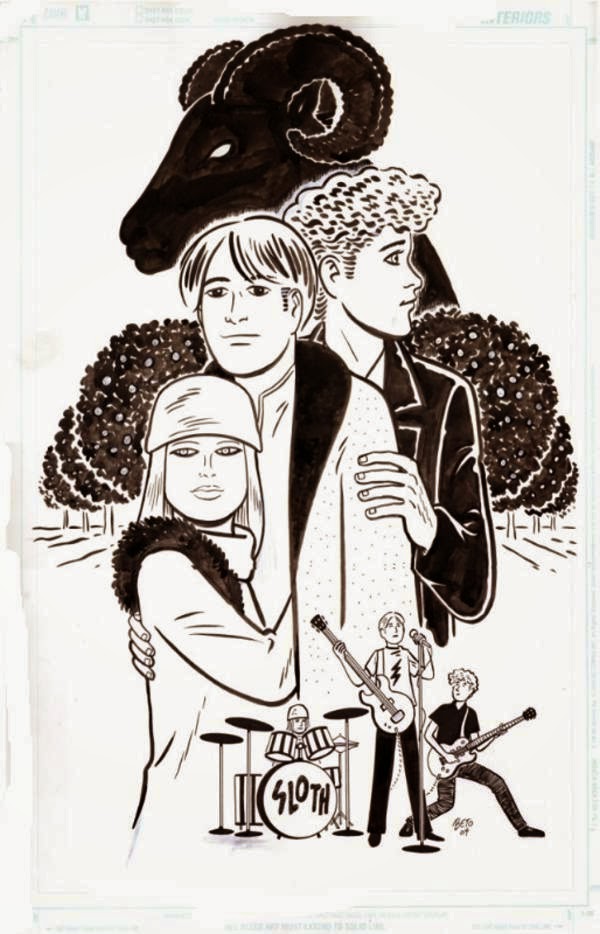
Sloth by Gilbert Hernandez review


"Adults who burn out from living in the city pick up their families and move to towns like this for the slower pace, the quiet. They feel they can raise their younger kids in relative peace and safety. What they fail to recognize is that it's their teenagers who suffer boredom and existential low self-esteem in extreme ways."

I’m a very big fan of Gilbert Hernandez, co-creator of one of the greatest comic series of all time, Love and Rockets. There is an ethereal quality to his work that is combined with strong characterization and bold, unapologetic art. His Palomar stories are a young man’s masterpiece but Beto (as he’s known) has continuously improved throughout his career. Though I’m most familiar with this Love and Rockets stories, I’ve been slowly working my way through the rest of his oeuvre. Note that the only reason I’m doing it slowly is that he’s rather prolific. Thirty years after the first issue of Love and Rockets Beto continues to regularly publish comics on an annual basis. Some years, he’s even got three or more publications if you count his collection of serialized works and original graphic novels.

Released in 2006, Sloth is an original graphic novel. Hernandez wanted to create something that was different than his Love and Rockets stories. For those who might not know, Beto’s half of Love and Rockets is a huge, sprawl family epic with dozens of regular characters who have age in slightly quicker than real-time since their original appearance. Part of his inspiration for Sloth was to create something with fewer characters and really focus on them. That’s really what Sloth is. It’s a study in character and it’s also a study of what it is to be a teenager.

The story is about Miguel, a depressed teen who wanted to escape reality and willed himself into a coma. The comic starts out with his reawakening after his year-long coma. We follow him as he re-enters the world he left behind. Hernandez presents us with a bit of Miguel’s family history and he also gives us the events that may have led to his coma. Miguel lives with his grandparents since his father is in prison for selling drugs and his mother abandoned him when he was a toddler but is now rumoured to be dead and buried in the lemon orchard, a local haunted spot.

Structurally, Sloth is fascinating comic. Beto splits the story in two parts, the first dealing with Miguel’s post-coma return to normal life and he second is Lita’s post-coma story. The story is linear for the first two thirds (give or take) but the story is partially rebooted when Lita wakes up. There are interesting parallels and differentiating storie happening to Miguel and Lita but what really captivated me was how some parts of the story, those related to Romeo (and maybe the Goatman?) appear to continue from the first to the second part and ultimately lead us to a third comatose teen.

Beto has mentioned in an interview (which you can read here) that the coma is a metaphor for adolescence. In order to understand the characters you have to understand why they chose to self-induce themselves in a coma. For Miguel it was a way to escape life. It was too much for him to deal with but when he woke up, everything was still the same. He still has the same girlfriend, his band is still together, the legend of the Goatman (who lives in the lemon orchard and can swap bodies with you using his willpower alone) is still being circulated. Absolutely nothing has changed and when he slips into what can only be his final coma, his only regret is that he’s leaving Lita behind. For Lita, her coma is nothing but an extended dream, a fantasy. Nothing in her life remained the same. She has different friends, Romeo has become an incredibly successful rock and roll star. What really makes it a fantasy though is that everything she wants (a relationship with Miguel, to meet Romeo X, etc) happen without requiring any real effort. Her post-coma (dream) life is a fantasy because it depicts an unrealistic portrayal of life where change happens easily and is always rewarding.

A big fuss is made over the Goatman but what is his portion of the story really about? I think the Goatman symbolises change or the desire to change. Teenagers have their entire life ahead of them and they often dram of what they will one day be. Few teens actually work towards achieving any of their goals. Teens are dreamers and because of that they’re static, they don’t do much. They’re so unmotivated to enact change and better themselves that they’re rather avoid real life and regress into a cocoon of sleep and hope everything will fix itself in their absence or that their dreams will come true all on their own. The problem with this approach is that by the time they wake up they’ll realize nothing has really changed and their coma approach to life was counter-intuitive. You can’t just dream of what you want, you have to go out and obtain it. While Lite and Miguel were busy trying to film the Goatman, Romeo stayed home and worked on his music. Later, in Lita’s coma fantasy, Romeo is a successful rock star because he worked hard to achieve his dream. In the dream Romeo X hangs out with Miguel and Lita and he tells them he’s from the same hometown as them essentially telling them and the reader that it doesn’t matter where you’re from, you can achieve greatness if you work hard. I see the Romeo as being the Goatman and they both represent will power, which Romeo used to get what he wanted out of life rather than run away from life like Miguel and Lita did.

Sloth looks and reads like the typical Beto comic, that is to say all the components are there, the elliptical storytelling, the heavy-inked bold art and a focus on developing interesting and deeply flawed characters. It really works though because he rearranges those components to tell a very effective story about teenagers and their hopes and dreams. Beto’s later work is often categorized by a false sense of simplicity. Sloth, despite its name, is a pretty quick read but unless you slow down and think about what is happening, you won’t be able to appreciate. My interpretation of the story isn’t necessarily right and I’m certain there are far more interpretations that could be made, each of which could be equality validated, but that’s the pleasure of this kind of comic. Beto doesn’t spoon feed us the answers but he avoids giving the reader a pile of unrelated visual symbolism. If you focus on the characters and the recurring elements of coma, dreams, movement and the Goatman’s famed will power, you can puzzle together a story that sheds light on the lives of teens and how best to escape it all. 

Wednesday, 22 January 2014

Orbiter by Warren Ellis review


I really like Warren Ellis as a writer. I’m not his biggest fan but his name is enough to draw me to a project. Some of the reasons I like Ellis so much is that he likes big ideas but in most cases he doesn’t let character or story suffer because of it. He’s also produced work with extremely talented artists throughout his career and when your career consists mostly of comic books, that’s a good thing because visuals matter a lot. Another reason I like Ellis is that he’s gender and race neutral. That’s a pretty big deal, it’s more important than some people think. What I mean by gender neutral is that he doesn’t go out of his way to make every single character a woman but woman are present in most if not all of his work in roles that matter. They’re not limited to being background characters that don’t speak or aren’t otherwise involved in the narrative. Unlike other writers, Ellis doesn’t forcefully integrate women or racial minorities in his work. He’s aware that he’s using a character that isn’t the statistical average human male and so he doesn’t write them as such. He also avoids writing his female and racial characters as stereotypes. It might not seem important, but these elements are present in Warren Ellis and Colleen Doran’s original graphic novel Orbiter.

Orbiter, like a lot of really good science fiction, begins with real world ideas and scientific facts and uses them to provide us with interesting ideas. Good science fiction is often speculative in nature and it’s concerned with social, political, economic issues. With Orbiter, Ellis uses the lost wonder of his childhood growing up during the Space Race along with the retrospective nature and overly cautionary administration of human spaceflight exploration, specifically the funding and administration of NASA, as the starting point of his story. Ten years ago, Space Shuttle Venture blasted off and disappeared. The shuttle and its crew where never heard of or seen again. Because of the incident, the American Space Shuttle program ended and Kennedy Space Centre has deteriorated and become a shanty town. On a day like any other, the thought-to-be-lost Venture returns home and crashes at KSC. Experts are brought in to study the shuttle and figure out where it went, how it got them and how it got back.

The rest of the story is a science fiction procedure grounded in real world ideas. Ellis has three experts, a psychiatrist, a biologist and an aerospace engineer, study the shuttle and the sole survivor crew member. Along the way he argues why crewed space flight is crucial to the success of space exploration. There are things that men and women can experience that robots just can’t, no matter how sophisticated they are. More importantly, you need humans in order to do experiments. Try having a robot do what Canadian astronaut Chris Hatfield did on the International Space Station last year. His experiments where simple but they helped to clearly demonstrate the way zero gravity can affect everyday items. That’s just the tip of the iceberg when it comes to the things we can learn from space exploration and study.

I mentioned that Ellis is usually pretty good at keeping the human element in his stories present in his stories along with big ideas. He does so here, too. The four main characters all have their reasons to be concerned with the Venture. For one, it’s as simple as being fascinated with space and curious to learn how it affects animal and vegetable biology. For the pilot of the Venture it’s a matter of exploring and discovering the unknown. Space exploration is also extremely important to the engineer who only wants to help others reach space and come back in the best way possible. He wants to create things that will allow man to do the impossible. I particularly like the character of Anna Bracken, the psychiatrist who doesn’t have any interest to physically go to space but she’s devoted to the idea of helping others understand their own experiences.


Ellis’s comics can sometimes feel like essays. It’s true. If you don’t believe me you only need to read Crécy or Supergod. Better yet, find a copy of Orbiter and give that a read. I say this because Ellis’s writer can sometimes feel much more argumentative than other fiction. In Orbiter, Ellis and Doran argue for the importance of crewed spaceflight. As such, the comic succeeds but it flounders a bit as a narrative.  Part of the problem with the narrative is that everything goes so smoothly. This comic is, in essence, a science fiction mystery and boy, what a mystery it is! The problem is that the specialists from very different fields all work seamlessly together and solve the mystery based on well informed guesses. They’re still guesses though and they guess right every single time.

I don’t get too bothered by that because the point of Orbiter isn’t to provide a great narrative. The point is to inspire. Ellis is trying to inspire pride and joy in the idea of manned space exploration while (unhappily) predicting the end of the manned space flight. I was impressed by Orbiter because the creators also managed to throw in a heavy dose of science fiction while making all three elements, inspirational story, science fiction ideas and prediction all work together. As a species, man has the incredible potential to do the seemingly impossible but in order for us to do the impossible; we have to actually do it. We can’t use technology as a crutch or as a replacement of man in space. That will provide some answer but robotic exploration is stale and uninspired and ultimately not worth as much as real life experienced individuals doing what they do best which in this case happens to be exploring, learning and discovering.

Sunday, 14 July 2013

Army@Love volume 1 & 2 review


Rick Veitch has made a career out of writing satire comics. I find most of these satires are actually some of his best comics. What makes them so good is that Veitch understands and often loves his subject and that’s what enables him to write a successful comic that also serves as poignant satire. That dual relationship of love and hate is what fuels powerful criticism. I remember the first time reading Brat Pack, Veitch shattered an important part of superhero comics. He was able to do so effectively because he understood superhero comics so well. It’s with that realization, that he knows his subject; you can really understand the satire for what it is. It’s too bad that Veitch doesn’t seem to understand love and war as much as he does superheroes and Army@Love suffers because of it.

The first volume, collection issues #1-5 is actually a pretty good start to a series. The problem is that the seven remaining issues, collected in volume 2, can’t keep up with what came previously. Veitch can’t follow his own act and its damn shame because, for a while at least, he had something interesting to say about the American military, modern warfare and the media. What began as the exploration of our near future devolved into a shock and awe tactic that only left the narrative (and the reader) feeling hollow and spent.

The first volume begins with a woman fighting somewhere in the Middle East. She’s in the middle of combat talking to her husband in America on her cellphone. In the next few pages we see her join the Hot Zone Club. It’s a spin on the Mile High Club in which active soldiers have sex in the middle of combat, combining the adrenaline of combat with the pleasures of sex for the ultimate high.

The Hot Zone Club is the product of one man, Colonel Haley. Colonel Haley used to be a corporate man, working in marketing and specializing in consumer profiling. Haley ended up in the military after congress passed a corporate level draft. They began enlisting older men with job market skills and work experience in an effort to revitalize their military. People like Haley, having a specific set of skills, were able to apply them directly to certain areas of the military. After doing a deep-psyche consumer profile, Haley discovered that young Americans who indulged in movies and video games have developed an addiction to low levels of adrenaline. Based on his research and analysis, Haley has coined the phrase "peak life experience". He recruits huge numbers of young Americans by selling them peak life experience which they can find in the combat hot zone in the Middle Eastern theatre.

Colonel Haley's Motivation and Morale (or MoMo as the soldier's call it) has combined the adrenaline inducing experience of military combat with other experiences, most notably soldiers have sex while under fire. Soldiers are also allowed cell phones in combat and female recruitment has been increase to further exploit sexual tension in military settings. If that wasn't enough, MoMo organizes regular Retreats, which are essentially orgies that take place in controlled environments.
Army@Love did have some fun covers.
Veitch based his covers on
magazine advertisements. 
Army@Love outgrows its premise early on. Outgrows might be the wrong word. It's more of an issue that Veitch reveals too much too soon and it affects the potential growth of the story. In very little time the comic becomes a satire and a mockery of religion, witchcraft, romance, corporate America, magazine ads, various cultures as well as future technologies both near and far. The military satire stops developing in the third or fourth issue. The satire is still present but its repeated ad nauseum. It doesn’t change. The story doesn’t really evolve either. Veitch should have put sex somewhere in the title because we get far more of that than we get love. Quite a few issues revolve around discovering who’s sleeping with who and I stopped caring before the end of the first volume.

Army@Love could have benefitted from a shorter length and tighter focus. Like the Middle Eastern war it's commenting on, it's grown into a self-parody. I don't think Veitch pulled any punches in his commentary but he did run out of breath. Still, I enjoyed Army@Love but not in the form it was originally intended. I really liked it because of the funny melodrama and for seeing the artistic collaboration between Veitch and inner Gary Erskine. I don't think Veitch's art has ever looked better. It's too bad the story only required they draw the same small core of characters and military vehicles over and over. As much as I enjoyed it, it seems the art just like the story was destined to repeat itself without really adding anything new to the mix.


Monday, 1 July 2013

The Books of Magic review


Alan Moore can easily be considered the pioneer of the Vertigo comics universe while Neil Gaiman is responsible for giving it much of its heart and soul. At the very least, the parts of the “Vertigoverse” that form a shared universe. As many people know, Vertigo is also the home of many great comic runs that are unrelated to other comics and inhabit their own little worlds. Those are actually some of the most famous Vertigo titles. They include but are not limited to The Invisibles, Preacher, Transmetropolitan, Scalped, Y: The Last Man and Fables. Vertigo does have many other series and mini-series that are linked together. Stories that are set in their own comics bus share a universe with other titles. Swamp Thing, Hellblazer, Sandman, Lucifer, The Dreaming are all examples of this. Although Moore is the one who cleared the path for more mature and intelligent comics to be told, it’s Neil Gaiman who’s responsible for giving the Vertigoverse a sense of coherence, a direction and its tone.

Alan Moore's Swamp Thing had a tone of its own, but it never carried past his own tenure on the title. Gaiman's own series, Sandman, is more representative of the tone of Vertigo than any other comics from the publisher. The Books of Magic has that same tone that readers can find in Sandman. It’s not surprising considering they’re both by Gaiman.  

Gaiman can do horror just as well as Moore but he chooses not to. In his Vertigo comics he explores the ideas of myth, magic and identity. He's also very concerned with the idea of choices and individuals’ perceptions of reality. He's also quite the fan of stories that introduce someone to a hidden world of wonders, stories of initiation. It's evident in so many of his stories: Several Sandman stories, Neverwhere, Stardust, American Gods, Anansi Boys, The Graveyard Book, The Ocean at the End of the Lane and The Books of Magic.

The Books of Magic is the story of young Timothy Hunter's initiation into the world of magic. He's guided by four magicians which Gaiman playfully nicknames the Trenchcoat Brigade. It's composed of Doctor Occult, Mister E, the Phantom Stranger and, of course this being a Vertigo comic, John Constantine. Each one takes Timothy on a journey. The Phantom Stranger brings him to the past and shows him the development of magic. Constantine takes him to America and shows him how magicians live in the modern world. Doctor Occult (and Rose) take Timothy to the land of Faerie and many other to show him all the lands in which magic is present. Finally, Mister E takes Tim to the very End. They travel to the future and see how magic transforms itself all the while witnessing some of Timothy’s possible futures. The Trenchcoat Brigade’s intentions are to positively influence Timothy whether he chooses the walk to path of magic or not.

In The Books of Magic, Gaiman demonstrates one of the skills Moore used while writing Swamp Thing. He seems to effortlessly incorporate existing DC characters into the richer world of Vertigo comics. It’s not surprising when you consider that Gaiman is a protégé of Moore. Over time there some pretty interesting differences have developed between both writers and depending who you talk to either one of them can be considered the superior author. Moore's work can be dry, cold and so structured it can make the reader feel alienated. Gaiman on the other hand has a softer approach.

I’ve just realized that part of this review is more of a comparison of Gaiman and Moore Vertigo comics than a proper review of The Books of Magic. It seems a bit late to go back now so I might as well continue with my comparison and how it relates to The Books of Magic. Both authors clearly love magic. There are several different types of magic and Moore and Gaiman each write about a specific kind of magic. Moore's magic is based in the real world study of magic, the magic that can quite literally be found in the day to day. He's studied the works of Crowley and the Jewish Kabbalah and has applied that to his work as well as his life. His comic that focuses on magic, Promethea, is a wonderfully complete story about the rules of magic. In fact, you could easily argue that a significant portion of the series is an essay in comic book form outlining the complicated rules, symbols and iconography of magic and how to understand it. In short, Moore's magic is overly structure and complexly defined.

Gaiman's magic is simple. He offers simple rules that can be combined in many different ways in order to offer thrilling results. Like Moore's magic it has a structure and some rules, but it's simpler. It's not as heavily as obviously structured but it’s all there. Based on the magic and the lands of the fantasy books of his childhood, Gaiman's magic could be said to be based in fiction instead of reality. This fictional magic also has symbols but their meanings are left to interpretation more so than Moore's. For Gaiman, there is no rule more important than the rule of names. He's also an ardent believer than there is nothing free, everything has a price. It's like a second law of thermodynamics for the magical realms. Every gift is met with an equal gift or service in return.

Gaiman demonstrates this best in the third chapter of The Books of Magic which is my favourite. The chapter focuses on one of the best elements of Gaiman's oeuvre and one of his most distinct collaborators, Charles Vess, is along for the ride. I love Gaiman's Faerie. It’s inspired by all the fairyland he encounter in the fantasy books of his childhood all condensed in one elegant and potently magical place. Of all the artists to have worked with Gaiman to this day, no one captures the essence of faerie quite like Vess. Artistically, this chapter is also my favourite. It’s gorgeously illustrated, the lines are elegant yet otherworldly and the colours are spot on.

For Timothy Hunter, magic is choice. It's as simple as that. You choose to live a life of magic; you choose which path to follow and which side you'll follow it on. You can even chose to make your own path. It’s not limited to Good and Evil, Chaos and Order, etc. It’s about the ability to make choices. Balance is still important to Gaiman though but it’s a balance on the micro scale, not on the macro. If an individual offers a service or a good, the person who took it has to offer something of equal value in return. Once again though, the power of magic is in the choices you make while giving and taking.

If there's one thing you need to have understood from this review is that Gaiman knows magic. More importantly, he knows his kind of magic and that's about all we can really expect to see from any author. He offers the reader a world where magic can truly be felt, you can experience the magic along with Timothy. Some things are left unexplained or ambiguous (the battle against the Cold Flame in India or the key Tim receives from Titania) and that’s the beauty of it. It adds incredible richness and depths to the comic. The Books of Magic is an excellent example of Gaiman casting one of his spells on the reader by engrossing him in the world that’s already in place but giving it a fresh spin and adding some depth and characterization. It’s a great comic and it really puts me in the mood to grab another Gaiman book and jump feet first into the land of Faerie or any other magical lands.

Wednesday, 8 May 2013

Punk Rock Jesus Review


Even though I know Sean Murphy has written comics before (Off Road) I think of him primarily as a comic book artist. Murphy tried to prove me and possible other non-believers that he has just as much talent behind the keyboard than he has at the drawing table. 

Punk Rock Jesus is a story set in the future. A new reality TV show, J2, has impregnated a virgin woman with the clone of Jesus Christ. They’ve taken dead DNA material from the Shroud of Turin, revived it and cloned Jesus. The J2 compound is located on an island before the first episode of the show even aired, dozens of people are found outside the gates protesting. For obvious reasons, the show causes much controversy and like many things that are controversial, the show becomes hugely popular. Murphy sets up the story in a mere handful of pages. This comic is wonderfully dense and I really enjoyed that. The story spans several years in the life of the cloned Jesus and it’s all contained in six issues. In a market still dominated by decompressed storytelling, Murphy decides to head the other way and pack a satisfying amount of story in each issue. That alone makes this a worthy comic for your hard earned dollars.

Punk Rock Jesus gives us a chance to see Writer Murphy battle it out with Artist Murphy. I was surprised at the amount of smaller panels and that's probably because I consider Murphy primarily as an artist. He surprised me though. He has a large amount of caption boxes and speech bubbles on most pages but it doesn't crowd the page. That's one of the biggest a surprises here. The pages are dense with words and panels but Murphy's keen eye as an artist keeps it balanced and more importantly, he keeps the reader engaged in the story. I've found in the past that the more a comic is dense the more difficult it is to keep the reader at a suitable level of excitement. The density of a comic has a significant impact on the pacing of the story being told. Either due to impressive story or the stellar art, Punk Rock Jesus captivated my interest and never let it go. This story had some serious momentum. It’s also got tons of action. More than I was expecting. 

Sean Murphy, quite unsurprisingly, draws a great polar bear. It's name is Cola.
One of the concerns I had while reading developed over the course of the first issue. Murphy uses the media quite heavily. There are numerous reporters, news channel broadcasts and one news talk show host that take up a considerable part of the story. I'm not a huge fan of the media being used heavily in comic. It often comes off as expository and dry. I also find that it sucks the energy right out of the story. Few comic creators can and have used the media successfully in their stories. Frank Miller is particularly adept at using this technique (The Dark Knight Returns and The Dark Knight Strikes Again, and Elektra Assassin are probably his best examples). Murphy proves he has a knack for using this story telling device in a way that is not only effective, but interesting.

Murphy's use of the media allows for him to increase the amount of story he can fit in a single issue. Yes, it serves a purpose as an expository device but it also serves to comment on the story while it’s happening as opposed to simply telling the reader what's going on or what has already happened off-panel. His use of the media isn't done in a vacuum. Several characters appear on TV shows and are interviewed about events that have are happening. It helps that Murphy intercuts the media segments with other stories happening elsewhere.

I wasn't prepared for Punk Rock Jesus. I thought this was going to be some sort of pseudo-cult type story where the loss of innocents of one or many characters was going to be the focus of the story. All I knew for sure before flipping to that first page was that the art was going to rock, and it did. Murphy makes the ordinary look extraordinary and the extraordinary just plain awesome. The art is easy to follow and it all looks and feels so damn energetic. I'm glad this book is in black and white. It's adds a raw energy to the story and art that perfectly fits Murphy's style. There are some artists that simply don't require any colour and Murphy is one of them. Murphy is the kind of artist I want to see draw. I would love to find a video of him attacking the page with pens. It's suitable that punk lifestyle and music play a role in this comic because Murphy's art exudes that same energy. It's go scratchy lines and it gives a sense of artistic and creative energy that’s let loose on the page.

I finished reading Punk Rock Jesus a few days ago and I've been thinking about since. The prevailing emotion is still that of pleasant surprise. I don't know when Murphy had the time to grow as a writer but since he’s arrive on the comics scene with Joe the Barbarian and a couple other Vertigo mini-series, he still had enough creative energy to give us this dose of a 21st century religious big brother that’s combined with a documentary of punk all of which has undertones of social responsibility. This comic will make you a Sean Murphy evangelist. 

Saturday, 6 April 2013

Saga of the Swamp Thing Book Six Review


Book six concludes Moore and Veitch’s story of Swamp Thing’s Space Odyssey that started in volume 5. It is a bit of a strange book because the tone of the comic has changed quite a bit compared to what it was in the first four volumes. Moore and his team of artists are no longer breaking ground, they’re mostly developed all of Swamp Things powers, though there is some new stuff still present in this book. The fact remains Moore and his collaborat
ors are no longer telling huge cataclysmic stories.

In something that serves as a parallel to Swamp Thing’s vegetable nature, the time of death and rebirth was replaced by a summer of horror and grand epic battles between Good and Evil but all that has moved on to make room for a story that is about to end. Everything seems a bit more restrained but everything retains the high standards of execution and story that has been previously established.  

As always Moore is a formalist and as a continuation of all his Swamp Thing stories narration boxes are filled with poetic language accompanying images filled with fantastical imagery as Swamp Thing continues his impossible quest to find a way to return to Earth and his true love, Abby.

The highlights of this volume are the two-part Adam Strange story, the Green Lantern story and the final two issues where Moore ties up the loose ends and give Swampy and Abby some R&R together before Moore says goodbye to them forever. If it seems strange to you that I qualified most of the stories in the volume as being highlights of the collection, you’ve clearly not been paying attention to the previous five posts on Moore’s Swamp Thing run. This is a damn good comic. Moore’s last issue doesn’t end in a climactic battle to end all battles like the culmination of the American Gothic storyline in issue #50. That suits me just fine and it fits well with how the series has progress since all the stories following the showdown between Good and Evil have been of a quieter more introspective tone than the horror stories found in the earlier volumes.  

This is a really neat cover but the
story inside is a bore.
Unlike that other issue, this one gives
you exactly what the cover promises.


I’m sorry to say that one of the more interesting covers (issue number?) was one of the most disappointing issues in Moore’s run. The whole thing was drawn and sculpted in a mix media art collage in 23 pages but due to the printing quality at the time it’s just a muddy, blurring mess of cogs, bits of wire and drawings of swamp thing’s face all over a newsprint quality page. I do not mean to criticize Totleben’s art on the issue because I’m certain that in person these collages were at the very least interesting to look upon but it doesn’t work well as a narrative and it also didn’t transfer well to the page. To add to this, Moore’s script is a bore to read and it simply doesn’t add much of anything to Swamp Thing’s journey back to Earthy. It’s an unnecessary and poorly executed interlude.

Alan Moore makes an appearance for
his final issue as the writer of Swamp Thing
This is remedied by the following issue which focuses on Swamp Thing’s arrival to a planet where plants have become sentient and is protected by a member of the Green Lantern Corps. Here Swamp Thing’s powers evolve one last time and he is now able to shift and change his electromagnetic frequencies thus ending his forced exile from earth. As a reader we all knew the story was heading in this direction but Veitch and Moore pull off a masterful execution of this evolution.

It was nice of Moore to tie up his loose ends, which allows Veitch to dive right into his own story on Swamp Thing following Moore’s last issue. It was also very nice to have an issue to simply enjoy Swamp Thing and Abby’s reunion. This final issue also provided most of the artists from Moore’s run a chance to return for a final few pages of artwork. I wish I had more to say about the last volume of this legendary run but after six posts I think I’m all tapped out. I’m glad I decided to give this run a second chance. It’s unfortunate that everything slows down to a crawl about halfway through but for those that decided to see it through to the end, Moore’s Swamp Thing run offers one of the best comic series of the 1980s and of all times. You can hardly call yourself a serious comic fan without having read this series. So what are you waiting for?


Monday, 11 March 2013

Saga of the Swamp Thing Book Five Review


The fifth book collecting Alan Moore’s legendary run writing Swamp Thing is the second collection of Swamp Thing that I haven’t read previously. So far, the first three volumes have been rereads for me. During my first attempt at reading Moore’s Swamp Thing, I had mixed feelings. I recognized the sheer revolutionary power of his first 18 months on the title but after reading several issues consisting of Moore commenting on the mythology of America, I gave up. It was too preachy and, at the same time, hollow for my tastes. Last time, in my review of volume four, I mentioned the greatness that is to be found in the second half of the American Gothic storyline and I was once again spurred to continue reading Swamp Thing.

Once again I encountered my main problem with Alan Moore written comics with the first two issues of Book Five: momentum. I realize that it’s unfair to Moore that I seem to dislike all the issues of Swamp Thing that are less than spectacular. It’s either an excellent issue or an ok issue when it comes to his writing on this book. The thing is that’s how these issues read. My read problem though, isn’t exactly momentum. Moore’s formalistic approach to writing comics sucks the life out of whatever it is his writing. There is little or no energy at all to his writing and when a comic he wrote does display some kinetic and energetic storytelling it’s more often than not due to his collaborators than to Moore’s writing. His comics are too rigid; they’re not allowed to breathe under Moore’s guidance. On some occasions this style works really well but other times the story just falls flat.

Swamp Thing vs. Batman? Yup, and this
is Moore's run changing into a lower gear.
After the last book’s issue #50, I was expecting issue #51 to be a quieter story and it is. The problem is that it a set up for Swamp Thing’s Space Odyssey that truly begins in issue #56, the last issue in this collection. But, as you can imagine, Alan Moore sets up the story very well and he adds some nice element to the Swamp Thing mythos and there are even several good character moments which should not be surprising after 20+ issues. Swamp Thing is one of Moore’s most contemplatively moody series I’ve read and that tone leads to quieter stories. I didn’t know it at the time but issue #50 marked the last bombastic Swamp Thing story that Moore would write (yes, I’m aware of how ridiculous that sounds). The rest of the series is composed of quieter stories that still tell horrifying and moving stories about Swamp Thing and Abby Cable.

This collection turns the focus to Abby. The story deals with her relationship with the law after photos of her intimate relationship with Swamp Thing are revealed to the public in a newspaper. Swamp Thing returns from his war against Evil to find that Abby has seemingly disappeared. With these issues Moore juggles interesting character drama with Abby while also setting up an introspective journey through space for Swamp Thing.

An interesting thing about this collection is the similarities with Moore’s other comic work at the time, notably Watchmen with Dave Gibbons.  The similarities between issue 56 and the Watchmen issue where Dr. Manhattan goes to Mars are fascinating. I would really like to reread both those issue and discuss them further. For now, I’ll settle by saying issues 56 is one of the most interesting issues of Moore’s entire time as writer on Swamp Thing because of the way it encapsulates so much of what has already happened in the series and turning it against his main character in strange and frightening ways.

Swamp Thing is blue and he's alone on
a deserted planet reminiscing on the past.
Sound familiar? It should.
There are also similarities between Swamp Thing’s funeral issue in Gotham and the Comedian’s funeral issue in Watchmen (rain, a statue, people having flashbacks and what if scenarios intercutting the funeral scenes, one vigilante talking about another not quite vigilante). These elements may seem like elements that don’t share much with one another but it certainly doesn’t read that way. Was Alan Moore trying out storytelling techniques in Swamp Thing before leaving the title? Was it a way for him to practice before writing a work that was newer to him and maybe more important to him (I would argue Swamp Thing was ultimately more important to the world of comics than Watchmen). He seems to have done what he wanted to do on the title already. As far as I can tell, based on what Steve Bissette wrote in the introduction to volume 5 and volume 6 Moore’s story was being led in directions that Rick Veitch was more interested in and Moore agreed to go in that direction having done all there was to be done with horror in comics (no kidding).

In short, volume five goes off in a new direction for both the creators and the readers. Swamp Thing continues to be a very good comic even though it’s going through some changes in tone, characters and a change in art teams.  

Friday, 1 March 2013

Saga of the Swamp Thing Book Four review


This volume collects issues 43 to 50 which conclude the American Gothic storyline that began in book three. I have to admit the last third of American Gothic is a triumphant finish to the longer Swamp Thing story arc by Moore. I was caught by surprise. The beginning of American Gothic is so difficult to read, not because it’s a challenging comic but simply because it’s not good, so when the momentum builds seemingly out of nowhere I was caught off-guard, not only by the story being told, but how well told it was. Everything culminates in issue #50 and I mean everything. The journey to that anniversary issue wasn’t such a treat though.

The momentum picks up almost from the first issue in this collection. Moore tells an interesting story staring one of the many tubers that grow and fall off of Swamp Thing. A man, Chester Williams, finds one of the tubers while in the swamp and brings it home. The tuber is cut up and sold off as a drug to different people. They all have hallucinogenic experiences but they all differ from one another. The type of person you are and the reason you’re eating the tubers will affect the time of hallucination you will get. It’s a clever, emotional one issue story and although if fits in the context of American Gothic, is works just as well on its own.

After that issue, Moore falls back into a few issues of exploring American horror and that other garbage. We also find out what Constantine has been training Swamp Thing for. We’re introduced to the Parliament of Threes, Swamp Thing continues to develop his powers and there is also the cataclysmic battle between Good and Evil in the concluding issue. Moore deftly interweaves a big philosophical question, magic and horror elements to his recently developed Swamp Thing mythology to tell what is easily one of his top three Swamp Thing issues. He also takes the time to joke around.

Moore ends issue 50 with two jokes. One of the jokes is admittedly dark humour. While Cain thinks over what he has learned from the confrontation of Good and Evil he comes to a realization that neither can nor will ever been defeated, they will continue to exist. However, Good and Evil can be refined and come to signify slightly different aspects of what they used to be. Once done his reminiscing, Cain turns to Abel and murders his brother for the nth time. Everything has changed but just slightly.

Moore also takes the time to take a jab at Steve Bissette. Bissette and John Totleben are considered to have been the primary artists on Moore’s run writing Swamp Thing. It’s not necessarily because they drew the most issues (I’m not even sure if that’s true or not). I think it’s more because they defined the look of Moore’s run more than any of the other artists who collaborated with him. Bissette had an ongoing struggle with deadlines and on the last page of issue #50 there is a tombstone with him name on it. The following is engraved beneath his name: “Here lies S. R. Bissette. He arrived late to his own funeral.” It’s great, I loved it.

This fourth volume of Saga of the Swamp Thing is a return to form for Moore and his team of artists. Not only do many plot elements all come together for a grand finish, but Moore also takes the time to set up the stories to come. It’s a bit unfortunate that not all of the issues are excellent but enough of them are to make this a worthwhile read. Things settle down a little bit in the next volume but only for about an issue or so. Review for book five coming up soon. 

Friday, 22 February 2013

Saga of the Swamp Thing Book Three review


The third volume of Alan Moore’s time as the writer of Swamp Thing collects the first half the American Gothic storyline. Those issues present the first lull in the momentum that Moore and the artists had been building since issue #20. American Gothic is famous for introducing the character of John Constantine who became the poster boy of sorts for Vertigo Comics. Constantine cons Swamp Thing to go on a journey to different parts of America on what appears to be wild goose chases. To the perceptive reader, it is clear that Constantine is forcing Swamp Thing to change and develop as a plant Elemental.

This volume comes off as a slight disappointment compared to the first two volumes. The individual stories presented here aren’t as interesting as the previous issues. More importantly, they are difficult to read because Alan Moore gets preachy with him commentary of various elements of old and present America. I guess he tried to say something about America but I don’t think he was very successful.

The issues are very well executed but they’re simply uninteresting for the most part. It seems strange that the team that gave us a new Swamp Thing, a revamped and terrifying Floronic Man, a monster brawl between Swamp Thing, the Demon and the Monkey King, a frightening Arcane, a trip to hell and back and more than one out of body experiences give us, in this third volume, stories of a radioactive man, underwater vampires, a werewolf and a movie about slavery haunted by the very past it is trying to replicate. It’s pretty boring add to that Moore’s preachy narrative it’s almost enough to make you lose faith in the creative team.

Listed like that it doesn’t seem like this stories have much in common but they do and it’s that very thing that keeps this volume interesting and stops it from being a failure. Two things, actually. Swamp Thing is developing both as a character and as an elemental. His growth is what anchors this journey across America. The second thing keeping my interest in this volume is the introduction of John Constantine. He’s a manipulative jerk who has little remorse for the things he does to others. Swamp Thing is just a tool to him and he’s doing what he can to shape and prepare him for what is yet to come. It’s interesting to see just how much of a jerk John Constantine is in his first year. and the other is John Constantine being a horrible person and manipulating Swamp Thing. John Constantine is a jerk in these pages.

To follow up what I’ve written about Swamp Thing’s more texturized look in Moore’s run, in his introduction, Steve Bissette clarifies that it was John Totleben who wanted to draw Swamp Thing as something actually composed of vegetation and not simply a green man suit with roots. Thanks John Totleben, you and Bissette’s Swamp Thing looks great. There’s just so much texture.

I’d rather not write any more about this third volume, my least favourite of Moore’s run on Swamp Thing, so I’ll stop here. The story gets much, much better next volume. Well, not right away, but the end of American Gothic is a high point not only in Moore’s run but in Swamp Thing’s entire comics history. Review of volume four coming soon.  

Thursday, 14 February 2013

Saga of the Swamp Thing Book Two review


I like this volume even more than the first. It is one of the few truly revolutionary comics (Julian Darius demonstrated as such in a very interesting three part article in which he attempts, and succeeds, in understanding the bad blood between Alan Moore and Grant Morrison. It is an excellent article and you should check in out on Sequart).  It is with the issues collected in Book Two that Moore goes from telling an excellent story to dishing out a masterpiece in monthly installments.

In Book One he tied up all the loose ends from the previous creative team’s time on Swamp Thing. Some people will tell you that all the loose ends where tied up in the first Moore issues titled “Loose Ends” but I think it took longer. The first eight issues felt like a superhero comic which isn’t the case with the second volume. In the first volume there are two pretty clearly defined storylines and in each one there is a pretty clear villain and a pretty clear hero. The first story concentrated on the Floronic Man and the second was about the Monkey King and Etrigan the Demon. They were two very good well done monster brawl comics but even so, the conflict is essentially two or more monster duking it out. There aren’t any monster brawls in volume two. There is still a villain though. Swamp Thing has a big confrontation with Anton Arcane, the Swamp Thing villain but it’s not a fist fight or even a dark magic death and decay vs. plant elemental fight which would be a reasonable thing for a comic to be about. Instead, Moore chooses to evolve Swamp Thing into a different kind of comic and these are the issues it happens in.

Swamp Thing is different than many other comics written by Moore because even though this is primarily a horror comic Swamp Thing has heart, it has real emotion. Some of Moore’s comics can feel like soulless machines designed to entertain. They feel constructed.

Moore and his collaborators are also developing Swamp Thing’s new identity as well as his supporting cast, specifically Abigail Cable. The first eight issues were all about taking care of the left overs plot threads and laying the groundwork for the stories to come. By volume two it’s already paying off. That’s one of the great things about open ended serialized storytelling. Good writers are able to simultaneously tell and epilogue of sorts from a previous story, tell a story and set up another story yet to come. When done well it builds an incredible momentum that’s even more apparent when read in quick succession or in collected form. It allows you to be able to tell stories that require a lot of preparation without it feeling like set up because you can have other shorter stories being told in the same issue. It’s great. Bill Willingham has been pretty good at doing this with Fables. It got to the point with that series that it didn’t feel like there were storylines anymore it was all one giant comic where multiple storylines took place all at the same time. It’s something you find all too rarely in comics I find but it’s one of the medium’s strength. I would like to see more ongoing comic series where it’s a rolling ball effect of plot and subplots and character development.

When I did the post for the first volume I mentioned how Bissette and Totleben made Swamp Thing look like a walking humanoid plant that didn’t necessarily have a clean cut layer of skin with roots sitting on the top such as was the case for Dan Day’s, and many others’, Swamp Thing. I was wondering if this was a plot point or simply Bissette and Totleben’s way of drawing Swamp Thing. It seems, if this volume can stand as proof, that it was more of an artistic choice. Shawn McManus draws Swamp Thing like a rubbery looking plant man with thick skin and roots sitting on the top while Bissette and inkers Totleben and Alfredo Alcala draw him like they did in volume one. In their hands Swamp Thing looks fuzzy with moss, he doesn’t seem to have skin as much as composed of plants and sticks and roots and other various vegetable bits. He looks like a Swamp Thing and not man wearing a green skin tight suit with roots sewn on his chest and shoulders. It’s strange when artist draws defined abdominal muscles on Swamp Thing. It doesn’t look right.

Bissette and Totleben are also very good at making the swamps look and feel like swamps. There are other animals and insects, several different types of vegetation; it’s very pleasing to the eyes. It gives everything a nice sense of realism but mostly it makes the swamp feel as though it’s habited. There are other things in the swamp other than Swamp Thing much like there is more to Swamp Thing than green skin.

I’m really looking forward to the next volume but I know I’ll be a bit disaponited. It’s the beginning of the year long American Gothic story arc which have some of Moore’s worst Swamp Thing issues.