Showing posts with label Gilbert Hernandez. Show all posts

Wednesday, 3 December 2014

Bumperhead by Gilbert Hernandez review


Bumperhead is the second original graphic novel that creator Gilbert “Beto” Hernandez has done for Drawn and Quaterly, following last year’s Marble Season. Marble Season was a semi-autobiographical story that dealt with the joys of childhood. In my review I described it as “love letter to the magical delights and misfortunes of childhood”. Beto used his own experiences as a framework for the story and with Bumperhead he set out to do the same thing with his experiences as an adolescent. The result is a fascinating story about a young man who was forever shaped by his adolescent years and the life lessons that can be taken from his past experiences.

The book feels similar to a few recent works by Hernandez. Marble Season, of course, because it focuses on a period in a person’s life and develops that into a larger narrative. The other comic is the recent collection of Julio’s Day which tells of Julio’s entire life, from birth to death. Bumperhead combines these two narrative formats into a familiar yet different story of its own. The book starts with Bobby, a young man who is teased for having a big forehead, continues to spend a large portion of the book on his teenage and young adult years to finally wrap it up with a few pages of Bobby in his golden years to end with a strange and unconvincing declaration that he’s had a good life.

Along the way, Hernandez deals with several issues. The first is the passivity of youth and how that can shape a sad, isolated and depressing adulthood. Bobby doesn’t seem interesting in committing to anything one thing in particular. He loves music, he loves girls, he likes hanging out with his friend and taking part in recreational drinking and drug use but he doesn’t have any ambition. He does all of these things but a particularly attractive girl or an excellent record are enough to make him change interests. When discussing his future with a girlfriend, Bobby mentions he doesn’t have any interests in going to college. He’s simply happy to be done with high school and he’s ready for whatever will happen next. What he doesn’t understand is that by choosing not to pursue any in particular nothing worthwhile will ever cross his path.  
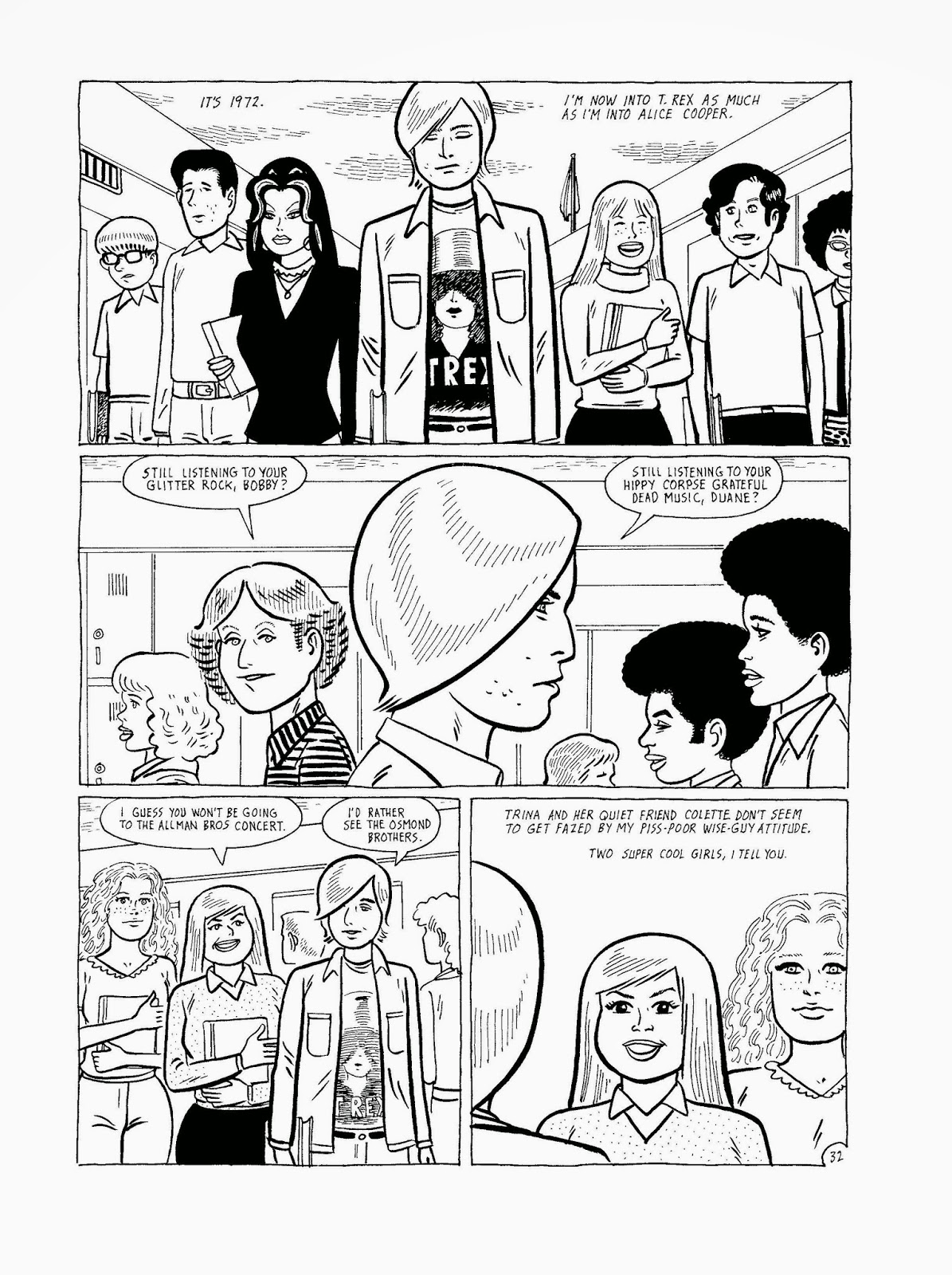

It’s not surprise that he ends up working a job he hates and living alone. That is, until he discovers the punk movement and decides to get angry. He uses this anger to create a new lifestyle for himself but it’s hollow. It has no meaning for him. People get angry for all sorts of reasons and we often try to maintain the anger for extended periods of time. So long that we often forget what initially caused us to be angry.  Bumperhead deals with this theme and we see Bobby deal with his anger in different ways throughout his life only to have it end with the recognition that it’s often not worth holding on to our anger as it’s a self-destructive emotion.

Bumperhead also proves to be an interesting remuneration as to how the smallest things from our past (regrets, thoughts, actions, feelings) can and often do haunt us for the rest of our lives. It’s a neat look at the idea that high school never ends. No matter what we do to change ourselves, we remain the same. We struggle with our identity and the identity of others to the point of stressing ourselves out. The consequences are that it begins to affect our health. We care so much about what other people think of us that we change and continue trying to change to no avail.


Bobby makes his way into the punk scene of the 1970s only to slowly move away from it all. He returns to the scene a few years later but he doesn’t recognize the movement anymore. He sees other punks, shirtless with shaven heads and piercings. He admits to himself that he doesn’t belong anymore. Did he ever truly belong within the punk scene or was it just a way for him to run away from his past experiences? Just like he moved from one girlfriend to the next during his high school days, in adult life he moves from one scene to the other. At one time he’s a lazy, booze sloshing couch potato, then he becomes a heavy drugs user only to move in and out of the punk scene for a few years. Along the way he breaks old friendships, makes new ones as he meets new people only to sever ties with them, makeup with old friends, and start all over.

At times Bumperhead feels like an anthology story. Beto uses the same characters is somewhat different roles in order to present the reader with alternatives to the lives of Bobby and the supporting cast. In each iteration the characters seem unhappy and it takes them their entire lives to recognize that they should stop pretending to be something they don’t truly want to be and simply be themselves with all their likes and dislikes. Even the characters who were consistent throughout the entire comic (and their life), such as Colette a born-again Christian who becomes a nun, doesn’t seem particularly happy with her life choices.

It’s quite nice that Beto doesn’t appear to be judging any of his characters. Instead, he presents their lives with such ferocious veracity as to make his themes that much more effective. Similarly to his black and white illustrations his storytelling presents a stark dichotomy, heartfelt portrayals of humanity contrasting with some of the worst decisions individuals can make in a lifetime.


This year Gilbert Hernandez won his very first Eisner Award for an untitled short story released in Love and Rockets: New Stories #6. He’s been nominated before but it’s shameful that the Eisner Award has failed to recognize such an important creator in comics. Gilbert Hernandez has worked with his brothers Jaime (and sometimes Mario) Hernandez on their ground-breaking and consistently spectacular comic Love and Rockets for more than thirty years. As if that accomplishment wasn’t enough, they’ve used Love and Rockets as well as their side projects to tell some of the most harrowing and heartfelt set of stories in any medium since the 1980s. They’re master storyteller, both of them, and it’s about damn time that Beto gets his Eisner. I wouldn’t consider New Stories #6  his best work but the man definitively needs to be recognized as being one of the great storytellers of our time. He’s worthy of your attention and readership and he’s got dozens of books in print, just waiting for you to dive in and shake you up a little. When people argue against comics being a trashy medium or being nothing but superhero stories, I suggest they read something by Los Bros Hernandez. The works of Gilbert Hernandez act as definitive proof that comics can tell some of the most powerful stories in print.

Saturday, 12 April 2014

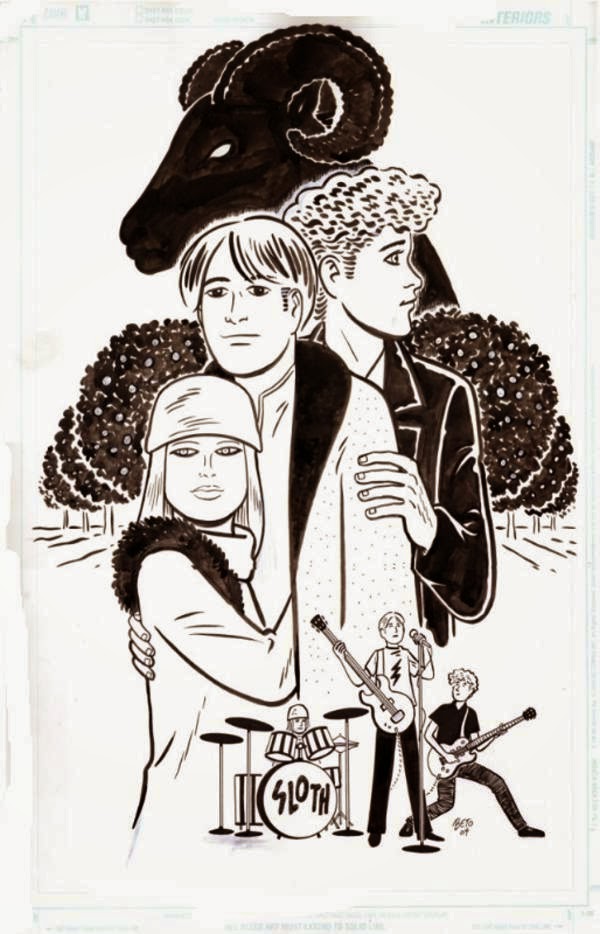
Sloth by Gilbert Hernandez review


"Adults who burn out from living in the city pick up their families and move to towns like this for the slower pace, the quiet. They feel they can raise their younger kids in relative peace and safety. What they fail to recognize is that it's their teenagers who suffer boredom and existential low self-esteem in extreme ways."

I’m a very big fan of Gilbert Hernandez, co-creator of one of the greatest comic series of all time, Love and Rockets. There is an ethereal quality to his work that is combined with strong characterization and bold, unapologetic art. His Palomar stories are a young man’s masterpiece but Beto (as he’s known) has continuously improved throughout his career. Though I’m most familiar with this Love and Rockets stories, I’ve been slowly working my way through the rest of his oeuvre. Note that the only reason I’m doing it slowly is that he’s rather prolific. Thirty years after the first issue of Love and Rockets Beto continues to regularly publish comics on an annual basis. Some years, he’s even got three or more publications if you count his collection of serialized works and original graphic novels.

Released in 2006, Sloth is an original graphic novel. Hernandez wanted to create something that was different than his Love and Rockets stories. For those who might not know, Beto’s half of Love and Rockets is a huge, sprawl family epic with dozens of regular characters who have age in slightly quicker than real-time since their original appearance. Part of his inspiration for Sloth was to create something with fewer characters and really focus on them. That’s really what Sloth is. It’s a study in character and it’s also a study of what it is to be a teenager.

The story is about Miguel, a depressed teen who wanted to escape reality and willed himself into a coma. The comic starts out with his reawakening after his year-long coma. We follow him as he re-enters the world he left behind. Hernandez presents us with a bit of Miguel’s family history and he also gives us the events that may have led to his coma. Miguel lives with his grandparents since his father is in prison for selling drugs and his mother abandoned him when he was a toddler but is now rumoured to be dead and buried in the lemon orchard, a local haunted spot.

Structurally, Sloth is fascinating comic. Beto splits the story in two parts, the first dealing with Miguel’s post-coma return to normal life and he second is Lita’s post-coma story. The story is linear for the first two thirds (give or take) but the story is partially rebooted when Lita wakes up. There are interesting parallels and differentiating storie happening to Miguel and Lita but what really captivated me was how some parts of the story, those related to Romeo (and maybe the Goatman?) appear to continue from the first to the second part and ultimately lead us to a third comatose teen.

Beto has mentioned in an interview (which you can read here) that the coma is a metaphor for adolescence. In order to understand the characters you have to understand why they chose to self-induce themselves in a coma. For Miguel it was a way to escape life. It was too much for him to deal with but when he woke up, everything was still the same. He still has the same girlfriend, his band is still together, the legend of the Goatman (who lives in the lemon orchard and can swap bodies with you using his willpower alone) is still being circulated. Absolutely nothing has changed and when he slips into what can only be his final coma, his only regret is that he’s leaving Lita behind. For Lita, her coma is nothing but an extended dream, a fantasy. Nothing in her life remained the same. She has different friends, Romeo has become an incredibly successful rock and roll star. What really makes it a fantasy though is that everything she wants (a relationship with Miguel, to meet Romeo X, etc) happen without requiring any real effort. Her post-coma (dream) life is a fantasy because it depicts an unrealistic portrayal of life where change happens easily and is always rewarding.

A big fuss is made over the Goatman but what is his portion of the story really about? I think the Goatman symbolises change or the desire to change. Teenagers have their entire life ahead of them and they often dram of what they will one day be. Few teens actually work towards achieving any of their goals. Teens are dreamers and because of that they’re static, they don’t do much. They’re so unmotivated to enact change and better themselves that they’re rather avoid real life and regress into a cocoon of sleep and hope everything will fix itself in their absence or that their dreams will come true all on their own. The problem with this approach is that by the time they wake up they’ll realize nothing has really changed and their coma approach to life was counter-intuitive. You can’t just dream of what you want, you have to go out and obtain it. While Lite and Miguel were busy trying to film the Goatman, Romeo stayed home and worked on his music. Later, in Lita’s coma fantasy, Romeo is a successful rock star because he worked hard to achieve his dream. In the dream Romeo X hangs out with Miguel and Lita and he tells them he’s from the same hometown as them essentially telling them and the reader that it doesn’t matter where you’re from, you can achieve greatness if you work hard. I see the Romeo as being the Goatman and they both represent will power, which Romeo used to get what he wanted out of life rather than run away from life like Miguel and Lita did.

Sloth looks and reads like the typical Beto comic, that is to say all the components are there, the elliptical storytelling, the heavy-inked bold art and a focus on developing interesting and deeply flawed characters. It really works though because he rearranges those components to tell a very effective story about teenagers and their hopes and dreams. Beto’s later work is often categorized by a false sense of simplicity. Sloth, despite its name, is a pretty quick read but unless you slow down and think about what is happening, you won’t be able to appreciate. My interpretation of the story isn’t necessarily right and I’m certain there are far more interpretations that could be made, each of which could be equality validated, but that’s the pleasure of this kind of comic. Beto doesn’t spoon feed us the answers but he avoids giving the reader a pile of unrelated visual symbolism. If you focus on the characters and the recurring elements of coma, dreams, movement and the Goatman’s famed will power, you can puzzle together a story that sheds light on the lives of teens and how best to escape it all. 

Wednesday, 19 March 2014

Miscellaneous Reviews 05: Dr. Slump vol. 18 and Maria M. Book One

Dr. Slump volume 18:
This is the final volume of Dr. Slump. I have to say, it’s a bitter sweet moment. I’m glad that the series is ending because there is no way to make an open ended humour series work. It will eventually grow stale and if I’m being perfectly honest with myself and with Akira Toriyama, the creator of Dr. Slump and Dragon Ball, some of the stories in the later volumes demonstrated that things had indeed started to slow down. Part of this could be that while ending Dr. Slump, Toriyama was also working on the early chapters of Dragon Ball which as well all know became and international phenomenon. Maybe he was getting a bit distracted by his new series. It’s not surprising to thing that after four years of non-stop hilarity in Penguin Village, a new series with new characters and a different setting would have its appeal. Why wouldn’t Toriyama want to focus on a different project? I’m not saying this to complain or to rationalize a depressive decrease in quality in the 18th volume of Dr. Slump. The opposite is closer to the truth.

It’s impressive that Toriyama still manages to write funny stories about the townspeople who live in Penguin Village. If there’s one thing you need to understand about Dr. Slump is that there is a rotating cast of villagers that regularly pop up in stories. Some only appear one or just a handful of times but others appear at least once or twice a volume. Even after 18 volumes Toriyama is still creating new characters. The most notable in this volume is Biker Boy which should come at no real surprise considering the focus of this volume. Toriyama didn’t shy away from infusing Dr. Slump with his hobbies and all the other things he enjoys in life. Toriyama loves science fiction movies, building models, motorized vehicles and animals. He didn’t just incorporate this in the bonus feature pages in-between the chapters in the collections, he also incorporate these elements to the title pages and the stories themselves.

If there is one predominant theme to the final volume it’s advertising his new series, Dragon Ball. Seriously, if you haven’t read it, go out and buy a copy. It’s great stuff! I actually enjoy Dr. Slump far more than I ever liked Dragon Ball (and I really like it!). It’s one of the most overlooked manga series I know of. Sorry, I lost focus there. If there is one predominant theme to this volume its setting up stories in which Toriyama gets to draw vehicles of all sorts but specifically motorcycles. The standout new character of this volume is Biker Boy. A boy who has a rare and complicated (and entirely real) disease: he will die if he is not riding his motorcycle. He lives his life riding around the island never stopping for anything. A truck has to drive next to him so he can refill. He radios his favourite food truck to toss food at him while he drives by. Biker Boy’s condition is so serious he can’t even stop to use the bathroom. He wears a biking suit which is cut out at the back allowing him to poo in a special compartment of his bike which then flings it out onto the side of the road. This solves one of the great mysteries of Dr. Slump: just where do all the little piles of poo come from? Now we know where Arale finds it all. Thanks Toriyama, fans around the world also thank you for finally revealing the greatest secret in all of manga history.


Maria M. Book One review:
Gilbert Hernandez is a genius. He’s been hard at work on one of the best long form comic works of all time. Along with his brothers, Jaime and Mario, they’ve been regularly releasing Love and Rockets for over thirty years. Gilbert been pushing his work and bringing it to very interesting places since the Luba in America stories have been published. The most notable of these comics is the “Fritz B-movie” sub-series. Half-sister of Luba, Rosalba “Fritz” Martinez gave up her job as a psychotherapist to take up acting and Maria M. is her long lost masterpiece.

All of the Fritz B-movies are low-grade sexploitation films taking advantage of and displaying her unique physique. Maria M. is based on a true story and it has Fritz playing her own mother. The true story on which this “movie” is based is Gilbert’s incredibly dense Poison River, a huge and complex comic book opus. Already without looking at the story itself, Maria M. is a complex work simply based on its origins, both metatextual and real. The story though is pretty impressive for a 135 page comic that averages four panels per page. Maria Martinez has recently arrived in America (having run away from her home country in South America after an affair with her father’s gardener which resulted in the birth of her first daughter, Luba – that is if my memory serves me well, I haven’t read Poison River in quite some time). She finds a few “modelling” jobs and finally gets a few acting jobs as well. An influential gangster helps to produce one of those films, falls in love and marries Maria. The inconsistencies, or specifically, the artistic liberties being taken by Beto (a widely used nickname for Hernandez) with one of his previous stories is fascinating. In part because of how it contrasts with the earlier story and also on how it reflects more of Fritz’s character than it does on her mother. That makes sense of course since she’s had her story told in Poison River. But details such as Maria’s husband actually loving her or Gorgo having a brother and being Maria’s step-son bodyguard all feel kind of off but it makes for an engrossing read due to the depth of meaning these seemingly minor changes could have on the larger story of Fritz found in Beto’s work.

The Fritz B-movies has varied in complexity and quality but this latest one is pretty damn good. I feel like I’m missing some of the nuances the comic has to offer because it’s been such a long time since I’ve read the stories in my hardcover collection of Luba as well as Poison River that I’m certain I’m missing quite a bit. This comic, like most of the Fritz B-movies can only truly be appreciated by fans of Beto’s previous work. Still, I’m convinced Maria M. is a very good read because it’s a fast paced, haphardously paced crime comic. There is sex and violence to be found on nearly every page and the paranoia filled lives of Senor Cienfuegos (Maria’s husband), Gorgo and even Maria herself will delight even the most biased and critical fans of crime comics. I can’t believe Beto and Fantagraphics decided to split this story in two because the wait might just make me lose my mind but I shouldn’t complain too much since it gives me time to revisit earlier stories with Fritz and refresh my memory on just how big an impact making this movie had on her as well as her family. 

Sunday, 5 May 2013

Marble Season Review

Reviewing Gilbert Hernandez’s newest masterpiece (for that is clearly what it is), Marble Season, is going to be difficult. Not because I’m unsure how I feel about the work, it’s a love letter to the magical delights and misfortunes of childhood, and not because I don’t know why this is an excellent example of why comics should continue to be celebrated among the most important literary works. The problem I’m facing is one that I’ve only just encountered since I started writing about comics on Shared Universe Reviews: other writers, professors and bloggers have written better reviews and analyses of Marble Season than what I’m attempting to write.

I know how it sounds. I sound like a whining wannabe who’s fishing for the pity of others. I sound like someone who spends more time trying to convince others that my fandom is real, that I am the actual number one Gilbert Hernandez fan. Despite having only discovered the Beto’s work, and the work of Los Bros Hernandez, specifically Love & Rockets, sometimes in 2008, I’m their biggest fan and you’ve got to believe me because I’ve real, not all, but most of their comics on several occasions and… well, you get my point. In the grand scheme of things, I feel rather unimportant but I really don’t think Beto would mind. Sure, I most likely can’t write a verbose and in depth appreciation of Marble Season to rival the afterword of academic Cory Kreekmur, which can be found at the back of the book but that’s ok, right? Just like Gilbert shows us there is more than one way to appreciate a comic, you can be like Gilbert’s stand-in, Huey, and read comics and analyse muscleman adds or you can be like little Chavo and enjoy tearing them up instead, there is more than one way to enjoy, appreciate and recommend Marble Season. The real important thing is that despite my limitations as a writer, I’m trying.

Enough about me, let’s talk about Marble Season. Gilbert Hernandez, my favourite of the Hernandez brothers (which isn’t saying much, they’re all masterful in their own right), has always excelled at writing convincing child characters in his Love & Rockets series. One of my all-time favourites is Guadalupe. I remember how I felt the first time I ever read “Heartbreak Soup”. I haven’t taken the time to count, but in that one story alone, Gilbert created nearly fifty characters and that’s not exaggeration. Out of all of them, Guadalupe was instantly my favourite. Her antics with all the other children in the fictional village of Palomar were an absolute delight. The nicest thing I can say about Marble Season is that it’s all child cast reminded me of the children of Palomar in “Heartbreak Soup” which is still one of Gilbert’s best known stories.


The story of Marble Season is rather simple, perhaps deceptively so. It’s about the day to day lives of Huey, his brothers and his friends. There isn’t much of a plot. The comic is episodic in nature which is apt since Gilbert’s is greatly influenced by the child centric comics and news strips of old such as Little Archie Comics, Little Lulu and Peanuts. Somehow the episodic nature that seems to contradict the publication format of a graphic novel is a very powerful tool in Gilbert’s hands. The themes are meaningful of complex for a work that, at first glance, appears to be slight. Long-time fans of the Hernandez Brothers won’t be fooled. The nearly completely silent pages that pepper the comic are an exercise in subtlety and are key for adding emotional depth to this story about the lives of children.

Consider one such page where little Chavo, Huey’s little brother, is walking outside quite content taking a stroll outside under the summer sun. He encounters something in the road. It’s a dead baby bird. Chavo is completely traumatized as to how the baby bird ended up in such a state. He continues on in with his stroll but his facial expression TRAHI the burdened mind of a young boy who has lost a bit of his innocence. The page is told entirely without text but it’s powerful. Perhaps little Chavo, despite his lack of speech, is aware of everything that is going on. Gilbert uses him to great effect in Marble Season. Chavo is the secret observer in the neighbourhood. That’s probably why he wanders off so much. He’s curious as to the affairs of the older kids. His bald, round head gives him the allure of a Latin American Charlie Brown which fools the reader into thinking this little child is as emotional troubled as Charles Shultz semi-biographic character. That’s not the case for Chavo though. On many occasions while reading Marble Season, I thought he was the only character to fully understand what was going on in the lives of the neighbourhood kids. As I said before, despite the simple nature of this book, there are a lot of things that happen or, more accurately, suggestions are made about things that will happen.

The vague yet marvellously descriptive title perfectly describes that period of every child’s life where they begin to understand the worlds of adults. The book is about growing pains as it is about anything else. A tomboy deciding to wear a dress in order to catch the attention of a boy, a boy more concerned who perhaps chooses to pursue the affections of a Latin American girl after being mocked by his friends for demonstrating feelings for a little white girl with freckles, another boy who is still as of yet unconcerned with the opposite sex, learns an important lesson about honesty, material desires and thievery. Marble Season perfectly describes that time in our lives where playing with your favourite childhood toy and being trouble by one of the mysteries of life happen in the same day, sometimes simultaneously. The Marble Season is the time in which you enjoy playing with your G.I. Joe all the while being embarrassed about what people think of you for playing with your G.I. Joe. Huey is encouraged to play with his G.I. Joe in ways he’d never done before in order to avoid such embarrassment during the course of the book.  Real boys are rough with their G.I. Joes, they toss them at the wall and throw them in the mud, and they shouldn’t be preoccupied with their toys getting hurt or other girly nonsense. Marble Season, among other things, is the twilight years of a child.


I could go on. There is a lot to consider in the relatively short 120 pages. I mentioned earlier that Gilbert is my favourite of the Hernandez Brothers but I didn’t say why. Gilbert is sneakily subtle in his writing and in his art. His art is simple but it can be full of energy and emotion. Gilbert carves his characters in the page. It’s harsh and beautiful at the same time and I adore it. His writing is the same. It’s straightforward but deceptively so. His writing will reward those who take their time. Linger on the quieter panels and pages. Take the time to flip back and forth and really see what’s going on. I described Marble Season as being episodic and it is, but all that really means is that Gilbert gives us little snippets of story that build on one another and weave together to form a tapestry. You can easily appreciate each little snippet on it’s on but it’s only once you stop and consider the whole that you think to yourself “I see what you did there, Beto. Well done!”