Showing posts with label DC comics. Show all posts

Sunday, 14 December 2014

Superman for All Seasons review


Jeph Loeb and Tim Sale have done a lot of work together. I’ve had the pleasure of reading a lot of their collaborations (though not all) and I’ve enjoyed them to varying degrees. The more recent book of theirs that I’ve read is Superman for All Seasons and I really like it.

I was expecting something similar to what he did at Marvel with their origins stories for Daredevil and Hulk. That’s not exactly it. It’s also different form their work on Batman which focuses, more or less, on telling mysteries set Gotham that used many of the main cast of characters from Batman stories. Superman for All Seasons begins with Clark Kent’s late adolescence and tells the story of his first few years as Superman. It’s not an origin story, not really. Nobody even mentions Krypton. It’s more of a story about Superman than a Superman story. I’ll do my best to explain that but let’s backtrack a little.

I’m not a huge fan of origin stories but hey are necessary to have for characters that live in a serialized medium like comic books. Knowing a character’s backstory, their very beginnings, helps to define a character. It gives them motivation and it helps the reader better understand why a character does what they do. The problem I have with origin stories is that some people feel it’s important to retell them over and over again. Reimagined origins or retelling with the purpose of focusing on a specific aspect of the character that was at best loosely defined before or at worst tacked on to the character later on in order to modernize them or make them more accessible to a new generation of readers. Personally I think it’s annoying as hell to have new original stories for some of the most popular superhero characters every few years. Batman and Superman have probably had more versions told of their origin stories than any other superhero characters.

I haven’t read Superman for All Seasons until now because I thought it was going to be another original story. I gave in because I felt like reading a Superman story and I hadn’t read this one yet but mostly I picked it up because of Tim Sale’s art which I really like. I like the way he draws Clark Kent and Superman. He convincingly makes them look like different individuals without giving them different body shapes or giving one different physical attributes than the other. His Clark Kent is wide and solid looking. He’s big but Sale gives him delicate features which makes him boyishly handsome while also giving him an air of friendliness and approachability. He convincingly illustrates the alter egos of Clark and Superman. Clark wears clothing that is a little loose which retains his bulky look without giving him muscular definition. His glasses accentuate his innocence and friendliness. When he’s Superman, his costume is tight, which serves well to show off his muscles which immediately gives him a strong presence. Without his glasses his eyes are drawn to be very squinty but it’s done in a way as to make him more threatening. This doesn’t always work because his features are still drawn rather small for the size of his body, particularly his face, but in doing so Sale maintains an air of approachability while also giving him a bit more menace (he’s a crime fighter after all).


Sale didn’t disappoint with his work on this book. It helps that Bjarne Hansen did a wonderful job with the colouring. The entire book is given a classy painterly look. The colour palette is nuanced and soft but it does so without becoming lifeless, stiff or muddy. Sale’s art is usually very clear, even when he uses a lot of black shapes. With Superman, compared to his Batman work, there are very few pages with heavy inks. Instead there are clear lines, well defined shapes but it’s Hansen that gives the art its depth. He grounds the characters into the background and he helps to sell the double-page spreads throughout the book of which there are many. One of the tricks Hansen did in the comic that I like was using slightly flatter colours for the superheroic elements of the story, like Superman’s costume or Lex Luthor’s robots. The bright colours contrast with the painted colours used throughout the book and the effect is to make all the superhero stuff leap off the page. It’s quite a pleasant and effective colouring technique.

While the art was good, even better than I was expecting, partly because of Hansen’s colouring, the story is what made this comic so damn good. I previously said that this comic isn’t a Superman story, it’s a story specifically about him and that’s the great idea that gives the comic its thematic weight and separates it from so many other Superman comics.


People say that Superman is different from other super heroes because his “real” identity is that of his super-powered identity, not his human identity. I think that depends on who is writing Superman. Some people say there are two types of Superman stories: those that focus on the man and those that focus on the super. I would say that this particular story focuses on the man. In writing Superman for All Seasons Loeb focuses on the man, specifically he focuses on the idea that Clark Kent becomes the hero of Metropolis because of the nurturing and care given to him by Jonathan and Martha Kent who found him in a rocket ship when he was still a baby. With this comic, Loeb argues that its nurture, not nature, that helped shaped Clark into a heroic figure. By doing so, he’s also clearly establishing his Superman story as one of those that focuses specifically with the man.

As you might have guessed from the title, Superman for All Seasons is divided into four chapters, each one dealing with a particular season. Each chapter is also narrated by an individual close to either Clark or Superman. The narrators and chapter pairings are: Spring/Jonathan Kent, Fall/Lois Lane, Summer/Lex Luthor and Winter/Lana Lang. The Spring and Winter chapters focus on Clark and how the emergence of his superpowers have affected him and the people from Smallville that are closest to him. The Summer and Fall chapters focus on the Superman identity and how it has affected the city of Metropolis and some of its key individuals. I think that the Spring and Winter chapters are the highlights of this book as Loeb succeeds to make Clark’s fantastic emotional turmoil relatable and believable.


Loeb makes his themes and his approach to Superman’s story quite clear in the first issue. In a scene beginning with Clark and Lana are walking around in Smallville the narration by Pa Kent reads:

Sometimes, when the corn was planted, it shot up to soon. / The roots hadn’t taken hold, so the stalk couldn’t support its own weight. / The corn would turn sour. / I don’t know if Clark knew how lucky he was growing up in a place like Smallville.

The narrator is comparing a stalk of corn to Clark. Being raised in a small town like Smallville has given Clark the time to set down roots and to become morally grounded. Doing so will make him stronger later in life after he’s “shot up”. The analogy here is likely making reference to moral roots, being raised in a small town has given Clark a specific perspective on life. It’s immaterial and doesn’t focus on financial wealth. Instead, it focuses on family, being kind to others, and finding happiness in small comforts. There is also a link with Clark’s emotional maturity and the development of his powers. It’s telling that his superpowers emerge at the end of his teenage years. By that time in his life he’s already learned the lessons that will guide him in using his power in a responsible way. Certainly there is a learning curve but for the most part the foundation was strong and so he eventually learns how far he will go in using his powers.

Another clue as to what this narration can means can be found in Sale’s dedication in the trade paperback. “For Norman Rockwell and his love of a vision of Americana that resonates through its limitations” Many of Rockwell famous paintings and illustrations highlight a simple way of life. His work is underpinned by core American values which were often sentimental and idealistic. He offered a vision of America that was simple yet complex, evocative, and thoughtful.


 The mention of limitations is linked to the story being told in the second half of Superman for All Seasons. After a confrontation with Lex Luthor, Superman learns that despite all of his powers there are certain things he simply can’t do. He’s superhuman but he’s not omnipotent. This is an important element of his character because the knowledge that he cannot do everything and anything means he, like all of humanity, is required to make choices. He’s had to learn to live with larger than life powers and then he had to learn that his choices as a super-powered being will have larger than life consequences.

While it’s not stated in the text as a part of this story, I also like to think of limitations as being an integral part of Superman. As a being that is so incredibly powerful he’s constantly a danger to normal people around him. Losing his temper could accidentally result in large scale destruction and potentially thousands of deaths. How does he interact with the rest of humanity when he’s Clark Kent? In order to function normally he has to suppress his impressive gifts. Many of Superman’s limitations are self-imposed. Limitations in the use of his power, both in what he is willing to do with them and in how much strength he uses in everyday situations. He does this in order to prevent himself from abusing his powers and hurting others.

This brings us back to his Clark Kent identity and the idea that Superman is his “true” identity. I completely disagree with this idea of a “true” identity. Superman is a complex character and you could argue that Clark Kent has existed far longer than Superman. Superman is a construct of Clark’s that allows him to use his powers while maintaining a life in which he can, as Clark, live like a man. This is another form of self-imposed limitation because it shows that Clark is not willing to fully embrace, on a permanent basis, the identity of Superman. He wants to maintain his connection to humanity and the best way to do that is to continue being part of humanity. Clark lives a human life in order to continuously provide his Superman identity with moral and intellectual guidance.


Loeb and Sale wanted to write a Superman story that lent itself well to large panels, many double-page spreads. They certainly succeed at that. The large panels and the overall decompressed aspect of the writing and the art really help to give this story resonance. Superman for All Seasons is a contemplative work and by keeping the focus tightly on Clark’s development into his new identity as the hero of Metropolis  the creative team succeeds at giving their book the thematic resonance they were attempting to achieve. I particularly liked the use of narrators that gave an outsider’s point of view of Clark’s struggle in cementing his identity as Superman. 

Wednesday, 11 June 2014

Wonder Woman: Guts (volume 2) review


Seeing the reaction to Wonder Woman has been nearly as entertaining as reading the comic itself. It appears to be a very divisive title; readers either love it or hate it. It makes sense when you consider what the creative team is doing. In essence, they’re rewriting the character’s past and her entire mythos along with it. I don’t think the problem is that he’s re-writing the character. It can be very interesting when a character is rewritten but of course, it can also end in a poor storytelling resulting in a comic that isn’t worth the paper it’s printed on. Thankfully, this series is well worth the paper, and even a little more but Wonder Woman has its faults. The biggest flaw of this comic is its depiction of Wonder Woman.

I’m unsatisfied with this version of Wonder Woman because she’s basically just muscle. She’s showed as a very skilled fighter in many issues but other than that, her character is a little hollow. It might be surprising to make such a comment about a character who’s been around since 1941, but how much of the old Wonder Woman has stayed the same? Azzarello is really changing some fundamental elements of who she is as character. For all intents and purposes, unless I’ve seen it in the pages of the New 52 series, any previous characterization of Wonder Woman do not apply to this particular take on the character. Most of what we’ve seen so far is her being manipulated by her “new” family and kicking some ass.

For the first 12 issues, Wonder Woman is reactionary. Worse, she’s characterized as someone who thinks with her fists, not with her head. Diana (Wonder Woman’s name) is constantly learning about secrets that have been hidden from her for her entire life. She’s being led around blindly by her god siblings and some of them are even using her as a means to an end in their own affairs. She appears to be making decisions on her own, but really she’s out of her depths and that’s why she’s unable to successfully protect Zola. Her talent is that she’s physically strong and good at combat. Some of her siblings share her impressive physical strength (such as Apollo and Artemis) but they all have a more cunning mind than her and they use it to her advantage.

It can be frustrating to read these issues because it’s very difficult to believe that her heritage has been kept a secret for so many years. It’s also surprising that Diana is routinely caught off guard by elements of Greek mythology. Even if she wasn’t aware of her status as a bastard child of Zeus, the Amazons of Themyscira were pretty well steeped in that same mythology.  If she knew anything about the gods of Olympus, she would have acted more defensively around them. She should know that she should be mistrusting of her new family because all they do is bicker and fight amongst each other. You would think that she would expect Hades to bargain unfairly and double cross her. But really, how can she? Wonder Woman is just Amazonian muscle, right? I wouldn’t be surprised to hear that it’s the dumbing-down of the character that has long-time fans of Wonder Woman annoyed with the New 52 series.


The hook for me is the extended cast. What are their motivations? How will the story play out and ultimately, who will get what they want and who will have to pay the price for it? After 12 issues there are patterns developing and I’m starting to question why people trust who they trust. A lot of the gods so far have made remarks implying that Hermes frequently tells lies. As a messenger, he doesn’t appear to be very good at relaying messages correctly – or at least without omissions or modifications. This inability to tell the truth, and the comments made about it, don’t appear to register with Wonder Woman. Once again, Diana is blind to something, something even I’ve been able to puzzle together: don’t trust Hermes. Really though, the important thing is that even if Hermes doesn’t do anything to confirm the mistrust his family has in him, I haven’t been trusting him blindly. My guards are up and that’s a sign of good storytelling. The creators have me engaged and interested in what’s going on in the pages of Wonder Woman. The comic isn’t perfect, it has its share of faults, but it has my attention and that’s something few comics in DC’s New 52 can boast.

Another reason the comic has my attention is the crisp art of Cliff Chiang. I previously mentioned that I like his designs for the gods and his redesign of Wonder Woman’s costume is pretty great. It’s familiar yet fresh but most importantly of all, it looks good. What really works for me though is the colouring by Matthew Wilson. It adds a lot to the consistent look of the art, even on the issues where Tony Akins takes over the pencilling duties. It’s also interesting to see how he uses a palette of colours that really pop on the page. It’s almost a throwback to the comics of decades ago where bright colours where the norm. Wilson regularly incorporates more traditionally feminine colours, such as purples and pinks, into the palette of specific scenes. The purples, especially, work really well. It suits a title in which the main character is a woman but Wilson isn’t overbearing with it. His choices of colours work well with the different scenes and he’s rather good at capturing the mood and the tone in the artwork by Chiang and Akins. The colours manage to be bright without sacrificing the more serious tones necessary for some scenes. I don’t recall noticing his work on another series but I’ll be looking out for him name from now on because I’m rather impressed with his work on Wonder Woman.

The end of the second volume of Wonder Woman feels like the end of the first chapter of the book. There is a sense that a certain culmination point has been reached and the last page teases the reader by showing us a bit of what’s to come. Wonder Woman’s creative team is building towards something and though it feels like that certain something is still several issues away (perhaps even the series climax), the ride so far has been very enjoyable if a little bumpy at times. It’s not just Wilson’s colouring that has my attention, but also everything else about this comic. After an entire year’s worth of issues, it remains one of the New 52’s more interesting and engaging series. 

Sunday, 8 June 2014

Wonder Woman: Blood (volume 1) review


It’s been interesting to reflect on how my comic book reading habits have changed since I stopped collection comics in single issue format. There’s certainly some good along with the bad but mostly, I think it’s been a positive change. Some of the bad includes how I fell out of tune with recent comics. I’m not longer following the ups and downs of comic publishing on a monthly, or even weekly, basis. On the other hand, one of the positives has been that I spend less time chasing after and reading new comics and I’m able to focus more on acquiring and reading good (or at least interesting) comics, whether they’re new or old. For some readers this might sound a little silly. Why couldn’t I do both? Well when you consider that I’m an adult working in the modern world and I have responsibility and interests outside of comics, keeping up with monthly titles and having the opportunity to discover older and worthwhile works is a difficult thing for a person to do. The key thing to keep in mind though is that comics is but one of my interests. You just have to look at the archives of Shared Universe Reviews to see that I like reading novels, too and even though I don’t write a lot about movies, I really enjoy watching them.  

Before I quite the world of monthly comics, there were a few titles that I really enjoyed but I had to drop them when I changed my reading habits. I say “I had to” because cutting myself loose was a decision I made at the same time I moved to a different city. There were some series that I was leaving behind knowing I would return to them someday, mostly because I enjoyed them so much. Wonder Woman by Brian Azzarello, Cliff Chiang, and Tony Akins (SPELLING FOR ALL) is one of the series. I’m now trade waiting for this series and now that the third trade paperback volume has been released, I thought it’d be a good time to revisit the series.

In the very first issue, heck the first few pages, this latest Wonder Woman reboot marks itself as a different take on the character. Characters from Greek mythology have long been a part of Wonder Woman’s stories but here they take on a new look and feel. Even Diana’s portrayal is influenced by how Azzarello integrates the Greek gods into the story. He pushes that angle of the story much farther than any incarnation of the character I’ve read before. It immediately makes this comic worth checking out, not necessarily because it’s different but because the differences that Azzarello weaves into Wonder Woman make it an intriguing story.

Overall, these first six issues are about family and an individual’s identity within that particular social construct. It’s made more complex (or complicated, take your pick) by the fact that most of these characters are gods or demi-gods. The comic begins shortly after a young woman, Zola, has slept with Zeus. She is attacked by a couple of centaurs and after being rescued by Wonder Woman and Hermes, she finds out that she’s pregnant. The centaurs that attacked her where sent by Hera, Zeus’s wife and queen of Olympus. Angered by her husband’s latest infidelity she’s determined to put an end to the pregnancy before the child is ever born, even if it means killing Zola. Wonder Woman is determined to protect the child and in doing so she gets pulled into the family drama of the gods, learning disturbing secrets along the way. Meanwhile, Zeus has disappeared. His unexplained absence has put in motion some familial politics and some of his children vie for the throne of their father.


One of the interesting things about this latest Wonder Woman series is how it compares to previous versions of the character. It’s very interesting but also very different from the Wonder Woman comics I’ve read before. Azzarello is taking advantage of the New 52 reboot of the DC Universe to create a story that is unencumbered by continuity and previous incarnations of the character. I agree with his decision to do so, especially because it’s a choice that seems encouraged by DC’s line wide relaunch. I’m also the kind of fan that doesn’t get too upset when continuity changes take place. Superhero comics books are part of a shared universe and even if creators and editors worked together to maintain consistency throughout years of publishing, it would be impossible to do for a character as old as Wonder Woman in a shared universe as old and as complicated as DC Universe pre (and even post) New 52. Even in the relaunched series, of which several are coming up on their third year anniversaries, there have been some pretty serious inconsistencies between series that use the same characters. Wonder Woman is one of those characters, where how she’s portrayed in her solo title doesn’t match up with her appearance in other books, like say Justice League. Even with the books where continuity seems to matter it’s a mess so why not choose to ignore it for the most part and focus on telling an interesting story? I say kudos to the creators of the New 54 Wonder Woman for making a smart storytelling decision.

Really the best thing about this book for me is how Azzarello embraces the aspects of Wonder Woman’s previous mythology and its reliance on Greek myths. Instead of having Greek mythology as part of Wonder Woman’s mythology, he makes her a part of theirs. It’s a nice perspective and it’ll likely provide a lot of potential for future stories. For now the fun is limited to meeting members of the pantheon, such as Hermes, Apollo, Poseidon, Hera, Hades and a few others. I also appreciate this kind of approach because it doesn’t feel like he’s trying to shoehorn the Greek gods into a comic book story, instead he’s allowing this far older and in my (and I would imagine most everybody’s) opinion, better mythology, to raise Wonder Woman’s story to a new level. It’s also surprising just how familiar yet mysterious the gods can be in these first few issues. Chiang has done some really interesting characters designs and obviously some are better than others. My favourite is probably Hermes but I did get a kick out of seeing Ares being based on Azzarello himself. I enjoyed this issues a bit more the second time around but the constant, and often not all that clever, wordplay is tedious. I think it bothers because most of it is part of the characters dialogue and it sounds really awful. Thankfully the sub-par dialogue doesn’t take too much away from the rest of the comic. Without any doubt, Wonder Woman was, and is, one of my favourite titles from the New 52.  

Saturday, 24 May 2014

Miscellaneous Reviews 07: Batman: Ego and Other Tails and Lucky Luke: La Diligence


Batman: Ego and Other Tails:
Batman: Ego and Other Tails is nearly all written and illustrated by Canadian comics creator Darwyn Cooke. It’s a collection of shorter works by Cooke, all of which feature Batman except for story that focuses on Catwoman. Paul Grist wrote one of the stories and Bill Wray and Tim Sale drew one story apiece. My enjoyment of the collection was lukewarm as far as the Batman stories are concerned. Nothing really engaging or truly original happens. I enjoyed the art by Cooke, Bill Wray and Tim Sale but the writing that accompanied those stories was flat. I remember very little from the stories and I read them less than a day ago. It’s pleasant to read but it left no impression on me.

The Catwoman story, titled “Selina’s Big Score” was a different thing all together. In essence, it’s about Selina Kyle, better known as Catwoman, pulling a heist. At the beginning of the story she does a job that ends without pay and she quickly finds another job to pull, one with a big payout if everything goes right. The rest is played out like a novel written by Richard Stark. People who are familiar with Cooke’s body of work will know that he’s no stranger to Richard Stark, particularly his Parker series. “Selina’s Big Score” follows the formula of the Parker novels and the effect makes for a stellar comic. It’s also a little strange as it also works as a crossover story between Catwoman and Parker. Parker is named Stark and visually he is based on Lee Marvin except he’s uglier which suits the character just fine. The structure is just like that of a Parker novel. It’s in four part and the third part is presented from a different point of view, namely that of Slam Bradley a private detective who resides in Gotham City. The idea to make a crime story starring Selina Kyle is a stroke of genius. Her thieving background makes it a natural fit. It’s not surprising that this 80-odd-pages graphic novel led to an ongoing Catwoman series by Ed Brubaker and Darwyn Cooke. It’s solid work in an otherwise unimpressive collection.


Alfred Hitchcock cameo in La Diligence.

Lucky Luke: La Diligence (The Stagecoach):
I’ve mentioned before that my childhood was filled with hours spent reading. I devoured my dad’s collection of bandes dessinées for years. The only reason I stopped is because I eventually moved out of my parents’ house when I finished high school. Since then I’ve occasionally read a BD but nothing has quite captured me like the titles I read in my youth. Last weekend took a few Lucky Luke albums from my dad’s collection and La Diligence is the first of those that I’ve reread. Lucky Luke is still one of my favourite all ages BD.

Originally created by Maurice De Bevere, better known by his pen name Morris, Lucky Luke has been in publication since 1946. It’s a giant in the BD industry and new stories continue to be released even after Morris’s death in 2001. La Diligence is written by René Goscinny, Morris’s most famous collaborator on Lucky Luke. The story is pretty straight forward. Lucky Luke is hired to protect a Wells Fargo & Co. stagecoach as it travels a vast distance to transport gold and passengers from Denver to San Fransisco. The whole thing is a publicity stunt to show the world that Wells Fargo stagecoaches are a safe means of travel. The gold cargo is heavily advertised and as such the stagecoach becomes a target for desperados and thieves throughout the entire journey.


Morris and Goscinny use this simple story to provide the reader with numerous funny scenes in which Lucky Luke gets to show off his skill as a cowboy and the passengers each get their little moment in the spotlight. It’s a fun story that never forgets what it’s all about; that is to say a fun western adventure story with some jokes, some less subtle than others. What makes this is many other Lucky Luke stories is how it takes a few aspects of American history from the 19th Century and spins it into an entertaining BD. This album obviously dealt with the realities of traveling by stagecoach and it’s notably for its inclusion of Black Bart, a notorious thief who specialized in robbing stagecoaches. The historical aspects are often caricaturized but there is still considerable attention given to historical accuracy. At the very least, Lucky Luke: La Diligence tells the kind of story that will not only entertain readers of all ages, it will likely inspire you to do a bit of research on the more historically interesting elements of the story. 


My review is based on the French edition of La Diligence published by Dargaud published in 1984.


Wednesday, 5 March 2014

The Best of the Spirit review


As an avid reader I regularly encounter a problem: what should I read next? You’d think that’s an easy question to answer but that’s not always the case because there are often too many choices. When it comes to comics specifically, I tend to read works by creators I like and whose work I’ve regularly enjoyed in the past. I often make my way through their body of work until I’ve either read all or most of what they’ve done or until I no longer enjoy it. Back when I first started to collect comics in 2006, I felt a need to explore classic comics and critically acclaimed writers and artists. The problem is that I never really read a whole lot of comics that predated the 1980s. It’s not entirely by choice, newer comics tend to be more readily available, but there is still plenty of older material which can easily be found in stores or online. I consider myself a comic reader that doesn’t like to get pigeonholed into reading and buying from a single publisher or from a single genre. 

I absolutely love the variety that comics can offer. It’s an incredibly flexible and versatile form of storytelling. Sometimes I think that regular readers rarely explore as many older works as they probably should. In the last few years I’ve continued to explore different creators, genres and publishers but I still don’t own many older comics and that’s a shame because comics is still a young art form, having made a big splash in the first half of the 20th century, there is a wealth of interesting material that predates the shared universe superhero boom of the second half of the century.

That brings me to Will Eisner. He’s an immensely influential creator in the field of comics and although not as many people are as familiar with his work, everyone is familiar with at least a handful of creators Eisner influenced. I’m one of those readers. I’ve known of Eisner and his body of work for years but I’m never read one of his comics. It’s not that I didn’t want to, much the opposite really. It’s just so easy to be distracted by new releases and I’m just as likely to buy something from a creator I know I like than to explore and try something by a writer or artist that is new to me. That all ended this past weekend when I started to read The Best of the Spirit. It just so happens that it’s great timing as it’s currently the sixth annual Will Eisner Week. It’s celebration of the comics of Will Eisner, the promotion of literacy and free speech. It actually last for more than a week but that’s alright by meYou can find more information on the event here.

I chose to read The Best of the Spirit for a few reasons. It’s Eisner’s most famous work. It’s also known to be a highly experimental and innovative comic which was originally published from 1940 to 1952. The Spirit was a seven page comic book insert and it appeared in newspaper on a weekly basis during its initial run. Eisner was asked to write a superhero story, an increasingly and emergent genre at the time but he didn’t much feel like it and the result is a hero that’s essentially a detective but he has an origin story, wears a domino mask to go along with his trademark blue suit, tie, gloves and fedora hat. Detective Denny Colt confronts Dr. Cobra in his science lair and after a brief bout of fighting Colt “dies” after coming into contact with Dr. Cobra’s experiment. Later on he awakens in his grave, digs himself out and decides to continue pursuing a life of crime fighting as the Spirit. He wears a mask to keep his identity a secret but it doesn’t play into the series too much.

One of the things I like about The Spirit is its strict adherence to a seven page length. I find that creators work best with restrictions or limitations. It forces them to be more creative because there is a dual expectation. One is driving by the restriction itself; you must produce a seven page comic strip. The other goal is driving by the creator who wants to break from the format without breaking the format proper. Yes, Eisner had a seven page limit to each and every story, but if these 22 stories are representative of the whole series, that was the only constant structural element to The Spirit. Many of the stories treat the Spirit as a secondary character. He regularly doesn’t appear on the first or even the second page. That’s pretty surprising considering he’s the main character and that the comic is named after him.

For starters, the stories are never the same. The first one is a typical vigilante origin story but another can be a tense thriller, a suspenseful action story or straight up action. A lot of the stories deal with crime in one form or another and other stories still are romance or drama. A fair number of the stories also have humorous elements which Eisner worked into several different styles of stories. Some of the stories also contain racist or sexist elements. The most obvious of these is the depiction of young Ebony White, a black boy who acts as the Spirit’s sidekick in the earlier stories. Ebony is a typical caricaturized portrayal of a black person complete with wide vacant eyes and large lips. He also talks in a broken speech. I’m not sure how many stories he appears in or for how long he was a part of the strip. 

The Best of the Spirit only collects two stories that were published before Eisner was drafted into the World War II. The rest are collected from his more experimental era in the late forties. Ebony only appears in about three stories out of the 22 collected in this volume. In the later stories he’s replaced with a young white boy, Sammy, as the Spirit’s sidekick. It’s interesting that Eisner replaced Ebony with Sammy. It seems to indicate that while Eisner was clearly influenced by the portrayal of black characters typical of the time in which he was working on this comic; he didn’t entirely feel comfortable about it and so he replaced Ebony with another character. I’m not well suited to discussing racist depictions of black characters in fiction but there are plenty of interesting articles and essays to read on the subject and many are available online.

Other than the seven page length of the weekly Spirit story, the other defining aspect of the series was how many of the stories focused on Eisner presentation of the human condition. Stories include the life of a man driven to murder told through his point of view, literally allowing the reader to look at the world through his eyes (Eisner places us in the head of the murderer).  The life of Rice Wilder, aka Wild Rice, is told in just seven pages. Having grown up in a wealthy family she desired nothing more than to be allowed to escape and experience freedom first hand. She willingly heads into a life of crime only to have it end in tragedy when she gets what she wanted so desperately. One of Eisner’s most poignant stories in this collection takes place on a getaway island in South America. A friend of the Spirit asks him to clear the name of her husband who is clearly guilty but he changes his mind after the man dies while heroically trying to save the life of his step-daughter. Most of the stories in this collection present situations specific to human life in all its varied forms. You often get to see the Spirit punch someone, too but that’s more of a bonus. It’s very interesting how in his very own series, the Spirit regularly doesn’t appear for the first two pages of the strip. In many ways, he plays a secondary role to the true main character of any given story.

Though it only presents a small look at the series, The Best of the Spirit clearly demonstrates in many ways how Eisner was an innovator. He wasn’t the first to create many of the techniques he uses (though he did create plenty) but he changed them and pushed them further than they’ve ever been used before. He combined many different techniques together to produce interesting stories. There are several visual styles and storytelling tricks that continue to survive today that were first developed or used effectively by Eisner during his run on The Spirit. Some examples include new ways to use of sound effects, the further development of interesting and effective lettering techniques, “logotechture”, and the technique that incorporates a story’s title or the title of the comic into the background or buildings. These images were often one-page spreads. Later comics would adopt this technique to incorporate the credits of a particular comic into an introduction page. The idea of an introduction page is also something Eisner innovated. Many of the later stories in The Spirit begin with a nearly full or a complete one-page spread. Some of them didn’t even have text on them.

I would feel like my post was incomplete if I didn’t mention the fact that Eisner received a considerable amount of help while writing and drawing The Spirit. While in Europe during World War II, the comic was ghost written and drawn to allow for the regular publishing of the strip. During the end of its original publication, many creators, some of them well known such as Julius Schwartz, Wally Wood and others, were producing The Spirit nearly on their own which Eisner reduced to the role of supervisor and consultant. It’s pretty clear to me that The Spirit is as fascinating a comic as Will Eisner and they both deserved to be explored further. It’s something I plan on doing so don’t be surprised if either of them post up on Shared Universe Reviews again.

Wednesday, 20 November 2013

Miscellaneous reviews 03


Dr. Slump volume 9 by Akira Toriyama:
Akira Toriyama’s first weekly manga series, Dr. Slump, is an excellent read. It’s one of the funniest things I’ve ever read. Toriyama has a combination of intelligent, crass and simply stupid jokes. Each chapter is a barrage of various different types of jokes that incessantly pummel the reader. It all sound violent but trust me, it’s an excellent read. Arale is one of the cutest robots in the history of the medium.

I missed volume 9 when I was first buying the volume. I have most of the series and volume 9 was one of the two gaps I had in my collection. I was upset to have missed it because Dr. Senbei Norimaki and Ms. Midori Yamabuki get married. The weeding is followed by romping multi-part honeymoon. It was great to read about the wedding and honeymoon because I was wondering how the whole thing happened. Needless to say, Toriyama did not disappoint. I was a little weird to read one of the volumes at the half way mark because there was a surprising amount of differences from earlier stories. Someday I plan on writing a longer post about why this is one the most hilarious comics ever published. Each volume has special feature pages and this volume is no different. Half of the pages are slice of life type newspaper articles making fun of Toriyama. The rest are short, one page comics about the creation of some of the main characters. Dr. Slump is always an absolute joy to read I wouldn’t trust anybody who tells you they don’t enjoy it. They’re lying to you.


Babel-17 by Samuel R. Delany:
I really enjoyed Babel-17. It’s the first novel by Samuel R. Delany that I’ve ever read. I’ve been interested in reading some of his books as he sounds like a tremendous influence in the field of science fiction and fantasy. There were several of his novels at a used book store near home so I decided to pick up a few. I wasn’t sure where to start so I picked the book with the cover I enjoyed the most. It was a quick read but one that provided me with a few hours of enjoyment while reading and several more afterword. There is a lot to think about long after you put down the book.

The book deals with linguistic relativity (also known as the Sapir-Whorf hypothesis) or how language affects your understanding of the world. Some people believe that your ability to communicate something in directly linked to your understanding of it. Rydra Wong, a renowned poet, is asked to decode Babel-17, a code which is being used to orchestrate strategic military attacks. It turns out that Babel-17 is not a code but a highly advances language from the depth a space. As Rydra learns the language her perception and understanding of the world around her radically changes.

I read an interview in which Delany mentions how he discovered the Sapir-Whorf hypothesis a few years after writing Babel-17 which completely disproved the theory in his opinion. Delany thought of about linguistic relativity without being able to label it with specific words. I enjoyed Delany’s style. It was poetic and managed to starkly describe the world in which the characters exist while also portraying the beauty of things. There are also neat ideas about the future like the extensive use of “cosmetisurgery” that not only modify the appearance of individuals but can also give enhanced abilities. It’s also rather funny at times. I particularly enjoyed how one of the characters references James Bond as being a real person. I enjoyed Babel-17 and I understand why it’s regularly considered a classic science-fiction novel. I’ve not entirely made up my mind on Delany but I know for certain that I’ll be reading more of his books because I’ve rather enjoyed this one.


Jack Kirby’s Fourth World Omnibus volume 2:
Jack Kirby continues his opus in the second collection of all the Fourth World stories, Superman’s Pal: Jimmy Olsen, Forever People, New Gods and Mister Miracle. I think it’s great that the titles are organized chronologically in theses collections. It’s not all great though because there is a downside. Walter Simonson mentions the incredible momentum that Kirby was building with four titles coming out on bi-monthly schedules. I don’t see it. I don’t feel it, either. Most of these title have a momentum building up within their own pages but skipping from one title to another nullifies that feeling of momentum and growth in the story. It’s as if the story is too big and it’s taking an unnecessarily long time to really get going. I guess what I’m trying to say is that the omnibus collection and therefore the entire Fourth World saga feels unfocussed and unnecessarily bloated.

Two volumes in and I find it very difficult to enjoy any of the Jimmy Olsen issues. Unless something happens in that title in later volumes, I think it could have been completely cut out from the Fourth World story. I wish I didn’t have to say that, but it’s true. But, for every issue of Jimmy Olsen I get one issue New Gods and another of Mister Miracle which are just superb. I absolutely adore both of those two titles. Kirby’s crazy ideas are at their finest in those two titles and his art is spectacular. Mister Miracle because much more interesting than it was in the first volume with the introduction of Big Barda, it’s hard to believe, I know, but she’s a great character. Forever People also continues to be good. It’s much better than Jimmy Olsen but there is something holding it back from being as good as New Gods or Mister Miracle. Either way, these are great comics from the 70s and I’ll definitively enjoy revisiting this once I’m done the series. I might end up skimming through the Jimmy Olsen issues though. Especially those Don Rickles co-star issues.

Wednesday, 13 November 2013

Miscellaneous reviews 02


Jack Kirby’s Fourth World Omnibus volume 1

Jack Kirby is great. I don’t love everything he does but when it comes to dynamic art, he takes the cake. The Fourth World is probably his masterpiece and these handy omnibus volumes give me a chance to read it for the first time. Best of all, the whole thing is in chronological order which is a big deal for me as I find that’s the best way to read any series of books or comics. The Fourth World is a story told with fourth by monthly titles, Superman’s Pal: Jimmy Olsen, New Gods, Mister Miracle and Forever People. Unfortunately, not all of the titles are as worthwhile as the others. Jimmy Olsen, despite being filled with excellent ideas, interesting settings and some oddball characters, just doesn’t work for me. It’s not very good.

Thankfully the rest of the titles are better, Mister Miracle is my favourite in this first volume. The journey from Scott Free to Mister Miracle is a joy to experience. I love every single escape act that happen in the first three issues. New Gods is also an excellent title. It’s Jack Kirby at his most mythic and grandiose. I don’t think these stories would work in any other medium and Kirby proves that time and time again by filling his comics with big ideas, page after page. It allows for a quick, and fascinating, read for those who like to read their comics that way. The real strength of these comics though is that the big ideas also coalesce into a larger narrative in a satisfying way. There is plenty here to make the more pensive readers stop and reflect at the wonders of the Fourth World.  

Secret Avengers: Run the Mission, Don’t get Seen, Save the World by Warren Ellis
Warren Ellis is one of the best writers when it comes to single issue stories. Particularly when it comes to writing single issue stories that also built a larger narrative while also providing the reader with interesting character interactions. He’s done several series that shy away from excessively long and decompressed multi-issue story arcs such as Fell, Global Frequency and Planetary are just a few examples. Even some of his longer series had shorter story arcs. The Authority and Nextwave: Agents of H.A.T.E. are built on a three issues arc structure. Transmetropolitan was built on a combination of three issue arcs followed by three single issue stories. That particular series lasted for 60 issues and it’s the most representative of Ellis’s style and content out of his entire body of work.

With Secret Avengers: Run the Mission, Don’t get Seen, Save the World, Ellis tells stories similar in concept and execution of the stories in Global Frequency but with a superhero twist. The trade paperback contains six stories that mix together the super spy and science fiction genres together into an effective mix (super spy stories often come with a nice helping of science fiction anyway). Each issue is drawn by a different artist starting with Jamie McKelvie and continuing (in order) with Kev Walker, David Aja, Michael Lark, Alex Maleev and Stuart Immonen. It’s interesting to see how Ellis seems to write a story that will suit the artist he’s working with. The use of a different artist with each new issue makes this series seems even more like a superhero version of Global Frequency which is a good thing because it’s one of my favourite Warren Ellis series. I don’t think Secret Avengers is as good a collection because we’re so used to seeing these characters do extraordinary things that it’s difficult to put them in interesting and original situations and have the story begin and end in 22 pages. Ellis and the rotating team of artists do an excellent job telling engaging stories with overly familiar characters and that’s an impressive feat in the climate of today’s comic book industry. The fact that most of the stories deal with moral dilemmas of various kinds is just the icing on top of the cake, proving once again that Ellis, even while doing work-for-hire work on superhero titles, is a master of the genre.

Doctor Strange and Doctor Doom: Triumph and Torment
I’ve never really been a big fan of Doctor Strange. Not because I dislike the character but because I’ve never really read one of his solo stories until Doctor Strange: The Oath. Before that I’ve only ever read stories with Doctor Strange in them as a guest star or as a supporting character. Doctor Strange and Doctor Doom: Triumph and Torment is written by long time Doctor Strange writer, Roger Stern. It’s drawn by Mike Mignola and inked and coloured by Mark Badger. It’s also the best Doctor Strange story I’ve ever read (ok, I know this isn’t saying much considering the beginning of this paragraph). Once every year, Doctor Doom travels to hell and fights for his mother’s soul. Each year his battle ends in a stalemate. Triumph and Torment tells the story of the latest attempt by Doom to win back his mother’s soul. Doom, through an interesting series of events I won’t spoil here, is able to join forces with a reluctant Doctor Strange and once again challenges Mephisto in his domain.

Despite being more of a Doctor Doom story, Triumph and Torment is an excellent comic through and through. There is a theatricality to the comic that elevates it to the status of modern classic. Stern’s moving and often philosophical story also helps with this. The biggest highlight though is the artwork. I wish comics had art like that nowadays. The line work by Mike Mignola is very different to his work on Hellboy. I think the primary cause for the difference in art this early on in Mignola’s career is Mark Badger’s contribution as inker. The colouring, also by Badger, is simply beautiful. It adds so much depth to the comic that I doubt it would work as well without it. I love everything about this story. IT’s so rare to see a creative team firing on all cylinders while also having their individual contributions coalesce into a single work, a single vision.  

Despite being more of a Doctor Doom story, Doctor Strange and Doctor Doom: Triumph and Torment, is an excellent comic through and through. I’ve read this comic twice since its release and I plan on doing so again sometime soon because there is so much to love. It’s also convinced me to track down some more Doctor Strange comics. Luckily for me, this collection also includes three more Doctor Strange stories form the 1970s and 1980s which provide additional context to the main story after which this collection is named.

Sunday, 13 October 2013

Miscellaneous Reviews 01


Chew volume 7: Bad Apples
This is probably the weakest volume of the series so far which is a pretty big disappointment since every single volume has been a joy to read. The volume doesn’t really advance the story. Chew has recently reached its halfway point and “Bad Apples” seems to be setting up the story for the second half of the series. It doesn’t feel like much of a continuation of the first half of the series because the momentum sort of just . . . stops.

A considerable amount of Chew has to do with world building. John Layman and Rob Guillory have done a phenomenal job building a world in which the sale and consumption of chicken is an illegal activity up until this particular volume. The whole thing feels like it was done without any real effort. It’s repeating things that have previously been established but it’s dialled up a few notches. We know there several different kind of superpowers based on but, but on a single page the writer and artist create nearly a dozen new powers. The food related superpowers are approaching self-satirical heights. It’s completely unnecessary and each new power is less impressive than the other. I’m disappointed because I expected so much more story and a lot less frivolous world building and cheap gags. One of the things that have made Chew so good up to this point was the deft balance between humour and supernatural food related drama.


Challengers of the Unknown Must Die!
Challengers of the Unknown Must Die! Is the first published comic work of Jeph Loeb and the first collaboration between Loeb and artist Tim Sale. That alone makes this an interesting comic to read since we get to experience the writer and artist cutting their teeth on one of their earliest comics work. The story takes place in the aftermath of an attack on Challengers Mountain: they retire. Loeb and Sale give us the story of a group forcibly starting retirement, what they did after and then, how they came back out of retirement. It’s a nice little story but it’s something we’ve seen before: deconstruction of a superhero team followed by its reconstruction.
 
One of the highlights of the comic is Tim Sale’s art. I’ve always liked his art ever since the first time I read Batman: The Long Halloween but he’s been good ever since he started working in comics professionally. He really did a great job with the Challs. The most impressive aspect of his art on the book is his stellar page and panel designs. Challengers of the Unknown Must Die! is one of the few comics that revels in being a comic and telling the story in a way only comics can.

Sale inks, presumably, with a pen. His lines are the same thickness throughout the comic. It’s a pretty thin line and it doesn’t matter how close or far an object or a character is the thickness of the line remains the same. It gives it a loose and casual feel. This isn’t an overly polished digital image. There is something classic about Sale’s style it’s put to good use here. I can’t help thinking of reasons for which I admire his art. He uses very few straight lines; the whole comic has a nice fluidity of movement and looseness to the action. Superman’s guest appearance in one of the issues is a rare example of Sale’s obvious use of straight lines (such a square jaw). The art is interesting from the first page to the last but I can’t say the same about the writing. Loeb starts off with a really strong story but the whole thing loses it’s footing with the last couple of issues. For someone first published work, Loeb should be proud of his efforts since he wrote a several compelling issues reviving one of the earliest super science hero teams. Having Tim Sale on art duties surely helped too. It’s too bad this was only an 8 issue mini-series since I think it had the potential for an interesting ongoing series.


Lost Cat by Jason

Jason is one of my favourite comic creators. There is something about his deadpan, anthropomorphic animal style that really works for me. Despite the minimal facial expression and body language, his art is very expressive. He manages to do things with his art that he shouldn’t be able to do, it just shouldn’t work. The emotion his characters can convey is staggering and the feeling he can imbue in the reader is equally impressive.

Lost Cat is one of his longer workers. I’m not sure if it’s the longest so far but it’s being advertised as such. Sure, the page count is very high compared to his previous comics but his pages follow a strict four panel grid. I’m sure that some of his shorter 48 pages comics with nine panels on each page contain just as much story but the extra breathing room Jason gives Lost Cat helps with the story he’s telling.

One of the recurring themes in Jason’s work is loneliness. He does it so well in Lost Cat. One of the pivotal scenes in the book is a forty page long conversation between two astonishingly lonely people who, for the first time in their lives, feel connected to another individual. Lost Cat isn’t about a lost cat at all. It’s about a missed opportunity; it’s about missing out on the love of a lifetime because of mundane reasons like having cold feet. It’s a comic that ponders the deeper meanings of love and live and Jason brings his unique perspective it, aliens and all. 

Monday, 15 July 2013

OMAC by Jack Kirby review

Jack Kirby sure loves his flying chairs.

I had to learn how to like Jack Kirby as a creator. In a medium where he’s quite realistically dominated for several decades, its understandable why he’s known as Jack “The King” Kirby in comics circle. The sheer volume of output he’s had since he started making comics in the forties and the impressive versatility of genre he’s worked in. He’s also the co-creator of a significant portion of the Marvel Universe but despite all these accomplishments, Kirby’s had the short end of the stick for most of his career which also corresponds to most of his life. I get rather bitter when I consider the success of people who worked with Kirby throughout the years compare to the wealth and fame he’s accumulated. It all just seems unfair. I think that’s one of the reasons I gave him a second chance and that’s why I continue to explore his work. 

This is my second time reading OMAC and although I really liked it during my first reading I absolutely loved it the second time around. The same goes for the introduction by Mark Evanier. In his introduction, Evanier points out how OMAC is almost prophetic in its story about the future. He’s had a chance to read all eight issues every few years since it was first published and he’s personally noted just how closely Kirby got it right on so many different aspects of what our future would be like. I didn’t really see the same thing while reading OMAC for the first time. The world OMAC inhabits is so drastically different from our own. There’s one important thing I’ve learn about Kirby though. His ideas are really big ideas. He doesn’t think in small scale. When he chose the future as the setting of his new comic, he chose the far, far flung future. Not something that was going to happen in twenty or thirty years. But you know what? Mark Evanier was right. The prophetic quality of these OMAC issues is utterly impressive it not always accurate.

Jack Kirby created OMAC to fill his weekly quota of pages for DC Comics. According to Evanier’s introduction (and that’s a pretty good source since Evanier has worked closely with Kirby for many years and has even written a biography of the man) he mentions that Kirby was contracted to put out fifteen pages of comics per week. That’s insane! And you know what? Kirby did so by creating insane comics. OMAC lasted eight issues after which it was cancelled. I’m not so sure why but OMAC’s definitively endured as a comic. John Byrne did a four issue limited series on it. Paul Pope had an OMAC story in his issue of Solo. OMAC was even one of the New 52 titles from DC’s reboot of a little while back (unfortunately only lasting eight issues as well). It’s survive and rightfully so. OMAC is perhaps my second favourite of all of Kirby’s comics that I’ve had a pleasure of reading.

Those fish of the future look
like fish form the past!
In short, OMAC is the story of a man who undergoes long range molecular surgery to transform his being into a One Man Army Corp unbeknownst to himself. Buddy Blank doesn’t coexist with OMAC; one replaces the other. OMAC was created by the Global Peace Agency (GPA) an international organization that works in complete anonymity (they are nameless and faceless; they can be from any nation and thus represent all nations). Members of the GPA don’t carry weapons and act entirely without harming others. They have created for that purpose. In the future world where large armies are outlawed, OMAC is there to fight on behave of the GPA and serve as some sort of futuristic cop. There is so much that can be written about just the first issue of OMAC but what I’m going to focus on is the portrayal of the future. That’s one of the things I found the most interesting about this short lived series.  

In the future that can be found in the pages of OMAC, large armies are outlawed, cities have continued to grow and have become immense. The rich have continued to get richer and some people are now so wealthy they can rent and entire city for 24 hours if they so wish (and they do). Movies have become virtual space video games that people experience instead of viewing in passivity. Computerized dating (did this even exist in the 70s? I have no idea where Kirby got this idea) has evolved into a way for people to construct their entire families. “Packaged Living” as it’s called is responsible for giving OMAC new parents, assigned to him by a computer! There are ecological terrorists; the most villainous of all being Dr. Skuba who uses his mastery of the atom to compress huge quantities of water from lakes into brick sized cubes. He plans to blackmail the world into making him stupidly wealthy. One of the creepiest ideas from OMAC and one of my favourites is that there is a black market for young attractive bodies. These people are kidnapped, induced into a comatose state and sold to rich individuals who would like younger bodies. It’s one of the darker takes on immortality that I’ve encountered. That all sounds crazy right? Well there are more ideas and snippets into our future that what I’ve presented and it all takes place in eight issues. The more impressive feat is that Kirby doesn’t make it seem to unrealistic. Well, I didn’t think so the second time I read it.
The villainous Dr. Skuba!

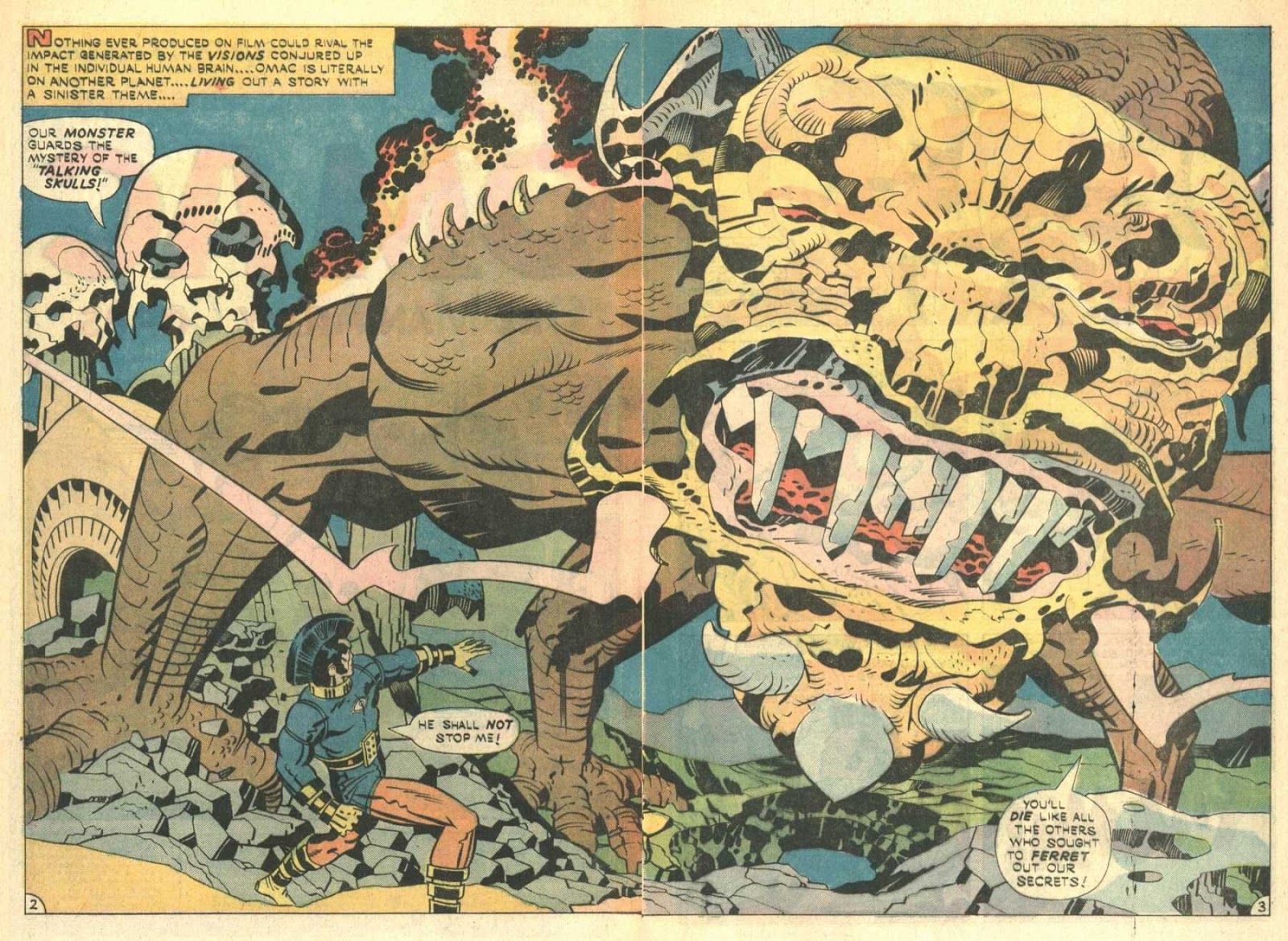
OMAC, like many Jack Kirby comics, is filled with high adventure, science fiction gadgets, explosion and incredibly energetic art. I actually feel bad that I’ve neglected to talk about his art on OMAC because it’s very, very good. It blows my mind that Kirby could produce such great art under such tight deadlines. Kirby regularly draws ugly faces and characters that have faces like those of a prehistoric humans but that’s his style and they’re meant to be ugly. OMAC’s got a normal face, so do many of the other characters (well, those who have faces, I’m talking about you GPA). I feel bad but I feel like I need to explore OMAC more in depth some other time. To try and make up for it, I’ve included several pages of art from OMAC that I’ve found online (I’m too lazy to scan some pages). What impressed me the most about this little comic is it’s depiction of the future in a way that was close to reality (or the reality that will someday exist) thing without being preachy. Kirby has managed to excite me and worry me about the days of tomorrow and that’s alright. It’s good to have action comics that provide food for thought and OMAC is a damn nutritious read.

OMAC walks on the bottom of a lake that was emptied by Dr. Skuba. That lake look so otherworldly.
Do you think it was pollution that mutated those fish and those plants?

Kirby loves to draw monsters. OMAC while "watching" a movie. 
Crazy satellite science! I completely forgot to mention that Kirby predicts are heavy use and dependence on
satellites orbiting the Earth in our daily lives. Sure, it doesn't transform us all into OMACs but
it helps me navigate the city using my GPS. Crazy stuff but remarkably on point.