Showing posts with label Jack Kirby. Show all posts

Wednesday, 20 November 2013

Miscellaneous reviews 03


Dr. Slump volume 9 by Akira Toriyama:
Akira Toriyama’s first weekly manga series, Dr. Slump, is an excellent read. It’s one of the funniest things I’ve ever read. Toriyama has a combination of intelligent, crass and simply stupid jokes. Each chapter is a barrage of various different types of jokes that incessantly pummel the reader. It all sound violent but trust me, it’s an excellent read. Arale is one of the cutest robots in the history of the medium.

I missed volume 9 when I was first buying the volume. I have most of the series and volume 9 was one of the two gaps I had in my collection. I was upset to have missed it because Dr. Senbei Norimaki and Ms. Midori Yamabuki get married. The weeding is followed by romping multi-part honeymoon. It was great to read about the wedding and honeymoon because I was wondering how the whole thing happened. Needless to say, Toriyama did not disappoint. I was a little weird to read one of the volumes at the half way mark because there was a surprising amount of differences from earlier stories. Someday I plan on writing a longer post about why this is one the most hilarious comics ever published. Each volume has special feature pages and this volume is no different. Half of the pages are slice of life type newspaper articles making fun of Toriyama. The rest are short, one page comics about the creation of some of the main characters. Dr. Slump is always an absolute joy to read I wouldn’t trust anybody who tells you they don’t enjoy it. They’re lying to you.


Babel-17 by Samuel R. Delany:
I really enjoyed Babel-17. It’s the first novel by Samuel R. Delany that I’ve ever read. I’ve been interested in reading some of his books as he sounds like a tremendous influence in the field of science fiction and fantasy. There were several of his novels at a used book store near home so I decided to pick up a few. I wasn’t sure where to start so I picked the book with the cover I enjoyed the most. It was a quick read but one that provided me with a few hours of enjoyment while reading and several more afterword. There is a lot to think about long after you put down the book.

The book deals with linguistic relativity (also known as the Sapir-Whorf hypothesis) or how language affects your understanding of the world. Some people believe that your ability to communicate something in directly linked to your understanding of it. Rydra Wong, a renowned poet, is asked to decode Babel-17, a code which is being used to orchestrate strategic military attacks. It turns out that Babel-17 is not a code but a highly advances language from the depth a space. As Rydra learns the language her perception and understanding of the world around her radically changes.

I read an interview in which Delany mentions how he discovered the Sapir-Whorf hypothesis a few years after writing Babel-17 which completely disproved the theory in his opinion. Delany thought of about linguistic relativity without being able to label it with specific words. I enjoyed Delany’s style. It was poetic and managed to starkly describe the world in which the characters exist while also portraying the beauty of things. There are also neat ideas about the future like the extensive use of “cosmetisurgery” that not only modify the appearance of individuals but can also give enhanced abilities. It’s also rather funny at times. I particularly enjoyed how one of the characters references James Bond as being a real person. I enjoyed Babel-17 and I understand why it’s regularly considered a classic science-fiction novel. I’ve not entirely made up my mind on Delany but I know for certain that I’ll be reading more of his books because I’ve rather enjoyed this one.


Jack Kirby’s Fourth World Omnibus volume 2:
Jack Kirby continues his opus in the second collection of all the Fourth World stories, Superman’s Pal: Jimmy Olsen, Forever People, New Gods and Mister Miracle. I think it’s great that the titles are organized chronologically in theses collections. It’s not all great though because there is a downside. Walter Simonson mentions the incredible momentum that Kirby was building with four titles coming out on bi-monthly schedules. I don’t see it. I don’t feel it, either. Most of these title have a momentum building up within their own pages but skipping from one title to another nullifies that feeling of momentum and growth in the story. It’s as if the story is too big and it’s taking an unnecessarily long time to really get going. I guess what I’m trying to say is that the omnibus collection and therefore the entire Fourth World saga feels unfocussed and unnecessarily bloated.

Two volumes in and I find it very difficult to enjoy any of the Jimmy Olsen issues. Unless something happens in that title in later volumes, I think it could have been completely cut out from the Fourth World story. I wish I didn’t have to say that, but it’s true. But, for every issue of Jimmy Olsen I get one issue New Gods and another of Mister Miracle which are just superb. I absolutely adore both of those two titles. Kirby’s crazy ideas are at their finest in those two titles and his art is spectacular. Mister Miracle because much more interesting than it was in the first volume with the introduction of Big Barda, it’s hard to believe, I know, but she’s a great character. Forever People also continues to be good. It’s much better than Jimmy Olsen but there is something holding it back from being as good as New Gods or Mister Miracle. Either way, these are great comics from the 70s and I’ll definitively enjoy revisiting this once I’m done the series. I might end up skimming through the Jimmy Olsen issues though. Especially those Don Rickles co-star issues.

Wednesday, 13 November 2013

Miscellaneous reviews 02


Jack Kirby’s Fourth World Omnibus volume 1

Jack Kirby is great. I don’t love everything he does but when it comes to dynamic art, he takes the cake. The Fourth World is probably his masterpiece and these handy omnibus volumes give me a chance to read it for the first time. Best of all, the whole thing is in chronological order which is a big deal for me as I find that’s the best way to read any series of books or comics. The Fourth World is a story told with fourth by monthly titles, Superman’s Pal: Jimmy Olsen, New Gods, Mister Miracle and Forever People. Unfortunately, not all of the titles are as worthwhile as the others. Jimmy Olsen, despite being filled with excellent ideas, interesting settings and some oddball characters, just doesn’t work for me. It’s not very good.

Thankfully the rest of the titles are better, Mister Miracle is my favourite in this first volume. The journey from Scott Free to Mister Miracle is a joy to experience. I love every single escape act that happen in the first three issues. New Gods is also an excellent title. It’s Jack Kirby at his most mythic and grandiose. I don’t think these stories would work in any other medium and Kirby proves that time and time again by filling his comics with big ideas, page after page. It allows for a quick, and fascinating, read for those who like to read their comics that way. The real strength of these comics though is that the big ideas also coalesce into a larger narrative in a satisfying way. There is plenty here to make the more pensive readers stop and reflect at the wonders of the Fourth World.  

Secret Avengers: Run the Mission, Don’t get Seen, Save the World by Warren Ellis
Warren Ellis is one of the best writers when it comes to single issue stories. Particularly when it comes to writing single issue stories that also built a larger narrative while also providing the reader with interesting character interactions. He’s done several series that shy away from excessively long and decompressed multi-issue story arcs such as Fell, Global Frequency and Planetary are just a few examples. Even some of his longer series had shorter story arcs. The Authority and Nextwave: Agents of H.A.T.E. are built on a three issues arc structure. Transmetropolitan was built on a combination of three issue arcs followed by three single issue stories. That particular series lasted for 60 issues and it’s the most representative of Ellis’s style and content out of his entire body of work.

With Secret Avengers: Run the Mission, Don’t get Seen, Save the World, Ellis tells stories similar in concept and execution of the stories in Global Frequency but with a superhero twist. The trade paperback contains six stories that mix together the super spy and science fiction genres together into an effective mix (super spy stories often come with a nice helping of science fiction anyway). Each issue is drawn by a different artist starting with Jamie McKelvie and continuing (in order) with Kev Walker, David Aja, Michael Lark, Alex Maleev and Stuart Immonen. It’s interesting to see how Ellis seems to write a story that will suit the artist he’s working with. The use of a different artist with each new issue makes this series seems even more like a superhero version of Global Frequency which is a good thing because it’s one of my favourite Warren Ellis series. I don’t think Secret Avengers is as good a collection because we’re so used to seeing these characters do extraordinary things that it’s difficult to put them in interesting and original situations and have the story begin and end in 22 pages. Ellis and the rotating team of artists do an excellent job telling engaging stories with overly familiar characters and that’s an impressive feat in the climate of today’s comic book industry. The fact that most of the stories deal with moral dilemmas of various kinds is just the icing on top of the cake, proving once again that Ellis, even while doing work-for-hire work on superhero titles, is a master of the genre.

Doctor Strange and Doctor Doom: Triumph and Torment
I’ve never really been a big fan of Doctor Strange. Not because I dislike the character but because I’ve never really read one of his solo stories until Doctor Strange: The Oath. Before that I’ve only ever read stories with Doctor Strange in them as a guest star or as a supporting character. Doctor Strange and Doctor Doom: Triumph and Torment is written by long time Doctor Strange writer, Roger Stern. It’s drawn by Mike Mignola and inked and coloured by Mark Badger. It’s also the best Doctor Strange story I’ve ever read (ok, I know this isn’t saying much considering the beginning of this paragraph). Once every year, Doctor Doom travels to hell and fights for his mother’s soul. Each year his battle ends in a stalemate. Triumph and Torment tells the story of the latest attempt by Doom to win back his mother’s soul. Doom, through an interesting series of events I won’t spoil here, is able to join forces with a reluctant Doctor Strange and once again challenges Mephisto in his domain.

Despite being more of a Doctor Doom story, Triumph and Torment is an excellent comic through and through. There is a theatricality to the comic that elevates it to the status of modern classic. Stern’s moving and often philosophical story also helps with this. The biggest highlight though is the artwork. I wish comics had art like that nowadays. The line work by Mike Mignola is very different to his work on Hellboy. I think the primary cause for the difference in art this early on in Mignola’s career is Mark Badger’s contribution as inker. The colouring, also by Badger, is simply beautiful. It adds so much depth to the comic that I doubt it would work as well without it. I love everything about this story. IT’s so rare to see a creative team firing on all cylinders while also having their individual contributions coalesce into a single work, a single vision.  

Despite being more of a Doctor Doom story, Doctor Strange and Doctor Doom: Triumph and Torment, is an excellent comic through and through. I’ve read this comic twice since its release and I plan on doing so again sometime soon because there is so much to love. It’s also convinced me to track down some more Doctor Strange comics. Luckily for me, this collection also includes three more Doctor Strange stories form the 1970s and 1980s which provide additional context to the main story after which this collection is named.

Monday, 15 July 2013

OMAC by Jack Kirby review

Jack Kirby sure loves his flying chairs.

I had to learn how to like Jack Kirby as a creator. In a medium where he’s quite realistically dominated for several decades, its understandable why he’s known as Jack “The King” Kirby in comics circle. The sheer volume of output he’s had since he started making comics in the forties and the impressive versatility of genre he’s worked in. He’s also the co-creator of a significant portion of the Marvel Universe but despite all these accomplishments, Kirby’s had the short end of the stick for most of his career which also corresponds to most of his life. I get rather bitter when I consider the success of people who worked with Kirby throughout the years compare to the wealth and fame he’s accumulated. It all just seems unfair. I think that’s one of the reasons I gave him a second chance and that’s why I continue to explore his work. 

This is my second time reading OMAC and although I really liked it during my first reading I absolutely loved it the second time around. The same goes for the introduction by Mark Evanier. In his introduction, Evanier points out how OMAC is almost prophetic in its story about the future. He’s had a chance to read all eight issues every few years since it was first published and he’s personally noted just how closely Kirby got it right on so many different aspects of what our future would be like. I didn’t really see the same thing while reading OMAC for the first time. The world OMAC inhabits is so drastically different from our own. There’s one important thing I’ve learn about Kirby though. His ideas are really big ideas. He doesn’t think in small scale. When he chose the future as the setting of his new comic, he chose the far, far flung future. Not something that was going to happen in twenty or thirty years. But you know what? Mark Evanier was right. The prophetic quality of these OMAC issues is utterly impressive it not always accurate.

Jack Kirby created OMAC to fill his weekly quota of pages for DC Comics. According to Evanier’s introduction (and that’s a pretty good source since Evanier has worked closely with Kirby for many years and has even written a biography of the man) he mentions that Kirby was contracted to put out fifteen pages of comics per week. That’s insane! And you know what? Kirby did so by creating insane comics. OMAC lasted eight issues after which it was cancelled. I’m not so sure why but OMAC’s definitively endured as a comic. John Byrne did a four issue limited series on it. Paul Pope had an OMAC story in his issue of Solo. OMAC was even one of the New 52 titles from DC’s reboot of a little while back (unfortunately only lasting eight issues as well). It’s survive and rightfully so. OMAC is perhaps my second favourite of all of Kirby’s comics that I’ve had a pleasure of reading.

Those fish of the future look
like fish form the past!
In short, OMAC is the story of a man who undergoes long range molecular surgery to transform his being into a One Man Army Corp unbeknownst to himself. Buddy Blank doesn’t coexist with OMAC; one replaces the other. OMAC was created by the Global Peace Agency (GPA) an international organization that works in complete anonymity (they are nameless and faceless; they can be from any nation and thus represent all nations). Members of the GPA don’t carry weapons and act entirely without harming others. They have created for that purpose. In the future world where large armies are outlawed, OMAC is there to fight on behave of the GPA and serve as some sort of futuristic cop. There is so much that can be written about just the first issue of OMAC but what I’m going to focus on is the portrayal of the future. That’s one of the things I found the most interesting about this short lived series.  

In the future that can be found in the pages of OMAC, large armies are outlawed, cities have continued to grow and have become immense. The rich have continued to get richer and some people are now so wealthy they can rent and entire city for 24 hours if they so wish (and they do). Movies have become virtual space video games that people experience instead of viewing in passivity. Computerized dating (did this even exist in the 70s? I have no idea where Kirby got this idea) has evolved into a way for people to construct their entire families. “Packaged Living” as it’s called is responsible for giving OMAC new parents, assigned to him by a computer! There are ecological terrorists; the most villainous of all being Dr. Skuba who uses his mastery of the atom to compress huge quantities of water from lakes into brick sized cubes. He plans to blackmail the world into making him stupidly wealthy. One of the creepiest ideas from OMAC and one of my favourites is that there is a black market for young attractive bodies. These people are kidnapped, induced into a comatose state and sold to rich individuals who would like younger bodies. It’s one of the darker takes on immortality that I’ve encountered. That all sounds crazy right? Well there are more ideas and snippets into our future that what I’ve presented and it all takes place in eight issues. The more impressive feat is that Kirby doesn’t make it seem to unrealistic. Well, I didn’t think so the second time I read it.
The villainous Dr. Skuba!

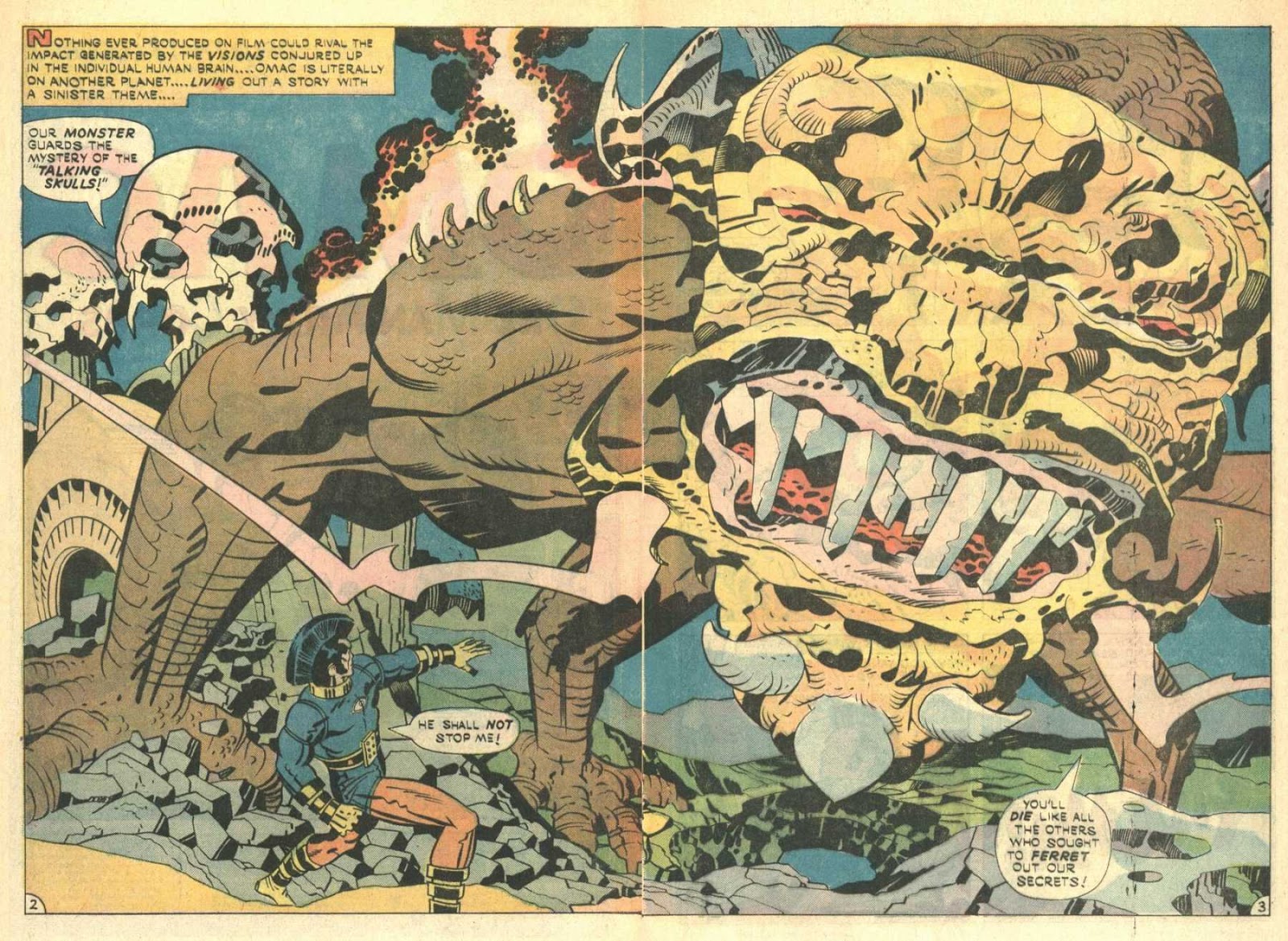
OMAC, like many Jack Kirby comics, is filled with high adventure, science fiction gadgets, explosion and incredibly energetic art. I actually feel bad that I’ve neglected to talk about his art on OMAC because it’s very, very good. It blows my mind that Kirby could produce such great art under such tight deadlines. Kirby regularly draws ugly faces and characters that have faces like those of a prehistoric humans but that’s his style and they’re meant to be ugly. OMAC’s got a normal face, so do many of the other characters (well, those who have faces, I’m talking about you GPA). I feel bad but I feel like I need to explore OMAC more in depth some other time. To try and make up for it, I’ve included several pages of art from OMAC that I’ve found online (I’m too lazy to scan some pages). What impressed me the most about this little comic is it’s depiction of the future in a way that was close to reality (or the reality that will someday exist) thing without being preachy. Kirby has managed to excite me and worry me about the days of tomorrow and that’s alright. It’s good to have action comics that provide food for thought and OMAC is a damn nutritious read.

OMAC walks on the bottom of a lake that was emptied by Dr. Skuba. That lake look so otherworldly.
Do you think it was pollution that mutated those fish and those plants?

Kirby loves to draw monsters. OMAC while "watching" a movie. 
Crazy satellite science! I completely forgot to mention that Kirby predicts are heavy use and dependence on
satellites orbiting the Earth in our daily lives. Sure, it doesn't transform us all into OMACs but
it helps me navigate the city using my GPS. Crazy stuff but remarkably on point.