I’ve been trying to figure out why my TBR pile has gone
out of control and I think there are multiple factors at play. For starters
I’ve always been a bit of a distracted reader. I’m always in the mood to read
more than I’m physically capable of reading at a given time. When I was young I
was able to read one series from start to finish but as the years went by and
I’ve discovered more writers, genres, and series I started to read a bit more
broadly. This resulted in my developing the habit of jumping around from series
to series. My living situation has also had an impact on this. I grew up in the
country and bookstores didn’t exist in my town. I could only find a Coles or
Chapters if we went out of town and into the city. The one we visited from time
to time was a good two hours away. When I would visit a bookstore I would buy
trilogies or series and I would stick to authors and series I knew for fear of
buying something I didn’t like.

Science fiction, fantasy, and comic book reviews and commentary. Regular updates once a week.
Sunday, 4 January 2015
Year of the Unread – An Introduction
Anybody who really enjoys reading has a reading list and
a to-be-read pile. It’s such a simple way to help you keep track of what you’d
like to read next that there are dozens upon dozens of online articles written
about to-be-read piles, not to mention forums where the topic is discussed.
I’ve got a TBR pile of my own and I think it’s quite huge. It’s made up of
books I own that I’ve never had the chance to read or took the time to read
after I bought them. I’ve come to the realization that I buy books faster than
I can read them. That’s always been the case but I’ve always been able to keep
my TBR pile respectably small. That’s no longer the case.

Wednesday, 31 December 2014
A Year in Review, Part Three – Best Comics and Novels of 2014

Prophet is an impressive comic. Its basic composition is clear for all to see
yet it combines words in pictures in ways that only the best comics can do. The
result is not only one of the best comics but also one of the best science
fiction stories I’ve read or watched this year. The third collected volume
dealt with the combination of the story’s two main storylines which also
happened to be the two opposing sides of a large conflict between various
species and factions. Prophet is an
excellent comic not just because of its interesting story. What really makes
this comic worthwhile is the storytelling. Brandon Graham, Simon Roy, and
Giannis Milonogiannis know how to craft an exciting and visually fresh
narrative. The continuation of this story was published in monthly single
issues but I have yet to see solicitations for the fourth trade paperback
volume. I really hope that I get to read the further adventures of all the John
Prophets as this comic book revival series has been a pleasant and engaging
surprise since the start.
I haven’t read
many science fiction novels this year. I’m not sure why because I seem to
continuously have an itch to read or watch science fiction but I often get
distracted by something else. That makes me sound like a bit of a liar or as
someone who’s exaggerating how much he’s been thinking of reading science
fiction but regular readers of SUR will have notices how scattered I am when it
comes to reading. There are just so many interesting books to read that I can
barely keep focused on finishing what I’ve already started. You’d think that
writing here would help with that but not nearly as much as I would like.
Saturday, 27 December 2014
A Year in Review, Part Two – Worst Comics and Novels of 2014
 Worst Science fiction novels
This should have
been a good book and that is one of the main reasons it disappointed me. The
idea of writing a Star Wars novel
that takes pale immediately after the end of Return of the Jedi is a good idea. What happens when the Rebellion
destroys the leader of the Empire? Apparently, you fuck off to the outskirts of
the galaxy and fight with space raptors and bicker in a public political
setting. Granted, the ideas here were good. Leia continues to own her part as
ambassador and her identity as the politically savvy member of the group. She
even gets to struggle with the idea that Vader was her father. Space Raptors
aren’t necessarily terrible per se and neither is the idea that Luke would fall
in love and find a pupil just a few hours after the end of the Episode VI. The
problem is that the execution of all those ideas fell flat and that’s that what
made this a bad book.
Runner-up: Star Trek: That Which Divides and Star Trek: The Weight of Worlds:
Again, these are
examples of books that have good ideas but fail to impress due to the authors’
inability to integrate the ideas in the narrative in a successful way. The
biggest problem with these books though is that it treats the cast of TOS as something untouchable. It’s as if
the writers are walking on eggshells the entire time because they can only use
what’s been established in canonical Star
Trek stories (such as the TV series and movies). No more, no less. That’s
certainly one of the difficulties of writing tie-in novels so I do not hold a
grudge against Dayton Ward and Greg Cox. I’m unaware if Ward and Cox are super
Trekkies that do not want to tarnish the image of the Enterprise crew or if there was heavy editorial intervention or a
combination of both. I don’t think having that knowledge would let me like
these books anymore. I found then to be boring and lacking the energy or even
the interesting premise of a lot of Star
Trek episodes. Overall, it felt as though these stories were of little
consequence. When you read a book like that you can’t help but think to
yourself what the point of it all is.
Wednesday, 24 December 2014
A Year in Review, Part One – Progress Report 2015
Here am I after
another successful year writing a blog. It’s been a good year and I’ve learned
a lot about what it takes to blog on a fix schedule. A lot of what I said in
last year’s end of year review posts applies to this year. I’ve got more
abandoned posts, I still have a secret project that my sister and I are working
on which we will be definitively uploading in 2015. Plenty of stuff happened at
SUR and I’m gearing up for plenty more good things to come for next year. Join
me as I take a look at this year’s posts.
The biggest
lesson I learned this year is that blogging at a rate of two posts per week
drains you. It’s a lot especially since I continue to read and review more
novels than I originally expected. I don’t know why it happens, it just does. I
don’t focus too much on what I’m reviewing or worry about keeping strict
balance or variety of mediums (comics, books, and movies or television).
Somehow I manage to keep a decent variety of reviews but novels at still a
pretty large focus. That’s unfortunate only because reading them is nearly
always more time consuming than reading comics or watching a movie. Aside from
that, there isn’t really a downside. It’s quite nice to have SUR there as an
excuse to read books I’ve been wanting to read for years but haven’t because I
was distracted by other things.
Sunday, 21 December 2014
The Blog Fantastic 032: Hogfather review

I’ve been
reading the Discworld novels one at a
time by publication order. I was going to read the sixth books, Wyrd Sisters but I thought it’d be fun
to skip ahead to book twenty, Hogfather
because it’s a Christmas book. There were a few problems with doing this
because skipping over a dozen books meant that I missed out on books two and
three of the Death series (Reaper Man and
Soul Music). The biggest problem with
that was not knowing who Susan Sto Helit is but you eventually find out while
reading this book. She’s Death’s granddaughter. In the grand scheme of things
that’s pretty minor and so I’m pleased with my decision to squeeze in a festive
book in my reading list for the month.
I said this is a
Christmas book and it is but the holiday isn’t quite the same in Discworld. There, they call it Hogswatch
and it is celebrated on the last day of the year, December 32nd.
They have a Santa Clause like fellow who go around in his sleigh pull by four
boars (Gouger, Rooter, Tusker, and Snouter). He also goes down chimney ands to
give gifts to the good girls and boys. Instead of leaving our milk and cookies
he’s expected to find sherry and a meat pie. For the most part, he’s rather
similar but Santa Clause and Hogfather’s origins could are quite different but
I won’t say how because that would spoilt a big part of the book.
In many was Hogfather delivered what I’ve come to
expect from Terry Pratchett’s Discworld
novels. There was humour abound, much philosophizing and satirizing as well.
The structure of the story was different though. The book is made up of four
storylines that are all, at best, loosely connected at first. Those storyline
are:
1-The Guild of
Assassins is hired to murder Hogfather. In turn they hire the services of Mr.
Teatime (pronounced the-ah-tim-eh) to do the deed. He accomplishes it
successfully in the very beginning of the book but how he did it isn’t revealed
until the end of the book. It’s the mystery that ties the other storylines
together.
2-Susan Sto
Helit , granddaughter of Death and governess to two children (in a very Merry
Poppins way but funnier), is trying to find out what happened to Hogfather.
Along the way she is aided by the Death of Rats, a rude raven, and the “Oh God”
of Hangovers.
3-In Unseen
University, the school of wizards, Archchancellor Ridcully is trying to find
out why so many new gods (or anthropomorphic personifications), such as the
Verruca Gnome, the Hair Loss Fairy and others,
are sprouting up all over.
4-Since the
Hogfather is dead, Death has taken his place in order to fill the void. His
main goal is to restore believe in Hogfather in order to bring him back.
As the story
progresses some of the storylines cross path and they eventually all crash
together for a big finish. It’s probably one of the most satisfying conclusions
for a Discworld novel that I’ve read
so far. The entire book might be the best so far, actually. While we know who
hired the Guild of Assassins we do not know why until the very end. When we do
learn why it’s a thematic punch to the face as Pratchett delivers and
incredible amount of big ideas that are tied to humanity’s very existence and
thriving nature on Discworld which echoes are own existence in the real world in
a rather stirring way.

I won’t spoil it
here but Pratchett deals with the notion of why believing in fantasies such as
Hogfather or the Tooth Fairy prepares us for believing some of the larger ideas
of the universe. It’s form of mental exercise, basically. Stories and fantasies
also act as a way for us to explain the world around us when we’re unable to
explain it any other way. Learning and understanding how the stories and
fantasies evolve throughout the ages also helps to better understand ourselves.
Hogfather delivers on some of the great elements of all Discworld novels. Pratchett has populated his world with dozens of
interesting characters. Best of all he knows how to make them interact in ways
that feel real but are also zany, completely unusual, and delightfully
entertaining. That’s not to mention how witty he is with his narration. Hogfather provides additional proof (as
if any was needed) that Pratchett is the king of satire. His observations are
accurate and they betray his wise and uncompromising understanding of people
and the world we live in. They’re also hilarious as anything you’re likely to
come by. The best of all, his humour isn’t one-note. His mastery of all things
gut-busting can be found on every single page and it appears in the form that
is best suited to the particular scene being told. It includes situational
comedy, wordplay, witticism, clever dialogue, comedy of manners, gallows
humour, philosophical jokes, etc. You name it and he’s done it. Even multiple
times and millions of fans around the world have enjoyed it. You’d be hard
pressed to find a better book to give to a book loving friend in order to pass
along some holiday cheer. Happy Hogswatch!
Wednesday, 17 December 2014
Star Trek: The Newspaper Comics vol. 1, 1971-1981 review
 Did you know there once was a Star Trek newspaper comic? It’s true. Around the time of the
release of Star Trek: The Motion Picture
Paramount launched a daily newspaper comic chronicling the further adventures
of the Enterprise and her crew. The
daily strip was set during the timeline of the movie, rather than being set
during the time of the original television show’s run. It’s very likely that
this was done in order to make the daily strips more marketable and relatable
to late 70s and early 80s Star Trek
audiences. Having launched at the very end of the 70s and just a few days
before the release of The Motion Picture
it made sense that the comic strip would tell new stories of Captain Kirk,
Spock and McCoy.
Did you know there once was a Star Trek newspaper comic? It’s true. Around the time of the
release of Star Trek: The Motion Picture
Paramount launched a daily newspaper comic chronicling the further adventures
of the Enterprise and her crew. The
daily strip was set during the timeline of the movie, rather than being set
during the time of the original television show’s run. It’s very likely that
this was done in order to make the daily strips more marketable and relatable
to late 70s and early 80s Star Trek
audiences. Having launched at the very end of the 70s and just a few days
before the release of The Motion Picture
it made sense that the comic strip would tell new stories of Captain Kirk,
Spock and McCoy.
This volume collects the first half of the US strip
produced by Los Angeles Times Mirror Syndicate. There was also a UK strip which
remains uncollected to this day but Rich Handley, who wrote the introduction to
this volume, has collected the US and UK strips. He’s responsible for initially
bringing this project to Dean Mullaney, the editor of IDW's The Library of
American Comics imprint, which resulted in the two volume collection of the
entire US newspaper comic. Handley is looking to have the UK strip collected as
well but it’s unclear if this is a project that Mullaney and IDW are actively
working on.
The Star Trek
comics strip debuted on December 2, 1979, just a few days before the release of
Star Trek: The Motion Picture. It did
not have a long life as it ended on October 25th, 1981. There are
two primary reasons for the short lived existence of the strip. The first is
that the young Star Trek newspaper
comic had to compete with classic series such as Buck Rogers and Flash Gordon
which had both been in print for decades. There was also a newer rival as Star Wars was also being distributed as
a comic strip. There was simply not enough of a fan base to allow for all those
various titles to survive in the newspaper landscape. The second reason is that
Star Trek received rather poor
circulation in newspapers in the US.
 |
| There are lots of picture in this post and I have to apologize for the quality of the images. I didn't want to damage the book on the scanner. I'm starting with this picture because it's a simple image that is well executed. I like it. |
The upside, of course, is that a publisher has finally
collected the strip in its entirety and reproduced it for a new generation of
fans. Using Handley’s private collection as well as many others that IDW could
get access to (purchased and borrowed), the publisher was able to put together
yet another stellar collection as part of their The Library of American Comics
imprint. They’ve done a very successful job putting together many collections
of classic and influential comic strips and while I’m not entirely certain that
Star Trek: The Newspaper Comic
deserted such a prestigious reproduction it’s nice to know that IDW continues
to produce some of the best archival comic book collections.
 |
| Artist Ron Harris adding some dynamic action in a Sunday page. |
I recently sat down and read the first volume and I had
good time but it was also a very frustrating read, mainly because of the nature
of Star Trek stories and the format
of daily newspaper strips. In short, I just don’t think that Star Trek lends itself well to the
format. While my overall impression is a negative one there were still some
rather impressive illustrations by writer/artist Thomas Warkentin. His drawings
were, hands down, some of the best things about this book and it’s unfortunate
that some strips simply look better than others because of how well they were
able to be reproduced. It reminds you that this truly is an archival project
and for that element alone I like this book. Yet none of that really matters if
you’re looking at the quality of what’s being reproduced and that’s where even
Warkentin, who is without a doubt the best writer and artist of the strip as
far as this collection goes, fails to deliver a completely satisfying set of
stories.
 |
| The first sample of many terrible alien designs to come. Those things like kind of look like scarves? Arms. |
 |
| This is a closer look at their faces. They're essentially big, cartoony eyes with what appear to be a series of neck flats for mouthes. Just nasty and boring. |
He certainly has a knack for writing dialogue that feels
true to the character and harkens back to the actors’ performance on the
original television series. Unfortunately, convincing dialogue and to-the-point
storytelling, even when well done, it’s enough to carry the book. The main
problem is the format of the newspaper strip. The structure of the comic strip
is very simple. Monday through Saturday saw the single strip which is often made
up of about three panels. Sundays consisted of a full page in colour. The
problem is that three panels a day just isn’t enough to make for a satisfying Star Trek story. It has a choppy rhythm
that is ultimately disruptive and breaks any momentum that the creative team
can possible build in three-panel doses. The longer Sunday strips are good for
building momentum but they’re undermined every Monday by a three-panel recap
strip to reintroduce readers who don’t read the Sunday paper back into the
story.
 |
| Another full page but this time it's with art by Warkentin and it's made up of daily strips. Notice how it's mostly made up of talking heads? Just riveting stuff. |
The comic strip brought with it the writing credits of
well-known writers and artists. The most famous contributor to the comic was
Larry Niven, famed science fiction writer and Gerry Conway, celebrated comic
book illustrator. Unfortunately I did not get to read any of the stories by
either of them as the first volume mostly collects the stories written and
illustrated by Thomas Warkentin, the first person to work on the comic strip.
He held the most reliable and sustained tenure on the title. He left after
completing eight complete stories from the first daily in 1979 to 1981 after
which he was followed by several other writers and artists. Based on the last
two stories that are feature in this collection Warkentin was likely
representative of the best stories the newspaper comic had to offer as the
stories that followed are of a lesser quality. A lot of that has to do with the
art though as Warkentin’s style was cleaner and more precise than that of the
artists who drew the last two stories in this volume.
 |
| This is the first half of one of the earlier Sunday pages. I just love the red suits with jet packs which Warkentin took from The Motion Picture. Great stuff from early on. |
That being said there could very well be nice surprises
in the second volume but I will probably not find out anytime soon. The
reproduction of the strip was expertly handled by IDW but that also results in
a high sticker price. The books, even when purchased at online bookstores, are
a little too expensive for my tastes. I enjoyed reading Star Trek: The Newspaper Comics but not enough to cough up the
money for the second volume. The biggest deal breaker here is the format of the
comic strip. It simply doesn’t work well enough to justify spending money on
the second volume. The newspaper comic format has such a bit impact on my
reading experience that I wasn’t able to read this book from cover to cover. It
took weeks to read in its entirety because I would sit down on weekends or
evenings and read one story at a time. The narrative flow was too erratic and
choppy that I wasn’t able to immerse myself in the stories being told, no
matter what a particular story was about or how much I enjoyed the art.
 |
| Here's another terrible alien design. These poor bastards don't even have eyes! |
It’s fitting that IDW gave this newspaper comic the
prestige treatment as they’ll most likely attract the attention of lifelong and
diehard fans of the franchise. The stories (their format, execution and
reproduction, and price) are not for the occasional fan of the movies or some
of the television series. The comic
strip will likely only be loved by those who have watched and rewatched all the
movies and (at least) all of TOS. A
lot of what makes Star Trek enjoyable,
including the enhanced visual effects of the movies (in comparison to the
television series) and the soundtracks, are obviously not part of the reading
experience but it’s also missing the momentum and the Act structure of the
episodes. For the most part this is a “talking
heads” comic and while that’s pretty true to the TOS episodes at least on the TV series you could see the characters
inhabit the fantastic setting of the Enterprise’s
bridge. The TOS movies were able to
expand on the visions of the original series and it’s unfortunate that the
strip, intended to attract the same audiences as the new movie, doesn’t have
any of the gravitas of its theatrical counterpart. Likewise, the format itself
presents a clear disadvantage to readers compared to other available Star Trek reading material at the
before, during and after the original publication of the newspaper comic. I’m
thinking primarily of other comics by Gold Key and Marvel Comics but paperback
novels were also widely available at the time. I’ve read Star Trek in all three of those formats and the comic strip is the
clear loser in nearly all categories.

Before buying this comic you must ask yourself how big of
a Star Trek fan you are. Not in order
to brag about it or to compare yourself to other fans (doing that will only
prove that you’re an asshole) but in order to determine just how likely you are
to enjoy this collection of newspaper comics.
 |
| Mushroom head aliens? Yes. Only in Star Trek, unfortunately. |
 |
| Mudd cameo. It's difficult not to love these panels. |
 |
| I'll end it here with a great illustration of the Enterprise by Warkentin. |
Sunday, 14 December 2014
Superman for All Seasons review

Jeph Loeb and Tim
Sale have done a lot of work together. I’ve had the pleasure of reading a lot
of their collaborations (though not all) and I’ve enjoyed them to varying
degrees. The more recent book of theirs that I’ve read is Superman for All Seasons and I really like it.
I was expecting
something similar to what he did at Marvel with their origins stories for Daredevil and Hulk. That’s not exactly it. It’s also different
form their work on Batman which focuses, more or less, on telling mysteries set
Gotham that used many of the main cast of characters from Batman stories. Superman for All Seasons begins with
Clark Kent’s late adolescence and tells the story of his first few years as
Superman. It’s not an origin story, not really. Nobody even mentions Krypton.
It’s more of a story about Superman
than a Superman story. I’ll do my best to explain that but let’s backtrack a
little.
I’m not a huge
fan of origin stories but hey are necessary to have for characters that live in
a serialized medium like comic books. Knowing a character’s backstory, their
very beginnings, helps to define a character. It gives them motivation and it
helps the reader better understand why a character does what they do. The
problem I have with origin stories is that some people feel it’s important to retell
them over and over again. Reimagined origins or retelling with the purpose of
focusing on a specific aspect of the character that was at best loosely defined
before or at worst tacked on to the character later on in order to modernize
them or make them more accessible to a new generation of readers. Personally I
think it’s annoying as hell to have new original stories for some of the most
popular superhero characters every few years. Batman and Superman have probably
had more versions told of their origin stories than any other superhero
characters.
I haven’t read Superman for All Seasons until now
because I thought it was going to be another original story. I gave in because
I felt like reading a Superman story and I hadn’t read this one yet but mostly
I picked it up because of Tim Sale’s art which I really like. I like the way he
draws Clark Kent and Superman. He convincingly makes them look like different
individuals without giving them different body shapes or giving one different
physical attributes than the other. His Clark Kent is wide and solid looking.
He’s big but Sale gives him delicate features which makes him boyishly handsome
while also giving him an air of friendliness and approachability. He
convincingly illustrates the alter egos of Clark and Superman. Clark wears
clothing that is a little loose which retains his bulky look without giving him
muscular definition. His glasses accentuate his innocence and friendliness.
When he’s Superman, his costume is tight, which serves well to show off his
muscles which immediately gives him a strong presence. Without his glasses his
eyes are drawn to be very squinty but it’s done in a way as to make him more
threatening. This doesn’t always work because his features are still drawn
rather small for the size of his body, particularly his face, but in doing so
Sale maintains an air of approachability while also giving him a bit more
menace (he’s a crime fighter after all).

Sale didn’t
disappoint with his work on this book. It helps that Bjarne Hansen did a
wonderful job with the colouring. The entire book is given a classy painterly
look. The colour palette is nuanced and soft but it does so without becoming
lifeless, stiff or muddy. Sale’s art is usually very clear, even when he uses a
lot of black shapes. With Superman, compared to his Batman work, there are very
few pages with heavy inks. Instead there are clear lines, well defined shapes
but it’s Hansen that gives the art its depth. He grounds the characters into
the background and he helps to sell the double-page spreads throughout the book
of which there are many. One of the tricks Hansen did in the comic that I like
was using slightly flatter colours for the superheroic elements of the story,
like Superman’s costume or Lex Luthor’s robots. The bright colours contrast
with the painted colours used throughout the book and the effect is to make all
the superhero stuff leap off the page. It’s quite a pleasant and effective
colouring technique.
While the art was
good, even better than I was expecting, partly because of Hansen’s colouring,
the story is what made this comic so damn good. I previously said that this
comic isn’t a Superman story, it’s a story specifically about him and that’s
the great idea that gives the comic its thematic weight and separates it from
so many other Superman comics.

People say that
Superman is different from other super heroes because his “real” identity is
that of his super-powered identity, not his human identity. I think that
depends on who is writing Superman. Some people say there are two types of
Superman stories: those that focus on the man and those that focus on the
super. I would say that this particular story focuses on the man. In writing Superman for All Seasons Loeb focuses on
the man, specifically he focuses on the idea that Clark Kent becomes the hero
of Metropolis because of the nurturing and care given to him by Jonathan and
Martha Kent who found him in a rocket ship when he was still a baby. With this
comic, Loeb argues that its nurture, not nature, that helped shaped Clark into
a heroic figure. By doing so, he’s also clearly establishing his Superman story
as one of those that focuses specifically with the man.
As you might have
guessed from the title, Superman for All
Seasons is divided into four chapters, each one dealing with a particular
season. Each chapter is also narrated by an individual close to either Clark or
Superman. The narrators and chapter pairings are: Spring/Jonathan Kent,
Fall/Lois Lane, Summer/Lex Luthor and Winter/Lana Lang. The Spring and Winter
chapters focus on Clark and how the emergence of his superpowers have affected
him and the people from Smallville that are closest to him. The Summer and Fall
chapters focus on the Superman identity and how it has affected the city of
Metropolis and some of its key individuals. I think that the Spring and Winter
chapters are the highlights of this book as Loeb succeeds to make Clark’s
fantastic emotional turmoil relatable and believable.

Loeb makes his
themes and his approach to Superman’s story quite clear in the first issue. In
a scene beginning with Clark and Lana are walking around in Smallville the
narration by Pa Kent reads:
Sometimes, when the corn was planted, it shot up to soon. / The roots
hadn’t taken hold, so the stalk couldn’t support its own weight. / The corn
would turn sour. / I don’t know if Clark knew how lucky he was growing up in a
place like Smallville.
The narrator is
comparing a stalk of corn to Clark. Being raised in a small town like
Smallville has given Clark the time to set down roots and to become morally
grounded. Doing so will make him stronger later in life after he’s “shot up”.
The analogy here is likely making reference to moral roots, being raised in a
small town has given Clark a specific perspective on life. It’s immaterial and
doesn’t focus on financial wealth. Instead, it focuses on family, being kind to
others, and finding happiness in small comforts. There is also a link with
Clark’s emotional maturity and the development of his powers. It’s telling that
his superpowers emerge at the end of his teenage years. By that time in his
life he’s already learned the lessons that will guide him in using his power in
a responsible way. Certainly there is a learning curve but for the most part
the foundation was strong and so he eventually learns how far he will go in
using his powers.
Another clue as
to what this narration can means can be found in Sale’s dedication in the trade
paperback. “For Norman Rockwell and his love of a vision of Americana that
resonates through its limitations” Many of Rockwell famous paintings and
illustrations highlight a simple way of life. His work is underpinned by core
American values which were often sentimental and idealistic. He offered a
vision of America that was simple yet complex, evocative, and thoughtful.

While it’s not
stated in the text as a part of this story, I also like to think of limitations
as being an integral part of Superman. As a being that is so incredibly
powerful he’s constantly a danger to normal people around him. Losing his
temper could accidentally result in large scale destruction and potentially
thousands of deaths. How does he interact with the rest of humanity when he’s
Clark Kent? In order to function normally he has to suppress his impressive
gifts. Many of Superman’s limitations are self-imposed. Limitations in the use
of his power, both in what he is willing to do with them and in how much
strength he uses in everyday situations. He does this in order to prevent himself
from abusing his powers and hurting others.
This brings us back
to his Clark Kent identity and the idea that Superman is his “true” identity. I
completely disagree with this idea of a “true” identity. Superman is a complex
character and you could argue that Clark Kent has existed far longer than
Superman. Superman is a construct of Clark’s that allows him to use his powers
while maintaining a life in which he can, as Clark, live like a man. This is
another form of self-imposed limitation because it shows that Clark is not
willing to fully embrace, on a permanent basis, the identity of Superman. He
wants to maintain his connection to humanity and the best way to do that is to
continue being part of humanity. Clark lives a human life in order to
continuously provide his Superman identity with moral and intellectual guidance.

Loeb and Sale wanted to write a Superman story that lent itself well to
large panels, many double-page spreads. They certainly succeed at that. The
large panels and the overall decompressed aspect of the writing and the art
really help to give this story resonance. Superman
for All Seasons is a contemplative work and by keeping the focus tightly on
Clark’s development into his new identity as the hero of Metropolis the creative team succeeds at giving their
book the thematic resonance they were attempting to achieve. I particularly
liked the use of narrators that gave an outsider’s point of view of Clark’s
struggle in cementing his identity as Superman.
Wednesday, 10 December 2014
Letters From Father Christmas review
 I discovered the works of J.R.R. Tolkien because of Peter
Jackson’s film adaptation of The Lord of
the Rings. For a little more than a decade, The Lord of the Rings and The
Hobbit were all needed from Tolkien. I knew there were other works floating
around, some related to the books I’d already read and some other mostly
unrelated works. In the last couple of years I’ve gathered some of those other
books. The first I read was The Children of Húrin which I thought was excellent. That was some time ago but
I’ve finally finished reading another book by Tolkien: Letters From Father Christmas.
I discovered the works of J.R.R. Tolkien because of Peter
Jackson’s film adaptation of The Lord of
the Rings. For a little more than a decade, The Lord of the Rings and The
Hobbit were all needed from Tolkien. I knew there were other works floating
around, some related to the books I’d already read and some other mostly
unrelated works. In the last couple of years I’ve gathered some of those other
books. The first I read was The Children of Húrin which I thought was excellent. That was some time ago but
I’ve finally finished reading another book by Tolkien: Letters From Father Christmas.
The book collects a familial tradition that Tolkien began
in 1920 when his eldest child, John, was but three years old. Every year the
children of Papa Tolkien would receive one letter (sometimes more) from Father
Christmas. They came in envelopes which were covered with little flourishes and
unusual postage stamps that looked like something you could only get in the
North Pole. Inside each envelope was a letter written is shaky handwriting that
also had plenty of flourishes. They were handwritten by Father Christmas himself!
He also drew pictures for the children on occasion and as the years went by his
letter would be accompanied by additional notes from the North Polar Bear
scribbled in the margins and later still, Ilbereth the Elf would write on
behalf of Father Christmas when he got particularly busy.
The letters vary a little in content based on the time of
year they were written. If in November, for example, Father Christmas mentions
how busy they’re getting up in the North Pole preparing for Christmas and he’ll
often conclude by asking the children to tell him what they’d like as gifts.
Otherwise, the letters tell of some of the activities going on in the North
Pole since the last letter that was written. This often deals with some of the
shenanigans the North Polar Bear has gotten into it (he’s well-meaning but very
clumsy), a quick mention of what Father Christmas and his friends have done in
the summer and how they’re preparing for Christmas day. A few letters focus on
the thievery of the Goblins or their invasions of the store rooms. They’re fun and rather precious reads when
you consider their real-world origins but ultimately reading them in quick
succession you can’t help but be very aware of the formulaic nature of each
letter. The content of many letters are so similar that it just feels
repetitive. The Goblin invasion I mention above is the biggest exception to
this formula.

Despite the letters’ shortcomings as a serial narrative, Letters From Father Christmas is a
wonderfully delightful book when you pull back from it and consider the
tradition Tolkien (secretly) had with his children under the guise of writing
letters from Father Christmas. That’s truly important because the letters are
lovingly crafted. Seeing the amount of work Tolkien put into his letters is
marvelous. His illustrations are colourful and fun but also quietly majestic at
times. The envelopes are decorated and the scripting in the letters is
stylized. Each and every person who writes in the letters (Father Christmas,
North Polar Bear and his cousins, and Ilbereth) all have their very own style
of writing. Father Christmas’s writing is shaky because he’s old, North Polar
Bear’s writing is very blocky and makes use of many straight lines since it’s
difficult for him to write with his paws (indeed, he does better when using the
pen with his mouth in later letters), and Ilbereth has a very spidery script
which reminds me of Elvish writing from The
Lord of the Rings. As if to strengthen that link Tolkien has Ilbereth write
in Elvish in one of the last letters.
What really makes Letters
From Father Christmas a good read are the letters themselves and their
presentation in the book. The production value of my edition is simply lovely.
Thick, glossy paper which helps to bring the various illustrations and
reproductions of the letters (and many of the envelopes those letter came in)
to life. That’s very important considering the amount of craft put into the
production of the letters, not just their content. It’s a hardcover volume
which is important because this is the kind of book readers will likely flip
through on a regular basis. Yet, it’s also a slim and rather compact hardcover,
somewhere between the size of a mass market paperback and a the trade paperback
(of not a novel, not of a comic book). It’s one of those rare book productions
that manage to be both sturdy and handsome while also being compact and easily
readable.

When I pull back from the book itself and think of the
idea of collection something very personal, something that used to only exist
for one particular family, my enthusiasm wanes a little. These are inherently private
letters, from a father to his children.
You could probably discuss about Tolkien’s intention for hours (did he
mean for the letters to ever be published?) but I think it’s a moot point
considering the book was released by his estate. The more I think about this
the more I think it doesn’t matter as much as I originally though. The letters
existed for many years but their future was uncertain. By collection and
publishing them the Tolkien Estate has ensured that a part of Tolkien will
continue to exist in the eye of the publish for as long as it remains in print
and a little while longer after that. I think I would mind less about my
intellectual heritage if it was published in such a nice way as Letters From Father Christmas.
One of the nicest thing about this book is that it has a
completely different appeal to me as a reader than the rest of Tolkien’s work
I’ve had the pleasure of reading. I’m not a Tolkien scholar or even an
exceptionally passionate admirer of his life and body of work. I rank him as
one of the most gifted and serious fantasy writers of the 20th
century but this is my first time reading a book by Tolkien the non-fantasy
writer. Don’t tell me that because there are goblins, bits of magic and that
Father Christmas is a potential pre-cursor for Gandalf that Letters From Father Christmas is and
should continue to be considered a work of the fantasy genre. You’re missing
the point. These letters weren’t written by Tolkien as a scholar or as a
fantasy novelist, they’re written by Tolkien as a father. They’re imbued with
so much love and joy that it’s impossible not to appreciate this book’s charm.
I’ve read letters and essays by Tolkien and they’ve often had a stuffy,
overly-serious tone so to read his Father Christmas letters addressed to his
children was a special treat because it added some much-needed lightness to the
man and his legacy.

I’m still a tiny bit bothered by the implications of publishing
something so personal, especially posthumously, but this isn’t the first time a
publication has been released after an author’s death and it likely won’t be
the last. Yet, I’m starting to think that if the Tolkien Estate made the
decision and his children were involved (they were, primarily Christopher
Tolkien) then I really shouldn’t let myself be bothered by it and simply enjoy
this wonderful gift from the life of J.R.R. Tolkien. Merry Christmas!
Sunday, 7 December 2014
Realism, Hope and Optimism in Warren Ellis’s Ocean: A Review
 Warren Ellis is the best writer of science fiction
stories in all of comics. There, I said it. I mean it too. His comics are
regularly intelligent and well-paced. He’s very skilled at taking big and
sometimes complicated ideas and simplifying them enough to make them easily
digestible. He manages to do this (exactly how, I don’t know) without dumbing
it down or changing the idea to fit the story he’s trying to tell. Instead, he
uses scientific ideas as the starting point for his stories and builds the rest
around it. His entire comic book writing career has dealt with scientific ideas
whether or not he’s writing a strictly science fictional story. This style of
writing is often paired with a large dose of realism all of which gives his
writing a very specific flair.
Warren Ellis is the best writer of science fiction
stories in all of comics. There, I said it. I mean it too. His comics are
regularly intelligent and well-paced. He’s very skilled at taking big and
sometimes complicated ideas and simplifying them enough to make them easily
digestible. He manages to do this (exactly how, I don’t know) without dumbing
it down or changing the idea to fit the story he’s trying to tell. Instead, he
uses scientific ideas as the starting point for his stories and builds the rest
around it. His entire comic book writing career has dealt with scientific ideas
whether or not he’s writing a strictly science fictional story. This style of
writing is often paired with a large dose of realism all of which gives his
writing a very specific flair.
In order to understand Ellis’s approach to writing
science I need to give a quick overview of two important movements in comic
books: revisionism and reconstructionism. The 1980s saw the emergence of
several highly regarded mature comic book works such as The Dark Knight Returns and Watchmen.
Their impact on the comic book industry was a nearly immediate attempt to
recapture the same feel of those comics but it was done so by creative teams
that lacked the crucial understanding of those influential works. Comic books
of the early 1990s were plagued with what is now known as the “grim ‘n’ gritty”
aesthetic. Writers and artists would try to emulate the harsh realisms and
brutality comics such as Watchmen
only to end up with senseless violent and poorly thought-out comics of their
own.
What made those critically acclaimed mid-to-late 1980s
comics so good was the use of realism in telling in storytelling. By adding
social, political and real-world physics to comics the revisionist movement was
born. This use of intelligent storytelling was often combined with experimental
narrative techniques. The Dark Knight
Returns used a 16-panel grid as the basis of every page while Watchmen did the same with a 9-panel
grid. Both works also considered the realistic implications of having
superheroes. In The Dark Knight Returns
this is mostly apparent in Frank Miller’s use of news media while in Watchmen Alan Moore took superheroes as
the foundation for his world building of an alternate America. Taking fanciful
ideas and treating them with the utmost seriousness and concern for
verisimilitude was one of the driving forces behind such revisionist works.
After the many failed attempts at recreating revisionist
comics a second movement was created with the release of Marvels by Kurt Busiek and Alex Ross in 1994. This movement, called
reconstructionism, had the intent of recapturing the wonder and awe of
superhero comics which used to inspire them as young readers. This wasn’t just
a return to form for superhero comics. Instead, it was a counter movement to
revisionism since it kept the intelligence of revisionist works while imbuing
them with a more hopeful tone. I must point out that revisionist works like Marvels and Busiek’s later series Astro City weren’t simply about having
fun with superhero comics. They had emotionally potent and often literary
stories to tell but they did not shy away from using highly fictitious elements
(superheroes and pseudo-science, primarily) in their stories. They were not
concerned with the often stark portrayal of reality that was often found in
revisionist comics.
You might be wondering what any of this has to do with
Warren Ellis. His comic book writing career began in 1990. By 1995 he wrote a
companion comic to Marvels called Ruins where he presented highly
revisionist and scientifically accurate (at least in theory, we do not have
real superheroes to provide any additional prove) depictions of various
super-powered beings in the Marvel Universe. He presented Invisible Woman as
being blind when using her invisibility powers since her eyes new longer
interact with light correctly (I apologize for being vague or inaccurate on
this point, it’s been a while since I read Ruins).
Wolverine is the victim of adamantium poisonings, the Hulk is essentially a
walking tumour, etc. Rising to fame as an important and skilled comics writer
during the nineties would result in Ellis’s entire career dealing with aspect
of both revisionism and reconstructionism in his work.
%2Bcover.jpg)
Warren Ellis used a realistic approach in his science
fiction writing which often brings him to deal with revisionist motifs. Yet,
Ellis is also quite capable of including reconstructionist ideals in his
stories, too. A lot of his superhero comics are characterized by his realistic approach
to science in his stories while also employing a sense of wonder and awe to the
science and his storytelling. A lot of that has to do with the tone of a specific
story. Ellis is as capable of writing a revisionist work at the same time that
he is writing something purely reconstructionist. He’s a an oddity amongst
comic book writers since he’s written series that combines the style and
content of both movements into under one title, with little or no narrative and
storytelling conflict. Planetary is probably
the best example of that.
Both these movement are tied to superhero comics (for the
most part) it’s difficult to apply them directly to his non-superhero work.
Most of his non-superhero work is science fiction and since a lot of superhero
comics are a sub-genre of science fiction you can see echoes of revisionism and
reconstructionism in his science fiction comics.
Warren Ellis deals with hard sciences and near future
science fiction. Some of the very first lines in his Wikipedia page say that he
“is well known for sociocultural commentary, both through his online presence
and through his writing, which covers transhumanist themes (most notably
nanotechnology, cryonics, mind transfer, and human enhancement).” Sometimes I
think his mind lives in the near future while he body occupies the same time
and space as the rest of us which allows him to write so convincingly and
intelligently about complex ideas that have their roots in the sciences (social,
technological and natural).
Those are some of the thoughts that float in my head each
time I read a comic by Ellis. This is what I had in the back of my head when I
recently reread Ocean, a single
volume science fiction story by Ellis with art by Chris Sprouse and Karl Story.
Ocean’s plot is
pretty straightforward. Set 100 years in the future, United Nations Weapons
Inspector Nathan Kane travels to a space station named Cold Harbor in rotation
around Europa, one of Jupiter’s moons. A significant yet highly secretive
discovery has been made in Europa’s ocean. A very large number of coffins are
submerged under the planet’s icy surface, along with weapons that are capable
of destroying planets. Kane’s been asked to investigate and, if need be, take
action to ensure they’re not put into use by individuals with nefarious goals.
It would have been a simple mission if the Doors corporation didn’t also have a
station in orbit to make things complicated, and highly dangerous, for Kane and
the scientists of Cold Harbor.
What makes Ocean
an engaging and worthwhile read isn’t the plot. That’s actually rather
run-of-the-mill. What’s truly wonderful is the tone which conveys a great sense
of respect for other cultures, humanity’s future and the scientific ideas that
Ellis is playing with. A big part of the tone is established by the clean and
very precise art of Chris Sprouse. He’s aided by regular contributor Karl Story
who handles the ink. Ellis’s distinct pacing allows Sprouse’s page layouts to
be very cinematic. He also gives the interiors of the space ships and space
stations are surprisingly open, almost breezy, feel.

The rest of the tone is the result of Ellis’s writing
choices. Consider his charactesr. Nathan Kane, the lead protagonist, is a black
man. Something we don’t often see in comics today, let alone ten years ago. Three
quarters of the crew at Cold Harbor’s crew are women, professionals in their
field of study. They’re skilled and intelligent but they’re also quirky
(without being stereotypical) and unique. All five main characters accept and
respect the people with whom they work. This isn’t the focus of the story but
it anchors it and gives the story weight and meaning. Ellis builds his story
starting with the science, continuing with characters and leading to the story.
That’s the formula to a lot of his work. He does this while celebrating a great
deal of positive things and without ever making it a sickly sweet read. We have
his English wit to thank for that, I’m sure as the dialogue is filled with
snark and sarcasm.
Ellis doesn’t shy away from showing you a potential
future where conglomerates have delved deeper into their invasions of our
individual rights and privacy for profit. He won’t hesitate to craft a story in
which humanity’s roots are discovered to be a long-dormant humanoid species
from the same solar system that lived to kill and destroy. In essence, he
doesn’t pull his punches. He will show you the worst of mankind in most of his
work but this is counter-balanced with his compulsion to show you the best of
mankind. He’s cautionary as well as being hopeful. It’s all incredibly
humanistic. Even the figurehead of the Doors corporation in Ocean is sympathetic in his own way.
He’s delusional, sadistic and hysterical, absolutely, but also a sad and
pitiful man that you’re made to understand is only trying to make the best of a
very, very situation.

It’s clear that there are some revisionist elements in Ocean, particularly the realism of the
technology of space flight. The science also includes the rather interesting
idea of guns designed to be safely used (for the shooter, not for the intended
target) in a space station or ship. The action piece in the last issue works
wonders with artificial gravity and atmospherics within the station. Despite
all of this, I would argue that Oceans
has more in common with reconstructionism because of the comic book’s overall
tone. It’s inherently optimistic. Certainly the Doors company is a frightful
look into our potential future but the organization is defeated by a small
group of five intelligent individuals. The comic remains hopeful and positive
in face of the clearly evil and equally realistic villains (one group of
villains acts more as an allegory of our past errors than as actual
murder-obsessed ancestors to humanity) of the book.
The book’s main theme is to supplant positive aspects of
humanity over negative ones. The Doors manager wants to harness the destructive
power of the alien technology for personal gain while the scientists want to
understand along with Kane who wants to understand it and make judgement on the
value or lack of value to humanity. The Doors corporation wants to continue
mistreating humans, even stripping individuals of autonomy in order to attain
higher profit margins while Kane wants to learn from the errors of our parents
and ancestors in order to build a better future for all. While Doors chooses
attempts to mean their goals by crushing individuals freedoms Kane succeeds in
his efforts by celebrating individual differences and unique abilities of the
individuals that surround him. That, ultimately, is what makes this a hopeful
story. Ellis shows a clear love and respect for science and both possibilities
of developing it (negative and positive) but he suggests that intelligent, educated
and determined individuals will find a way to overcome any negative aspects of
future scientific discoveries.
Ocean is one of
Ellis’s lesser works, that’s not really up for debate. Yet it’s still quite
satisfying because it fits so nicely within Ellis’s style as a writer and deals
with a fair amount of his pet themes. It’s not essentially reading for people
starting to discover his body of work but it does play a role in emphasising
the kind of writer Ellis is and the kind of comics he writes. It’s not just for
the Ellis completest but for any comic reader that enjoys comics that are made
up of equal part action and thought provoking storytelling.
Wednesday, 3 December 2014
Bumperhead by Gilbert Hernandez review
 Bumperhead is
the second original graphic novel that creator Gilbert “Beto” Hernandez has
done for Drawn and Quaterly, following last year’s Marble Season. Marble Season
was a semi-autobiographical story that dealt with the joys of childhood. In my review I described it as “love letter to the magical delights and misfortunes
of childhood”. Beto used his own experiences as a framework for the story and
with Bumperhead he set out to do the
same thing with his experiences as an adolescent. The result is a fascinating
story about a young man who was forever shaped by his adolescent years and the
life lessons that can be taken from his past experiences.
Bumperhead is
the second original graphic novel that creator Gilbert “Beto” Hernandez has
done for Drawn and Quaterly, following last year’s Marble Season. Marble Season
was a semi-autobiographical story that dealt with the joys of childhood. In my review I described it as “love letter to the magical delights and misfortunes
of childhood”. Beto used his own experiences as a framework for the story and
with Bumperhead he set out to do the
same thing with his experiences as an adolescent. The result is a fascinating
story about a young man who was forever shaped by his adolescent years and the
life lessons that can be taken from his past experiences.
The book feels similar to a few recent works by
Hernandez. Marble Season, of course,
because it focuses on a period in a person’s life and develops that into a
larger narrative. The other comic is the recent collection of Julio’s Day which tells of Julio’s
entire life, from birth to death. Bumperhead
combines these two narrative formats into a familiar yet different story of its
own. The book starts with Bobby, a young man who is teased for having a big
forehead, continues to spend a large portion of the book on his teenage and
young adult years to finally wrap it up with a few pages of Bobby in his golden
years to end with a strange and unconvincing declaration that he’s had a good
life.
Along the way, Hernandez deals with several issues. The
first is the passivity of youth and how that can shape a sad, isolated and
depressing adulthood. Bobby doesn’t seem interesting in committing to anything
one thing in particular. He loves music, he loves girls, he likes hanging out
with his friend and taking part in recreational drinking and drug use but he
doesn’t have any ambition. He does all of these things but a particularly
attractive girl or an excellent record are enough to make him change interests.
When discussing his future with a girlfriend, Bobby mentions he doesn’t have
any interests in going to college. He’s simply happy to be done with high
school and he’s ready for whatever will happen next. What he doesn’t understand
is that by choosing not to pursue any in particular nothing worthwhile will
ever cross his path.
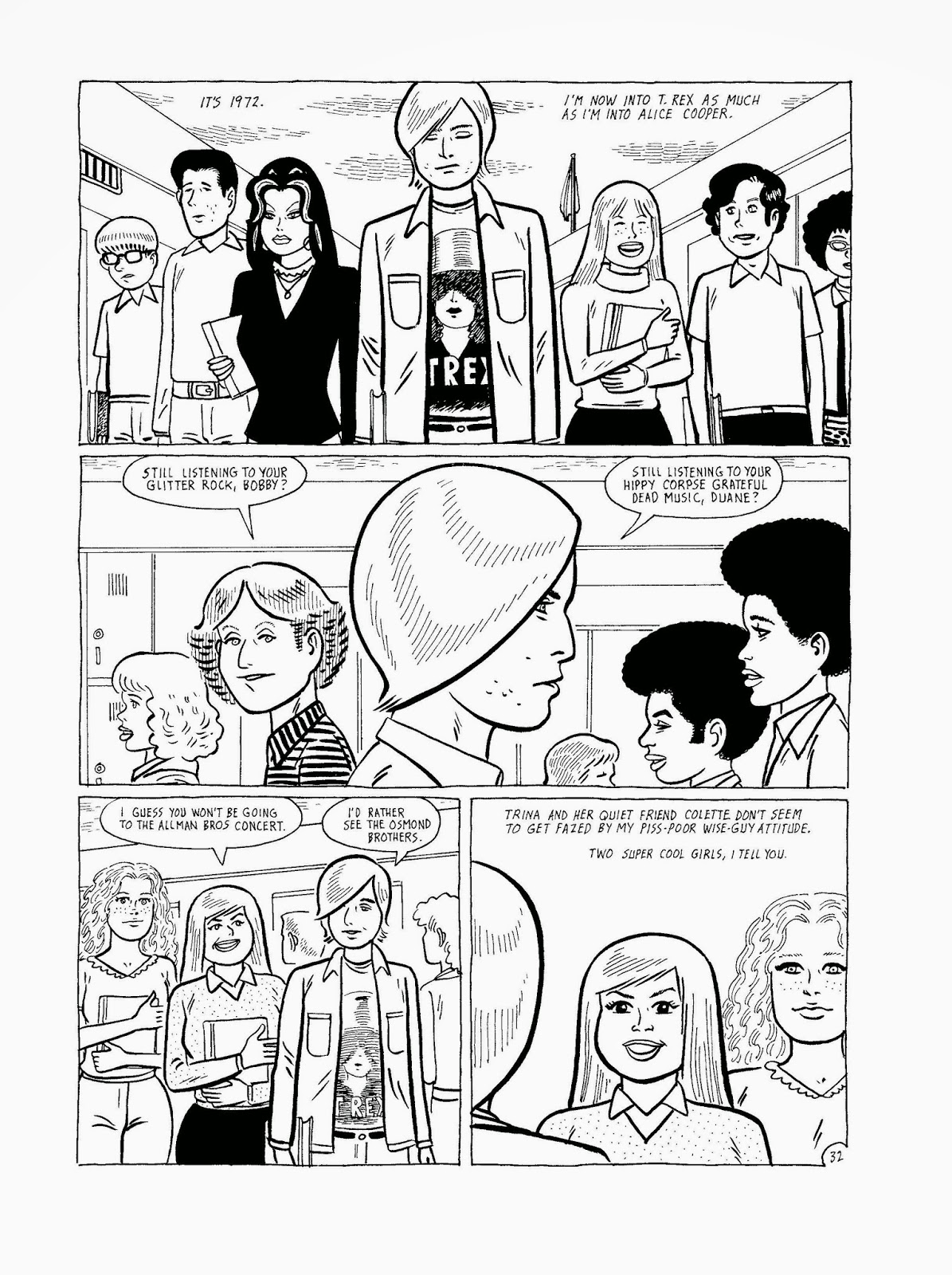
It’s not surprise that he ends up working a job he hates
and living alone. That is, until he discovers the punk movement and decides to
get angry. He uses this anger to create a new lifestyle for himself but it’s
hollow. It has no meaning for him. People get angry for all sorts of reasons
and we often try to maintain the anger for extended periods of time. So long
that we often forget what initially caused us to be angry. Bumperhead deals with this
theme and we see Bobby deal with his anger in different ways throughout his
life only to have it end with the recognition that it’s often not worth holding
on to our anger as it’s a self-destructive emotion.
Bumperhead also
proves to be an interesting remuneration as to how the smallest things from our
past (regrets, thoughts, actions, feelings) can and often do haunt us for the
rest of our lives. It’s a neat look at the idea that high school never ends. No
matter what we do to change ourselves, we remain the same. We struggle with our
identity and the identity of others to the point of stressing ourselves out.
The consequences are that it begins to affect our health. We care so much about
what other people think of us that we change and continue trying to change to
no avail.

Bobby makes his way into the punk scene of the 1970s only
to slowly move away from it all. He returns to the scene a few years later but
he doesn’t recognize the movement anymore. He sees other punks, shirtless with
shaven heads and piercings. He admits to himself that he doesn’t belong
anymore. Did he ever truly belong within the punk scene or was it just a way
for him to run away from his past experiences? Just like he moved from one
girlfriend to the next during his high school days, in adult life he moves from
one scene to the other. At one time he’s a lazy, booze sloshing couch potato,
then he becomes a heavy drugs user only to move in and out of the punk scene
for a few years. Along the way he breaks old friendships, makes new ones as he
meets new people only to sever ties with them, makeup with old friends, and
start all over.
At times Bumperhead feels like an anthology story. Beto uses the same characters is somewhat different roles in order to present the reader with alternatives to the lives of Bobby and the supporting cast. In each iteration the characters seem unhappy and it takes them their entire lives to recognize that they should stop pretending to be something they don’t truly want to be and simply be themselves with all their likes and dislikes. Even the characters who were consistent throughout the entire comic (and their life), such as Colette a born-again Christian who becomes a nun, doesn’t seem particularly happy with her life choices.
At times Bumperhead feels like an anthology story. Beto uses the same characters is somewhat different roles in order to present the reader with alternatives to the lives of Bobby and the supporting cast. In each iteration the characters seem unhappy and it takes them their entire lives to recognize that they should stop pretending to be something they don’t truly want to be and simply be themselves with all their likes and dislikes. Even the characters who were consistent throughout the entire comic (and their life), such as Colette a born-again Christian who becomes a nun, doesn’t seem particularly happy with her life choices.
It’s quite nice that Beto doesn’t appear to be judging
any of his characters. Instead, he presents their lives with such ferocious
veracity as to make his themes that much more effective. Similarly to his black
and white illustrations his storytelling presents a stark dichotomy, heartfelt
portrayals of humanity contrasting with some of the worst decisions individuals
can make in a lifetime.

This year Gilbert Hernandez won his very first Eisner
Award for an untitled short story released in Love and Rockets: New Stories #6. He’s been nominated before but
it’s shameful that the Eisner Award has failed to recognize such an important
creator in comics. Gilbert Hernandez has worked with his brothers Jaime (and
sometimes Mario) Hernandez on their ground-breaking and consistently
spectacular comic Love and Rockets
for more than thirty years. As if that accomplishment wasn’t enough, they’ve
used Love and Rockets as well as
their side projects to tell some of the most harrowing and heartfelt set of
stories in any medium since the 1980s. They’re master storyteller, both of
them, and it’s about damn time that Beto gets his Eisner. I wouldn’t consider New Stories #6 his best work but the man definitively needs
to be recognized as being one of the great storytellers of our time. He’s
worthy of your attention and readership and he’s got dozens of books in print,
just waiting for you to dive in and shake you up a little. When people argue
against comics being a trashy medium or being nothing but superhero stories, I
suggest they read something by Los Bros Hernandez. The works of Gilbert
Hernandez act as definitive proof that comics can tell some of the most
powerful stories in print.
Subscribe to:
Posts (Atom)